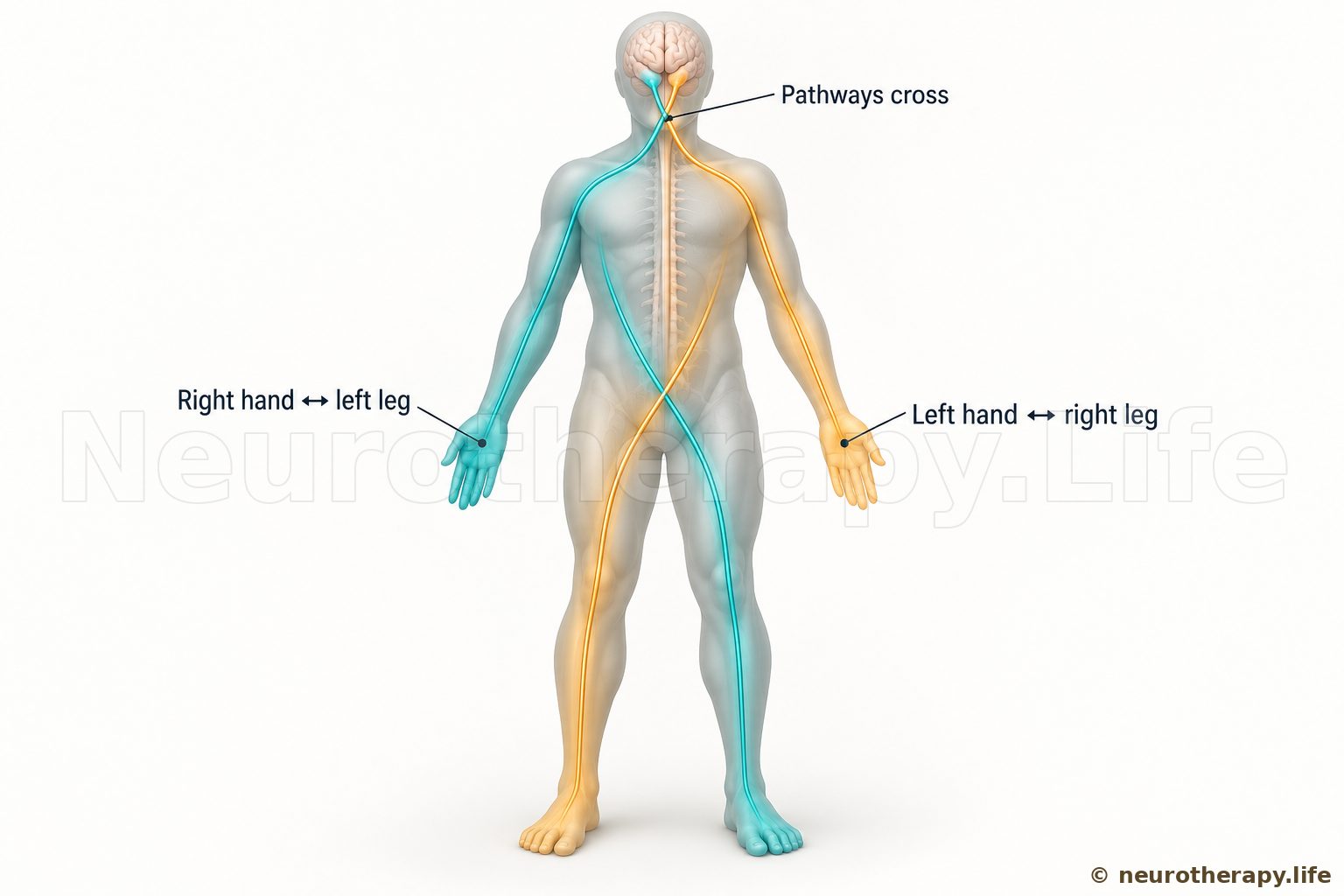
Opposite Point is a Neurotherapy (LMNT) rule for choosing where to treat, not a technique of its own. When a limb cannot be touched, the treatment it would have received is given on its diagonal partner: the right hand's opposite is the left leg, and the left hand's opposite is the right leg.
Overview
What is the Opposite Point?
Opposite Point is an address, not a stroke. It tells the therapist where to work when the affected limb is closed to the hands — broken, in plaster, freshly operated on, hot and swollen, or simply too painful to bear a touch.
'Opposite' here means diagonal, not mirror. Not right hand to left hand, but right hand to left leg — the partner across and down. The teaching spells this out so that it cannot be misread.
It belongs to the group of treatments found one at a time for uncommon problems. Its great value is that it keeps the treatment going when every other address on the limb has closed.
Opposite means diagonal: right hand with left leg, left hand with right leg.
Where it is given
Where is the Opposite Point given?
PositionLying on the back
Body areaThe limb diagonally opposite the affected one — right hand ↔ left leg, left hand ↔ right leg
On the limb diagonally across from the affected one. If the right hand cannot be touched, the work goes to the left leg; if the left leg cannot be touched, it goes to the right hand. The same holds for the left hand and the right leg.
No fixed position is required. The patient lies or sits in whatever way the treatment would need, as long as the opposite limb can be reached comfortably.
How it is given
How is the Opposite Point given?
How this point is given — the tool, the pressure, the count and the exact movement — is deliberately not described here. A demonstration video for this point is being prepared; until it is on this page, learn the method hands-on from a trained Neurotherapist before giving it. Please do not give any point from a written description alone: a point given in the wrong place or the wrong way can do harm.
The exact technique is taught hands-on in the Neurotherapy (LMNT) course. See the course →
What it does
Why does the Opposite Point work?
The teaching's own explanation is simple: the two sides of the body are wired together and cross over on the way to the brain, so the leg that shares a circuit with the arm can be worked when the arm cannot. Body science confirms that the main movement pathways cross, and that the arms and legs are coordinated diagonally in walking.
Keeps treatment going when the affected limb is broken, in plaster, freshly operated on, inflamed, or too painful to touch.
Carries the same treatment across to the diagonal partner, so nothing has to be cancelled.
The same idea of working the other side appears in Superfast, given on the other leg for a fresh strain in the groin or waist.
Organs it reaches
Brain — The movement pathways cross from one side of the brain to the other side of the body.
Spinal cord — Where arm and leg circuits are linked for walking.
Muscles — The muscles of the opposite limb receive the treatment.
Its family
Which treatments are close to the Opposite Point?
It sits with the other treatments for uncommon problems, and works best beside the gentle ones.
Superfast — For the leg that slipped — given on the other leg, the same 'work the other side' idea applied to a fresh strain.
Feather Touch — The lightest touch of all — given on the affected limb itself when it can bear nothing else.
Paralysis Clockwise — A paralysis treatment that may be carried across to the diagonal limb when the affected one is closed.
Shukla — The wrist and ankle treatment used in paralysis work.
What it is used for
When is the Opposite Point used?
Whenever the place that hurts is closed to the hands but treatment is still needed.
Injury and recovery
Sprain and injuryA bruised, swollen or plastered limb that cannot be touched for a while.
Wound healingA limb freshly operated on or with a wound.
Paralysis and nerves
Paralysis and strokeWhen the affected arm or leg is injured and closed for a time, the sessions go on through its diagonal partner.
The rule changes the place, not the safety. Every bar that applies to the treatment being replaced still applies on the opposite limb.
A limb that cannot be touched because it may be broken, hot and swollen, or newly painful needs a doctor's diagnosis first. One leg hot, swollen and tender — after surgery, illness, travel or pregnancy — may be a clot: do not rub it, and send the patient urgently. Thrombosis (blood clots)
In an older person after a slip, a leg that cannot take weight or lies short and turned outward may be a broken hip: hospital, not the mat. How to tell a patient to see a doctor
The opposite limb must be reachable comfortably; the patient is never twisted or strained to reach it.
A teaching case, put together from several patients: a man three years after a stroke was making slow gains in a right hand that had been curled shut. In the ninth week he fell at home and badly bruised the right forearm, which could not be touched for ten days. Those sessions were given on his left leg — the diagonal partner of the right hand — and on the hand only with the lightest feather touch, and nothing was cancelled.
A composite case written to teach the reasoning — not one patient’s file.
Common questions
Why is my leg being treated when my arm is the problem?
Because your arm cannot be touched right now. The two sides of your body are wired together and cross over on the way to the brain; when the arm is closed, the leg that shares its circuit is worked instead.
Why not my other arm?
Because the rule is diagonal, not mirror. The opposite of the right hand is the left leg, not the left hand.
Is the treatment on the opposite limb different?
No. It is the same treatment the affected limb would have received — only the address changes.
Surprising facts
1Your brain runs the opposite side
Most of the nerve fibres that carry movement orders cross over at the base of the brain, so the left side of the brain moves the right side of the body. That is why a stroke on one side of the brain weakens the other side of the body.
When you walk, your right arm swings forward with your left leg, and your left arm with your right leg. The spinal cord links the arms and legs diagonally, much as in four-legged animals.
Source: Dietz V. Do human bipeds use quadrupedal coordination? Trends Neurosci 2002;25:462–467.
3Training one side helps the other
When only one arm or leg is exercised, the untrained limb on the other side also gains some strength — an effect called cross-education, which shows how closely the two sides are linked in the nervous system.
Source: Manca A et al. Cross-education of muscular strength following unilateral resistance training: a meta-analysis. Eur J Appl Physiol 2017;117:2335–2354.
This page explains what a Neurotherapy (LMNT) treatment is for; it is not a self-treatment guide and does not diagnose. Neurotherapy (LMNT) works alongside your medical care — keep taking the medicines your doctor prescribed.
Ready to begin?
Send COURSE for course details, or your name, age and health issue for a consultation.