Also called: Paralysis clockwise, पैरालिसिस क्लॉकवाइज़
Paralysis Clockwise is a gentle Neurotherapy (LMNT) treatment given by hand for people after a stroke or paralysis whose hand stays bent inward and who walk dragging a leg. Small clockwise circles with gathered fingertips work along the muscles of the arm and leg to help open them out — always alongside proper rehabilitation.
Overview
What is Paralysis Clockwise?
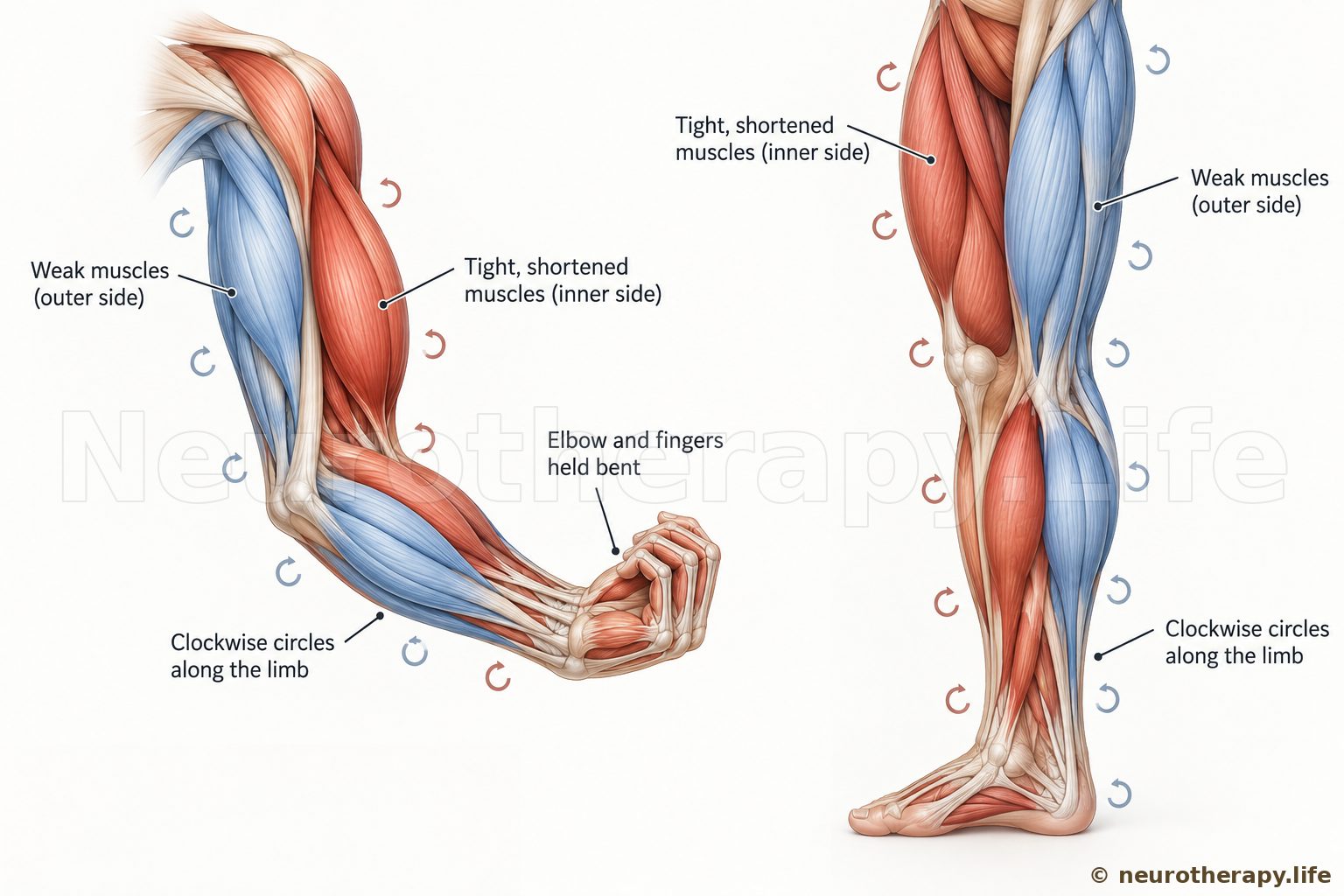
After a stroke or other paralysis, many people are left with a typical posture: the elbow, wrist and fingers stay bent and turned inward, and the leg is swung or dragged when walking. This happens because some muscles become tight and shortened (spasticity) while the opposite muscles stay weak.
The teaching describes exactly this picture — hands that stay bent inward and a leg that is dragged — and names Paralysis Clockwise as the proper treatment to open them out.
It is not a single spot but a route along the limb. Its name comes from the movement: the fingertips turn round and round in the direction of a clock's hands, rolling the muscle rather than rubbing the skin. It works both the shortened inner side and the overpowered outer side of the limb.
Because it uses no body weight and no jerk, it stays open to patients with thin bones, for whom several other paralysis treatments are closed.
After paralysis the inner muscles tighten and pull the limb inward — the picture Paralysis Clockwise is meant for.
Where it is given
Where is Paralysis Clockwise given?
PositionLying on the back
Body areaAlong the affected arm and leg, inner and outer sides
No fixed position is written; the limb simply has to be reachable on both its inner and its outer side. Most often the patient lies on the back, with the therapist beside them, using the hands only — no chairs, no feet.
It is given along the affected arm, from the shoulder to the wrist, and along the affected leg, from the thigh to the heel — on the muscles of both the inner and the outer side.
The weak arm is never pulled or used as a handle to position the patient. It is supported from beneath, at the elbow and the wrist.
How it is given
How is Paralysis Clockwise given?
How this point is given — the tool, the pressure, the count and the exact movement — is deliberately not described here. A demonstration video for this point is being prepared; until it is on this page, learn the method hands-on from a trained Neurotherapist before giving it. Please do not give any point from a written description alone: a point given in the wrong place or the wrong way can do harm.
Feels likeA firm, rolling massage along the limb
The exact technique is taught hands-on in the Neurotherapy (LMNT) course. See the course →
What it does
What does Paralysis Clockwise do?
The teaching names one aim: to open out the hand that stays bent inward and the leg that is dragged in walking. The body-science link is the imbalance between tight and weak muscles after a stroke; the effect of the treatment is the therapy's own clinical observation.
Works along the shortened muscles in the direction that lengthens them.
Works along the weak, overpowered muscles in the direction of their work.
Used to help the bent hand open and the dragged leg move more freely, alongside physiotherapy.
Organs it reaches
Muscles — The tight inner and weak outer muscles of the affected limbs.
Brain — Where the stroke happened; the limb posture follows the brain injury.
Joints — Elbow, wrist, fingers and ankle, which stiffen when held bent.
Its family
Which treatments go with it?
Paralysis Clockwise belongs to the group of treatments found one by one for particular problems. For a hand closed since a stroke, it is taught together with Shukla.
Shukla — Its partner for a paralysed limb: four movements at the wrist and ankle — not given in osteoporosis.
Feather Touch — The lightest treatment, for paralysis and stiffness when nothing else can be given.
Giriraj — Uses the same clockwise rolling action, on the thigh.
Motor Neuron Point — A forceful point at the base of the neck, used only after much thought — closed to fragile bones.
Katka — Another jerk-carrying back point, closed where bones are fragile.
What it is used for
What is Paralysis Clockwise used for?
It is chosen for the bent hand and the dragged leg that follow paralysis — after the calves have been checked and alongside the patient's rehabilitation.
After paralysis
Paralysis and strokeThe hand that stays bent inward and the leg that is dragged.
Check the calves first. One warm, swollen, tender calf may be a blood clot: send the patient to a doctor today and rub nothing — vigorous work on such a leg can send a clot to the lungs. Thrombosis (blood clots)
Never pull on a weak arm or use it as a handle. After a stroke the shoulder is often loose in its socket; support the arm from beneath. Shoulder dislocation
New weakness is an emergency, not a session: a drooping face, an arm that will not hold up, or thick speech — call an ambulance (108/112) at once. How to tell a patient to see a doctor
This work sits alongside proper rehabilitation, never instead of it. Tell the neurologist and physiotherapist what the patient is receiving here.
Skin over a paralysed limb may not feel pressure well; keep the circles moderate and look for redness or sores. Wound healing
Common questions
Can Paralysis Clockwise be given to someone with thin bones?
Yes. It uses only the hands and no jerk, so it stays open where treatments such as Shukla, Katka and the Motor neuron point are closed.
Can the family learn it?
Family members can learn it from a trained teacher in the course, along with the cautions — especially checking the calves and never pulling the weak arm.
Should we stop physiotherapy?
No. Paralysis Clockwise works alongside physiotherapy and the neurologist's care, never instead of them.
Surprising facts
1A recognisable posture
The bent elbow, wrist and fingers with a stiff, swung leg after a stroke is so typical that doctors recognise it at a glance; it comes from spasticity in some muscles and weakness in others.
Source: Standard neurology teaching on post-stroke spasticity and hemiplegic gait.
2The brain can rewire
After a stroke, undamaged parts of the brain can take over some lost functions — a process called neuroplasticity, which repeated practice and rehabilitation encourage.
Source: Standard stroke-rehabilitation teaching (e.g. World Stroke Organization; neuroplasticity reviews).
3A loose shoulder hurts
Many stroke survivors develop shoulder pain because the weak shoulder slips partly out of its socket; careful handling of the arm helps prevent it.
Source: Standard stroke-rehabilitation teaching on hemiplegic shoulder pain and subluxation.
This page explains what a Neurotherapy (LMNT) treatment is for; it is not a self-treatment guide and does not diagnose. Neurotherapy (LMNT) works alongside your medical care — keep taking the medicines your doctor prescribed.
Ready to begin?
Send COURSE for course details, or your name, age and health issue for a consultation.