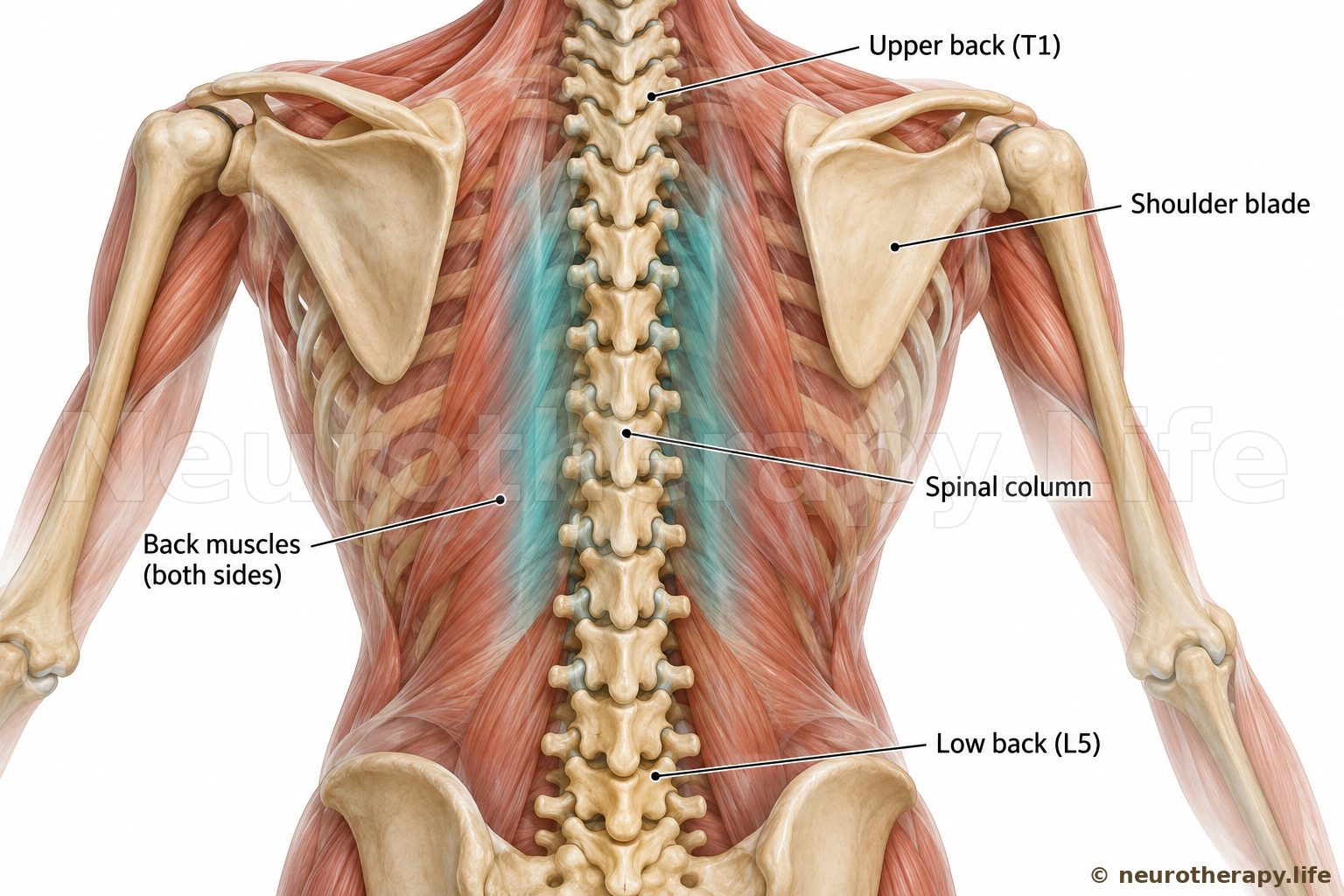
Katka is one of the two most forceful treatments in Neurotherapy (LMNT): given face down along the whole spine, it relaxes the back and ends with a mild jerk. The therapy itself says it should be used only after much thought, and it is closed to many patients.
Overview
What is Katka?
Katka is a physical point given over the back. Its stated purpose is to relax the spine. The Hindi word कटका names the sudden snap itself — the sharp 'katak' of something giving way — because a slight sound may sometimes come from it, which the teaching reads as the vertebrae setting.
The sound is a 'sometimes', never a target. A therapist who works for a click is a therapist adding force, and the teaching is plain that only a mild jerk is to be given.
Katka and Motor Neuron Point are named together as the most forceful things the therapy teaches. They share one set-up and one warning: they are not part of a routine and are not given just because a card is blank.
Katka works the muscles on both sides of the spine, from the low back to the base of the neck.
Where it is given
Where is Katka given?
PositionLying face down
Body areaThe whole back on both sides of the spine, and the shoulder blade toward the elbow — face down on four pillows
The patient lies face down on four pillows — three under the chest and one under the chin — instead of the usual one and a half. After placing them, the therapist checks with the hand that there is room of about three fingers at the front of the throat, so breathing is free throughout. Without the pillows, the treatment is not given that day.
The back muscles are relaxed. The work runs along the whole back, on both sides of the spine, from the low back up to the base of the neck, and then out from the shoulder blade toward the elbow, with the head turned first straight, then to the left and then to the right.
How it is given
How is Katka given?
How this point is given — the tool, the pressure, the count and the exact movement — is deliberately not described here. A demonstration video for this point is being prepared; until it is on this page, learn the method hands-on from a trained Neurotherapist before giving it. Please do not give any point from a written description alone: a point given in the wrong place or the wrong way can do harm.
The exact technique is taught hands-on in the Neurotherapy (LMNT) course. See the course →
What it does
What does Katka do?
The stated purpose is relaxing the spine, and the teaching reads an occasional sound as the vertebrae setting. Body science explains the common 'click' of a manipulated joint as a gas bubble forming in the joint fluid, not as a bone moving into place — which is one more reason never to chase the sound.
Relaxes the long muscles on both sides of the spine.
Works the back from the low back up to the base of the neck.
Carries the work out from the shoulder blade toward the elbow on each side.
Organs it reaches
Spine — The column of vertebrae from the low back to the neck.
Muscles — The back muscles on both sides of the spine.
Neck — The neck is turned to each side during the treatment.
Its family
Which point shares Katka's set-up and warning?
Katka belongs to the uncommon points, each found for one problem and kept because it worked.
Motor Neuron Point — Its twin in force: the same four pillows, throat check and mild-jerk limit.
Feather Touch — The opposite end: no force at all, open to patients who can receive nothing else.
Round Arrow — A gentler stroke along the sides of the spine.
L5–S1 Ghisai — A low-back treatment without a jerk.
What it is used for
What is Katka used for?
The only purpose written for it is relaxing the spine, and it is given only after much thought.
A stiff back
Low back painWhere the spine needs relaxing and none of its blocks apply.
Not given with brittle bones or long-term steroid treatment, a history of cancer, unexplained weight loss or pain at night, rheumatoid arthritis, blood-thinning medicine, or any sign that the cord in the neck is pinched — a clumsy hand or an unsteady walk. Osteoporosis
Four pillows and a checked gap at the throat are compulsory; without them it is not given that day.
Only a mild jerk. More force can cause the patient a great deal of trouble, and the sound must never be chased.
In cancer care, Katka is avoided, and the cancer blocks also apply: never (10) Pan, Thymus, Pit, Lu+Sh, Rt.Ov/Lt.Ov or (30) Medulla. Cancer care: Neurotherapy (LMNT) support
Sometimes a slight sound may come, sometimes not. It is not the treatment and not a measure of it, and a good therapist will not add force to make it come.
Why so many pillows?
Three under the chest and one under the chin keep your neck supported and your throat free, so you can breathe easily while the jerk is given.
I have a heart stent. Can I have Katka?
No. Katka is blocked in heart disorders because its force puts pressure on the heart. Gentler treatments are chosen instead.
Why is it given so rarely?
Because the therapy itself says it should be used only after much thought. It is one of the two most forceful treatments taught.
Surprising facts
1The click is a bubble
Imaging studies show that the cracking sound of a joint comes from a gas cavity forming suddenly in the joint fluid as the joint surfaces separate.
Source: Kawchuk GN et al. Real-time visualization of joint cavitation. PLoS One 2015;10(4):e0119470.
2A column of beads
Between the base of the neck and the sacrum lie seventeen vertebrae — twelve thoracic and five lumbar — each linked to the next by a disc and two small joints.
This page explains what a Neurotherapy (LMNT) treatment is for; it is not a self-treatment guide and does not diagnose. Neurotherapy (LMNT) works alongside your medical care — keep taking the medicines your doctor prescribed.
Ready to begin?
Send COURSE for course details, or your name, age and health issue for a consultation.