1Held by two small hooks
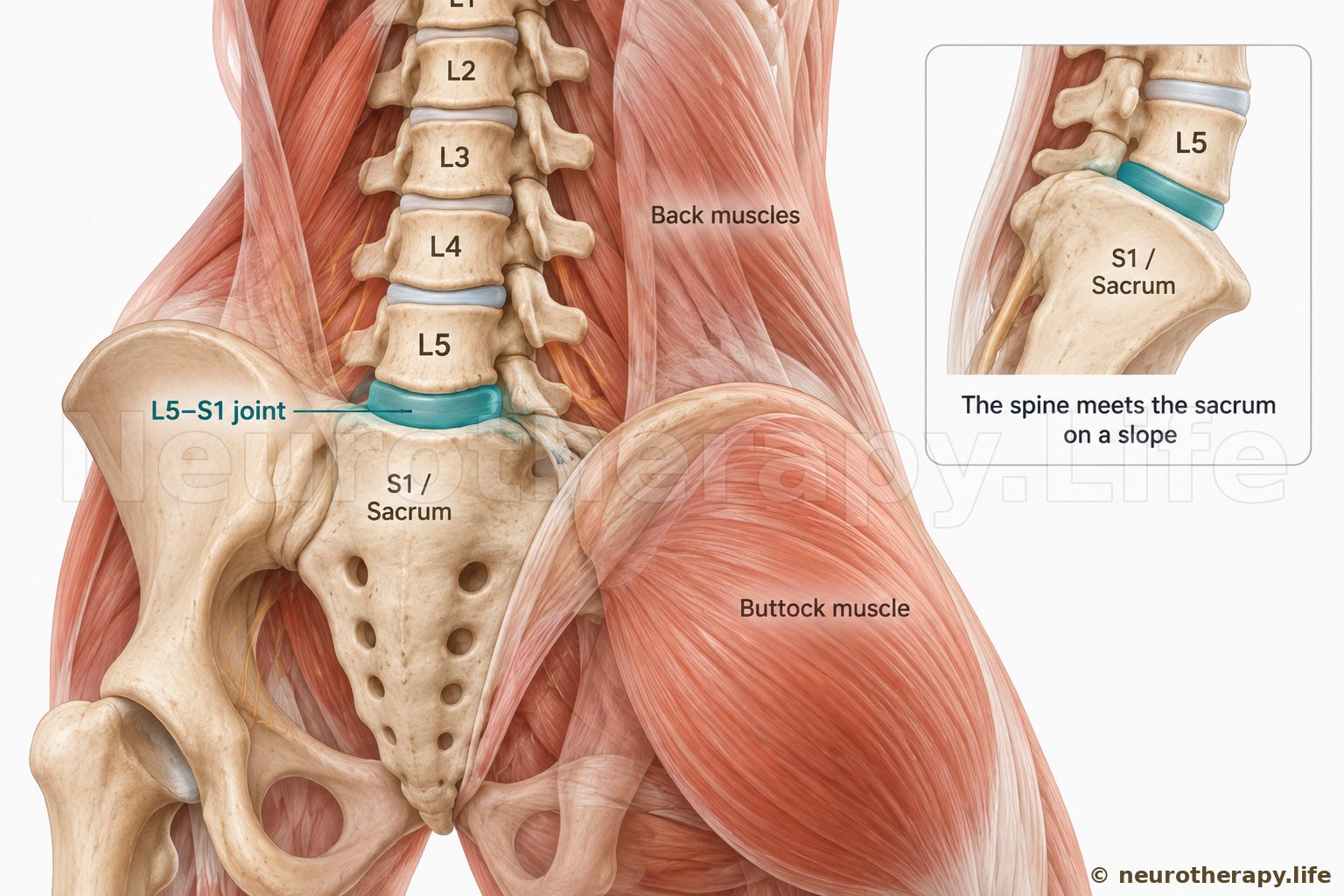
The sacrum is tilted, so L5 sits on a slope and is always trying to slide forward; a pair of small bony joints, one on each side, hold the whole upper body in place.
Source: Gray's Anatomy, 41st ed.
Also called: L5 S1 ghisai, L5-S1 rubbing, L5–S1 घिसाई, कमर की घिसाई
L5–S1 Ghisai is a Neurotherapy (LMNT) treatment for the low back, given lying face down. It is three different actions on the same area — softening, an outward stroke and a lengthening — and it is used for sciatica and for all pains of the back, especially lumbar spondylosis.
Ghisai (घिसाई) means rubbing — not a still press but a gliding, travelling stroke along a length of tissue. L5–S1 is the joint where the last bone of the low back (L5) meets the top of the sacrum (S1). This treatment is named for that joint, and it is the opening treatment of LMNT's low-back group.
It is not one treatment repeated three times. It is three different actions in a fixed order: the first asks the tissue to soften, the second asks it to move one way, outward from the lowest bone, and the third asks it to lengthen, up from the joint and out to the side of the waist.
LMNT teaches that it works in three ways: bringing the vertebrae from L1 to S1 into their correct place; relaxing the muscles on both sides of the buttocks; and pulling upward and setting right the muscles and nerves beside the vertebrae that have descended.
You lie face down with pillows under the chest and the head straight — this arrangement is compulsory for the whole low-back group. The work covers the band of the low back from L1 down to S1 on both sides, the area just outward from the S1 bone, and the band from the L5–S1 joint up toward L3 and out to the side of the waist.
How this point is given — the tool, the pressure, the count and the exact movement — is deliberately not described here. Watch the demonstration video on this page, and learn the method hands-on from a trained Neurotherapist before giving it. Please do not give any point from a written description alone: a point given in the wrong place or the wrong way can do harm.
The number written before a point's name is not a strength setting. Each numbered form is a separate named treatment with its own method and timing, taught hands-on in the course.
The exact technique is taught hands-on in the Neurotherapy (LMNT) course. See the course →
LMNT describes three effects, one for each stage. These are the therapy's own clinical observations; a slow, broad rub of tired back muscles is also simply relaxing.
It opens LMNT's low-back group and is often given beside these.
It is one of several low-back treatments chosen inside a plan built from the patient's findings. Neurotherapy (LMNT) works alongside your medical care.
A woman in her late fifties with right-sided sciatica was improving well on the Sciatica point and L5–S1 Ghisai. On the twelfth day the routine safety questions brought out new trouble starting urine and numbness in the seat area. The session was stopped before it began and she was sent to hospital that day with a written note. She had surgery quickly and later returned walking and well — the minute spent asking mattered more than any technique.
A composite case written to teach the reasoning — not one patient’s file.No. It is three different actions in a fixed order, each with its own direction, given with the feet under controlled weight.
LMNT uses it for back pain and sciatica, often with JJ⁺² for slip disc at L4–S1. Disc findings on a scan are common even in painless backs; your therapist plans from your symptoms, alongside your doctor.
It should feel firm and relieving. The therapist's weight is held through the chairs and can be eased at once — say so if it is too much.
No. It is given with body weight on the spine; it needs a trained therapist who has first ruled out the warning signs.
The sacrum is tilted, so L5 sits on a slope and is always trying to slide forward; a pair of small bony joints, one on each side, hold the whole upper body in place.
Source: Gray's Anatomy, 41st ed.
Disc bulges are found on scans in a large share of adults who have no back pain at all, and the share rises with age.
Source: Brinjikji W, et al. Systematic literature review of imaging features of spinal degeneration in asymptomatic populations. AJNR. 2015;36(4):811–816.
About nine in ten cases of low back pain have no single identifiable cause, and an ordinary acute back usually settles substantially within weeks.
Source: World Health Organization. Low back pain — fact sheet. 2023.

A demo of L5–S1 ghisai in its three parts, given face down with the front of the foot over the lowest part of the back and the buttocks, followed by the Fracture point with the legs raised on pillows. It is used for relief in low back pain.

The World Health Organization's summary of low back pain: the leading cause of disability worldwide, mostly without a single identifiable cause, best managed with movement, physical therapies and reassurance. It does not test Neurotherapy (LMNT).
World Health Organization. Low back pain — fact sheet. 2023.
This page explains what a Neurotherapy (LMNT) treatment is for; it is not a self-treatment guide and does not diagnose. Neurotherapy (LMNT) works alongside your medical care — keep taking the medicines your doctor prescribed.
Send COURSE for course details, or your name, age and health issue for a consultation.