L5–S1 Ghisai: the three-stage treatment for the lowest joint of the back
L5–S1 Ghisai is given face down for problems of the low back. It is three different actions on the same area, not one rub repeated over and over.
Overview
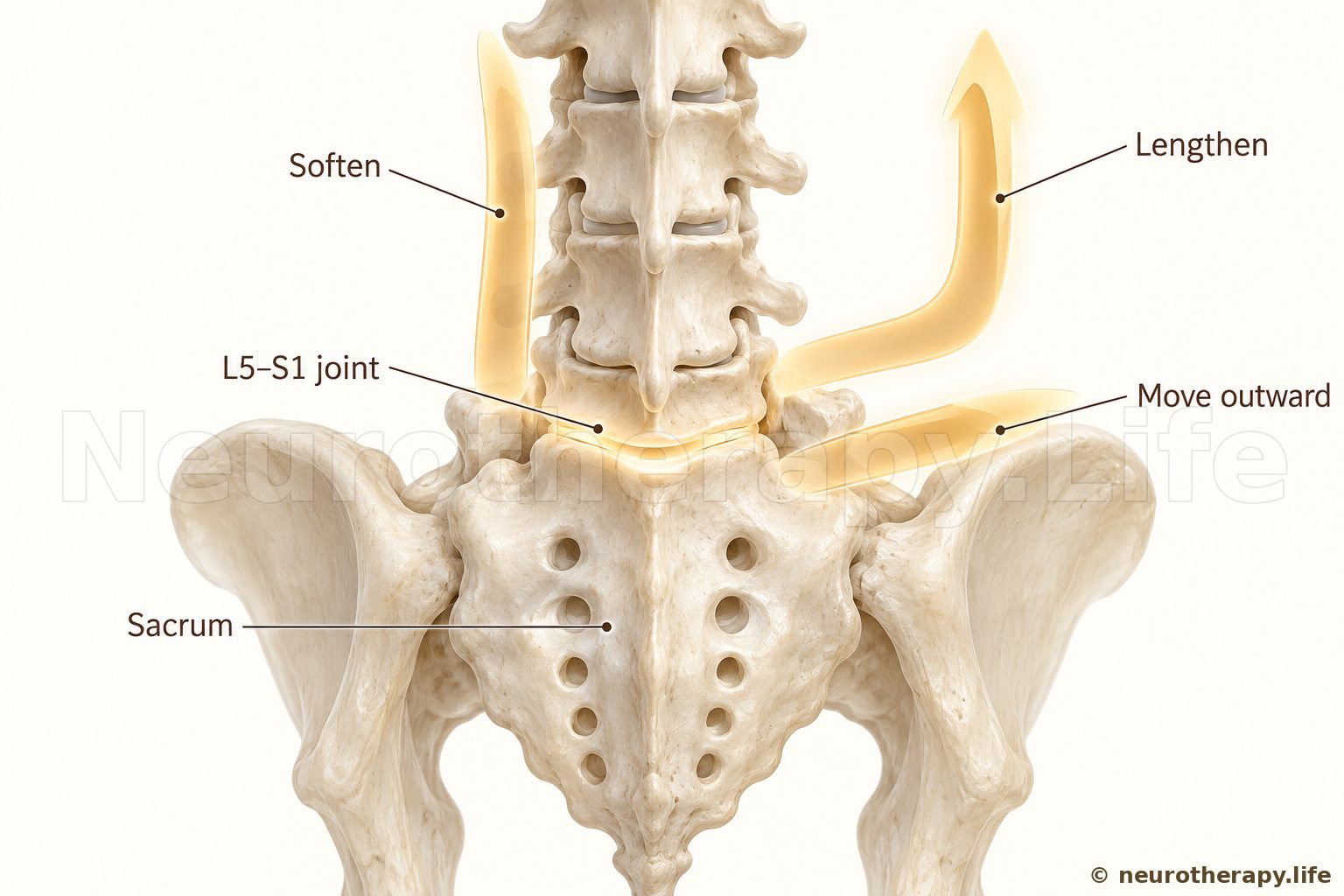
L5–S1 is the joint where the last bone of the low back meets the sacrum, the flat triangular bone at the base of the spine. Ghisai means rubbing. The treatment is given face down, with the compulsory one and a half pillows under the chest, for problems of the low back.
It has three stages, and each asks something different of the same tissue. The first softens a long band of the low back with the soft middle of the therapist's sole. The second moves the tissue one way only, outward at a slant from the base of the spine. The third lengthens the low back muscles, drawing them upward and then out to the side of the waist, with the therapist's weight carried on two chairs.
One direction is protected by its own warning. In the second stage the stroke goes outward only; the foot must never be dragged back the same way. A stroke dragged back undoes itself, and the tissue ends where it began. It is a mistake nobody in the room can see except the person making it.
Why this joint? Here the moving column of the spine meets a fixed bone set on a slope, so everything above is always trying to slide forward. Two small bony hooks hold it in place. That is why this level, more than any other in the back, wears, slips forward and pinches a nerve. The exact method of each stage is taught hands-on in the course.
Key points
- L5–S1 Ghisai is three different actions in a fixed order, not one rub repeated.
- It is given face down, with one and a half pillows under the chest.
- In the middle stage the stroke runs outward only and is never dragged back.
- The L5–S1 joint carries the whole upper body and is the level that most often wears and slips.
Go deeper
L5–S1 Ghisai
The full point page for L5–S1 Ghisai
Spine
How the spine is built and why the lowest joint wears
Low back
The low back as a region
Low back pain
Low back pain and how it is approached
Sciatica
When a pinched nerve sends pain down the leg
Fracture Point
Fracture point, often given alongside
The Low Back: Treatments for the Back, Hip and Sciatic Leg
The full guide to the low back
Read the full guide
This topic is part of: The Low Back: Treatments for the Back, Hip and Sciatic Leg
Safety: when it is held back
- Before any low back treatment, the therapist asks about the warning signs that need a doctor the same day. Low back pain: warning signs that mean see a doctor today
- If a broken bone of the spine is possible — after a fall, in brittle bones, or with long-term steroids — no body weight goes on the spine until an X-ray and a doctor have answered. Lumbar fracture (L4 / L5)
Watch

A demo of L5–S1 ghisai in its three parts, given face down with the front of the foot over the lowest part of the back and the buttocks, followed by the Fracture point with the legs raised on pillows. It is used for relief in low back pain.
This page explains what a Neurotherapy (LMNT) treatment is for; it is not a self-treatment guide and does not diagnose. Neurotherapy (LMNT) works alongside your medical care — keep taking the medicines your doctor prescribed.