Sciatica Setting is a gentle Neurotherapy (LMNT) treatment given with the hands on the foot while you lie on your back. The heel is held still while the forefoot and then the toes are bent against each other, one toe at a time. It is described as very useful for disc bulge.
Overview
What is Sciatica Setting?
Sciatica Setting is the only treatment in the low-back group given entirely with the hands — and it is given on the foot. That surprises people: why treat the foot for a problem in the back?
The answer is the nerve line. The sciatic nerve and its branches run in one continuous line from the low back to the sole. Bending the toes and ankle upward is the very movement doctors use to put gentle tension along this line. So working the foot in someone with leg symptoms is not as random as it looks.
It is called a 'setting' and not a stretch because it is a progression. At each stage the toes are divided differently, and the two groups are bent against each other, so the dividing line walks across the foot from the big toe to the smallest.
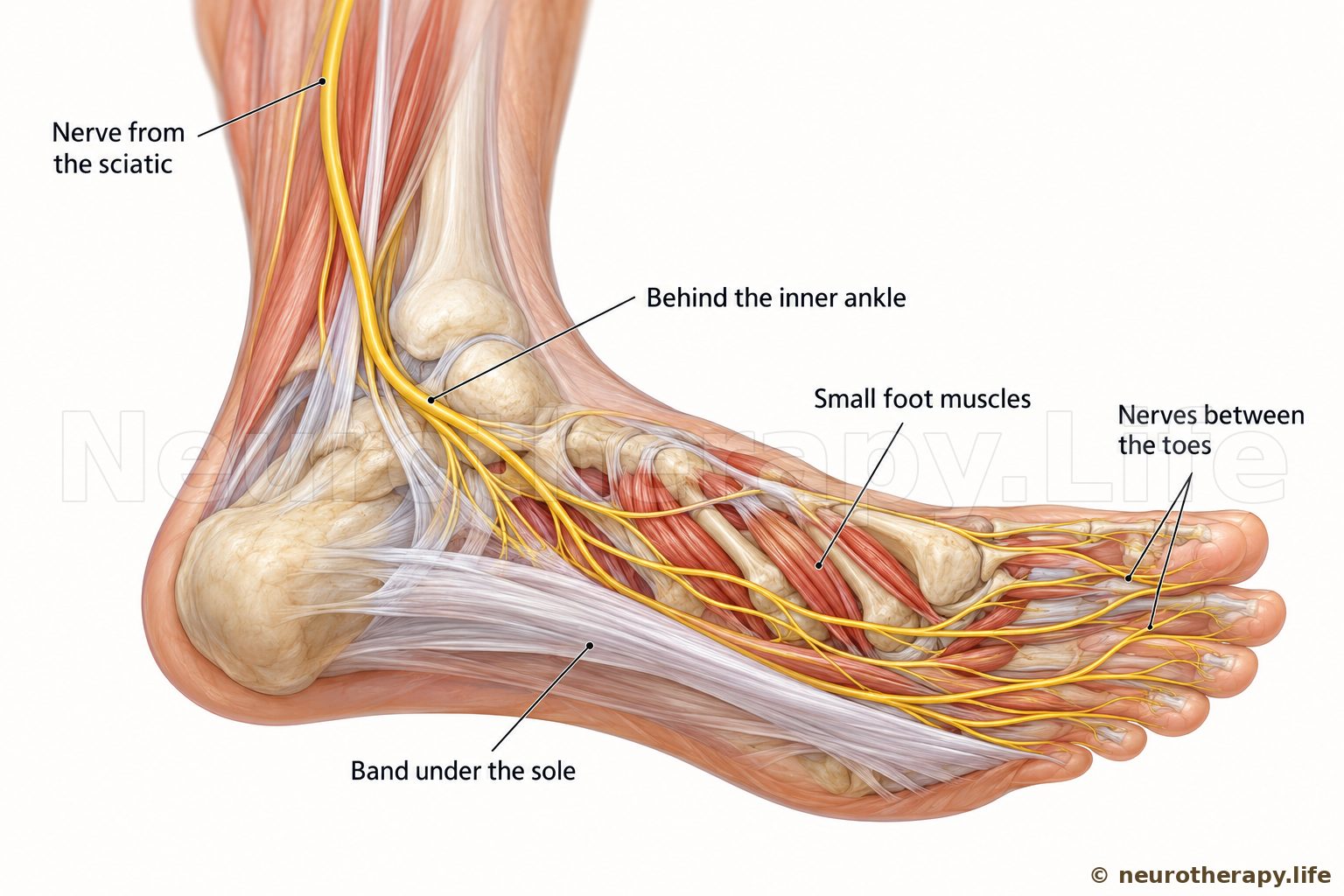
The sciatic nerve line continues into the sole and between the toes — the ground Sciatica Setting works on.
Where it is given
Where is Sciatica Setting given?
PositionLying on the back
Body areaThe foot — heel held, forefoot and toes worked; left foot first
You lie on your back with the leg straight on the mat and a pillow under the foot. The therapist works at the foot of the mat, with the hands only.
The area is the foot: the heel, which is held still, and the forefoot and toes, which are moved. The left foot is done first, then the right.
How it is given
How is Sciatica Setting given?
How this point is given — the tool, the pressure, the count and the exact movement — is deliberately not described here. A demonstration video for this point is being prepared; until it is on this page, learn the method hands-on from a trained Neurotherapist before giving it. Please do not give any point from a written description alone: a point given in the wrong place or the wrong way can do harm.
The exact technique is taught hands-on in the Neurotherapy (LMNT) course. See the course →
What it does
What does Sciatica Setting do?
The teaching says Sciatica Setting is very useful for disc bulge. What it plainly is, in body terms, is a gentle, well-tolerated loosening of the foot along the end of the sciatic nerve line; how it helps the back is the therapy's own experience.
Is used for disc bulge, the commonest cause of sciatic pain.
Draws on the strong band under the sole and the small muscles between the foot bones.
Works the spaces between the long bones of the foot, where the small nerves to the toes run.
Organs it reaches
Spine — The disc bulge it is used for lies at the low back.
Joints — The small joints of the toes and forefoot are moved against each other.
Muscles — The small muscles between the foot bones and the band under the sole.
Low back — The region the treatment is filed under, though it is given on the foot.
Its family
Which points go with it?
Sciatica Setting sits in the low-back group and also appears in the knee-and-leg list — one treatment reached from two directions.
Sciatica Point — Its face-down partner: a light touch at L5, then down the painful leg.
L5–S1 Ghisai — The three-stage rub of the low back, good for sciatica.
Bending Forward — Another low-back treatment, given seated or lying with knees bent.
Standing Point — Given right after Bending forward; also works on the foot, at the toe joints and sole.
What it is used for
What is Sciatica Setting used for?
It is one part of a low-back plan, not the whole answer.
Back and leg
SciaticaDisc bulge with pain running down the leg.
Pain down both legs, numbness in the seat or around the back passage, or loss of control of urine or motion is an emergency — hospital the same day, before any treatment. Low back pain: warning signs that mean see a doctor today
New weakness of the foot, back pain in anyone who has had cancer, night pain, or fever with back pain is sent for investigation, not treated. How to tell a patient to see a doctor
The heel is fixed first and the foot is never swung or forced. Stop at once if a sharp or shooting pain appears. Sciatica
My problem is in my back. Why is my foot being treated?
Because the sciatic nerve line runs without a break from the low back to the sole. Bending the foot and toes works on the far end of that line.
Does it hurt?
It should not. It is a slow, low-force bend with pauses, and it can be stopped at any moment.
Why is the left foot done first?
That is the instruction as written. The therapist follows the written order so that every session is given the same way.
Surprising facts
1A doctor's test uses the same move
In the straight-leg-raise test for sciatica, doctors often bend the ankle upward to add tension to the nerve — confirming that the foot and the low-back nerve are one line.
Source: Magee DJ. Orthopedic Physical Assessment, 6th ed. — straight leg raise with ankle dorsiflexion (Bragard's sign).
2Most disc bulges are silent
Scans of people with no back pain at all often show bulging discs — and the older the person, the more common they are. A bulge on a scan is not the same as a cause of pain.
Source: Brinjikji W et al. Systematic literature review of imaging features of spinal degeneration in asymptomatic populations. AJNR Am J Neuroradiol. 2015;36:811–816.
3A bow under your foot
The plantar fascia, the strong band under the sole, tightens when the toes bend upward and lifts the arch — like the string of a bow pulling its ends together.
Source: Hicks JH. The mechanics of the foot II: the plantar aponeurosis and the arch. J Anat. 1954;88:25–30.
This page explains what a Neurotherapy (LMNT) treatment is for; it is not a self-treatment guide and does not diagnose. Neurotherapy (LMNT) works alongside your medical care — keep taking the medicines your doctor prescribed.
Ready to begin?
Send COURSE for course details, or your name, age and health issue for a consultation.