Knee treatments in Neurotherapy (LMNT): chemical points first, then the physical work
Neurotherapy (LMNT) treats a painful knee in two halves: first the chemical points that improve the body's inner environment, then a group of physical treatments that return the pulled tissues around the kneecap to their place.
Overview
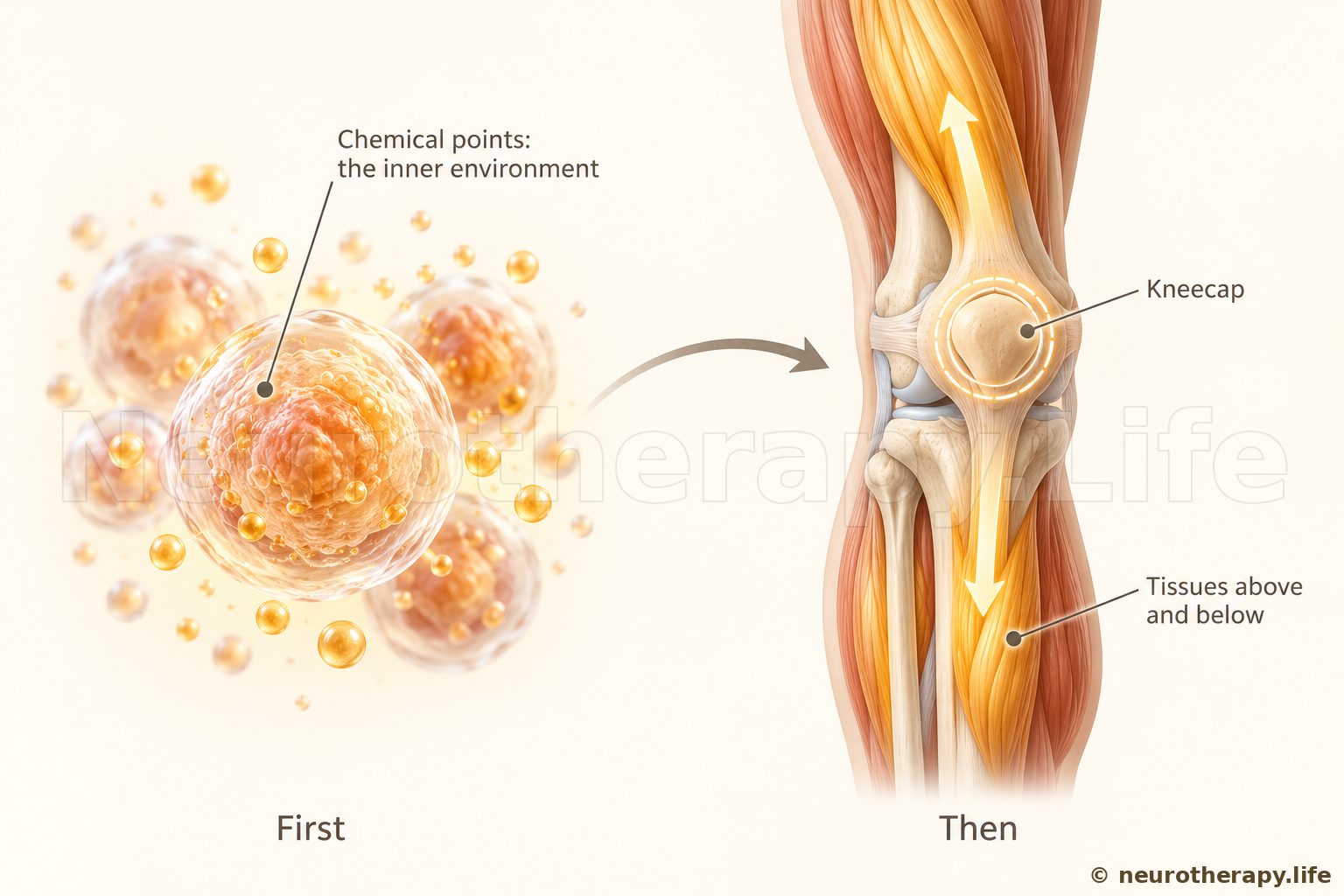
Neurotherapy (LMNT) treats a painful knee in two halves. First come the chemical points, chosen from the patient's own plan to improve the internal environment of the cells. After that come the physical treatments. Their aim is to return to their own place the tissues above and below the kneecap, which get pulled during work and become caught around it.
The physical group includes Back of Knees and Knee Cap Free, which make the kneecap supple; Giriraj and Calf Muscle Ghisai for the thigh and calf; Pradeep, the strongest of the group; and, only if one point of pain is left, JJ Groin or JJ Back. Beside them, BOF works the lower leg, and Big Toe Gas is used for gas in the stomach.
Each treatment names its own position and its own side, and these are not carried over from one to the next. One begins with the left knee, one with the more troublesome knee, and BOF begins with the right leg. Reading each line afresh prevents the most common mistakes.
Patients have reported relief in pain after only a few treatments, though full recovery takes time. This work sits alongside medical care. The order, the counts and the exact methods are taught hands-on in the course.
Key points
- Chemical points come first, to improve the inner environment of the cells.
- Physical treatments then return the pulled tissues around the kneecap to their place.
- Making the kneecap supple comes before the stronger work.
- Each treatment names its own position and side; never carry one across.
- Relief often comes early; full recovery takes time.
Go deeper
Back of Knees
Back of Knees, for a supple kneecap
Knee Cap Free
Knee Cap Free, freeing the kneecap
Giriraj
Giriraj, for the thigh above the knee
Calf Muscle Ghisai (Left)
Calf Muscle Ghisai, for the lower leg
Pradeep
Pradeep, the strongest knee treatment
JJ Groin
JJ Groin and JJ Back, for a leftover point
Knee pain
Knee pain and how it is approached
Knee, Leg and Foot: Neurotherapy (LMNT) for Knee Pain and the Lower Leg
The full guide to the knee, leg and foot
Read the full guide
This topic is part of: Knee, Leg and Foot: Neurotherapy (LMNT) for Knee Pain and the Lower Leg
Safety: when it is held back
- The forceful parts of Pradeep are never given in a replaced knee, a hot or swollen knee, brittle bones, or in anyone on blood thinners. Pradeep: the knee treatment that begins with an angled pillow
- The therapist's foot never falls on the knee joint itself.
- A numb diabetic foot gets light hand contact only, never body weight. Diabetes
- One leg that is hot, swollen and tender — especially after surgery, a long illness, a long journey or pregnancy — may hide a clot. That leg is not rubbed or worked on; it is sent to a doctor urgently. Thrombosis (blood clots)
Watch

A recorded online class by Dr. Diwakar Shukla on knee pain: the parts of the knee, advice on weight and food (such as keeping away from sour things), and a self-massage and exercise routine, followed by viewers' questions. It is shared as self-care support for knee pain.

A podcast on knee pain: the parts of the knee, common causes and signs, and how Neurotherapy (LMNT) looks at digestion, folic acid, vitamin D and lactic acid in knee pain. No points are demonstrated.
This page explains what a Neurotherapy (LMNT) treatment is for; it is not a self-treatment guide and does not diagnose. Neurotherapy (LMNT) works alongside your medical care — keep taking the medicines your doctor prescribed.