1The calf crosses the knee
The big calf muscle, the gastrocnemius, starts above the knee on the thigh bone. So it helps bend the knee as well as point the foot.
Source: Standard anatomy: Gray's Anatomy (41st ed.), gastrocnemius.
Also called: Calf muscle ghisai, Left calf muscle ghisai, पिंडली की घिसाई
Calf Muscle Ghisai is a hand-given rubbing of the calf and the inner border of the foot, drawing the tissue downward toward the heel. It belongs to the knee-pain sequence, where it follows Giriraj.
Ghisai (घिसाई) means rubbing — a sliding stroke, not a press. Calf Muscle Ghisai is a physical treatment of the knee group, given with the hands on the inner and outer calf and along the inner border of the foot.
The knee group rests on one idea: tissue above and below the knee-cap gets pulled during work and caught, and the physical points return it to its own place. Giriraj carries the thigh tissue back upward; the calf ghisai does the matching work below the knee, drawing the calf tissue down toward the heel.
It is easy to confuse with BOF, which works the same calf the other way — from the heel toward the knee. They are two different treatments with different names, positions, directions and purposes.
The patient lies on the back or sits, after Giriraj has been given. Its written form is on the left leg; the knee sequence treats both legs if both knees hurt, and otherwise the affected side only.
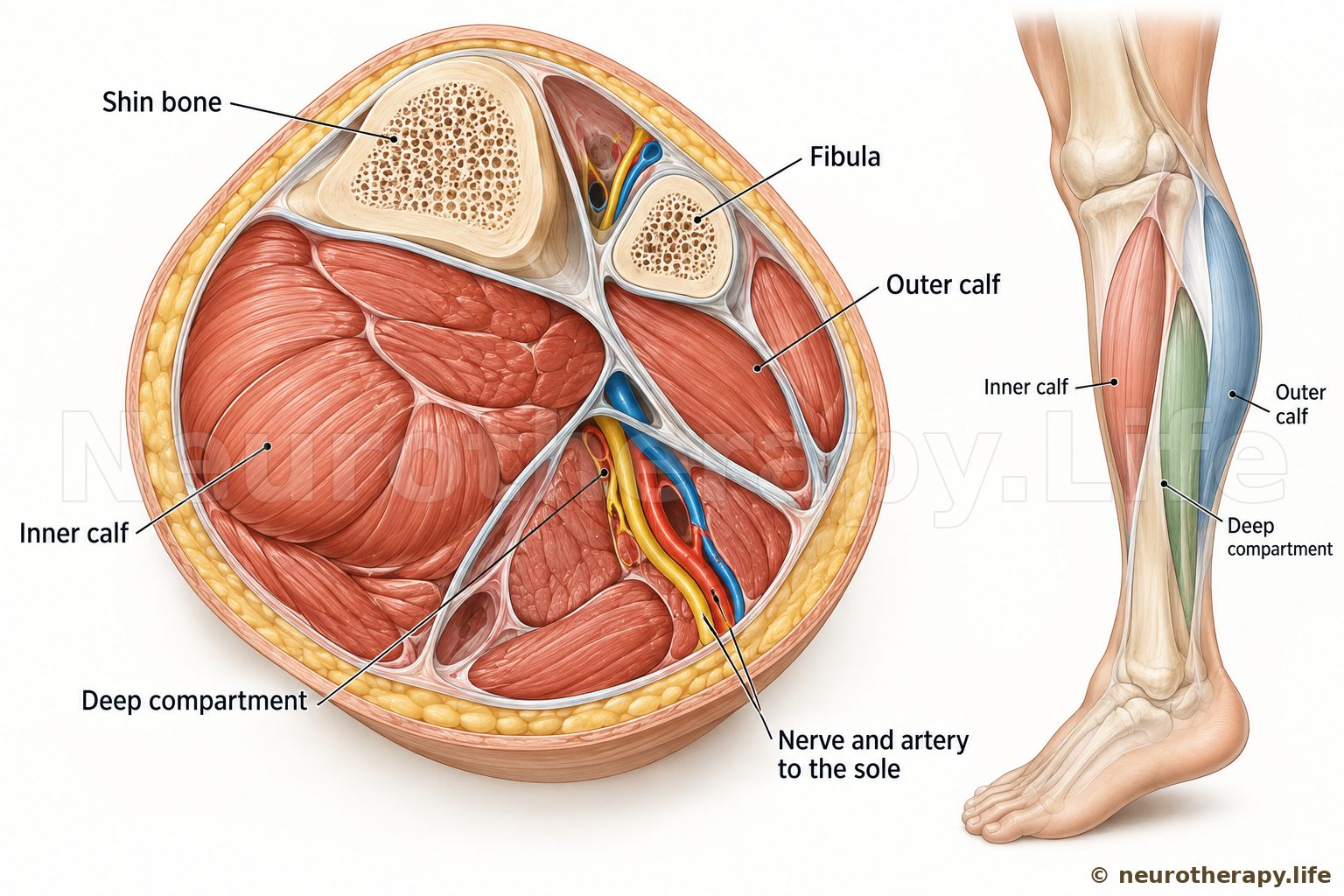
The area is the inner side of the calf from below the knee down to the heel, the outer side of the calf, and the inner border of the foot from the heel to the big toe.
How this point is given — the tool, the pressure, the count and the exact movement — is deliberately not described here. A demonstration video for this point is being prepared; until it is on this page, learn the method hands-on from a trained Neurotherapist before giving it. Please do not give any point from a written description alone: a point given in the wrong place or the wrong way can do harm.
The exact technique is taught hands-on in the Neurotherapy (LMNT) course. See the course →
The teaching describes the knee treatments as putting tissue back where it belongs. Below the knee, the calf ghisai draws the inner nerves and muscles of the calf downward toward the heel, matching Giriraj's upward work above the knee.
It is one link in the knee sequence.
It is used within the knee sequence, after the chemical points have prepared the body.
Its written form is on the left leg. In the knee sequence it is given on both legs if both knees hurt, and otherwise on the affected side only. Your therapist follows your card.
Because the muscles that cross the knee continue into the calf. The knee sequence works above and below the knee to return tissue to its place.
No. Calf Muscle Ghisai draws the calf tissue toward the heel; BOF draws it toward the knee.
The big calf muscle, the gastrocnemius, starts above the knee on the thigh bone. So it helps bend the knee as well as point the foot.
Source: Standard anatomy: Gray's Anatomy (41st ed.), gastrocnemius.
Calf muscles squeeze the deep veins when they contract and push blood back up toward the heart, so the calf is sometimes called the body's 'second heart'.
Source: Guyton & Hall Textbook of Medical Physiology (14th ed.), the venous pump.
The common fibular nerve winds round the outer side of the bone just below the knee, close under the skin — one of the easiest nerves in the body to bruise.
Source: Standard anatomy: Gray's Anatomy (41st ed.), common fibular nerve.
This page explains what a Neurotherapy (LMNT) treatment is for; it is not a self-treatment guide and does not diagnose. Neurotherapy (LMNT) works alongside your medical care — keep taking the medicines your doctor prescribed.
Send COURSE for course details, or your name, age and health issue for a consultation.