Knee Cap Free is the Neurotherapy (LMNT) knee treatment that loosens the knee-cap and frees it from the muscles beneath it, which reduces the stiffness of the knee. It is given with the patient lying on the back or seated, the more troublesome knee first.
Overview
What is Knee Cap Free?
Knee Cap Free is a physical point — a muscle-relaxing treatment. It is the second of two treatments the knee teaching gives first of all to make the knee-cap supple: Back of Knees works behind the joint face down, and Knee Cap Free works in front of it, face up or seated.
Its aim is stated in plain words: to make the knee-cap completely loose, freed from the muscles beneath it. That, the teaching says, is exactly why it is called cap free. Its use list names five groups it relaxes — the muscles behind the knee, the thigh muscles above it, the muscles around the bone below it, the muscles around the cap, and those beneath the cap.
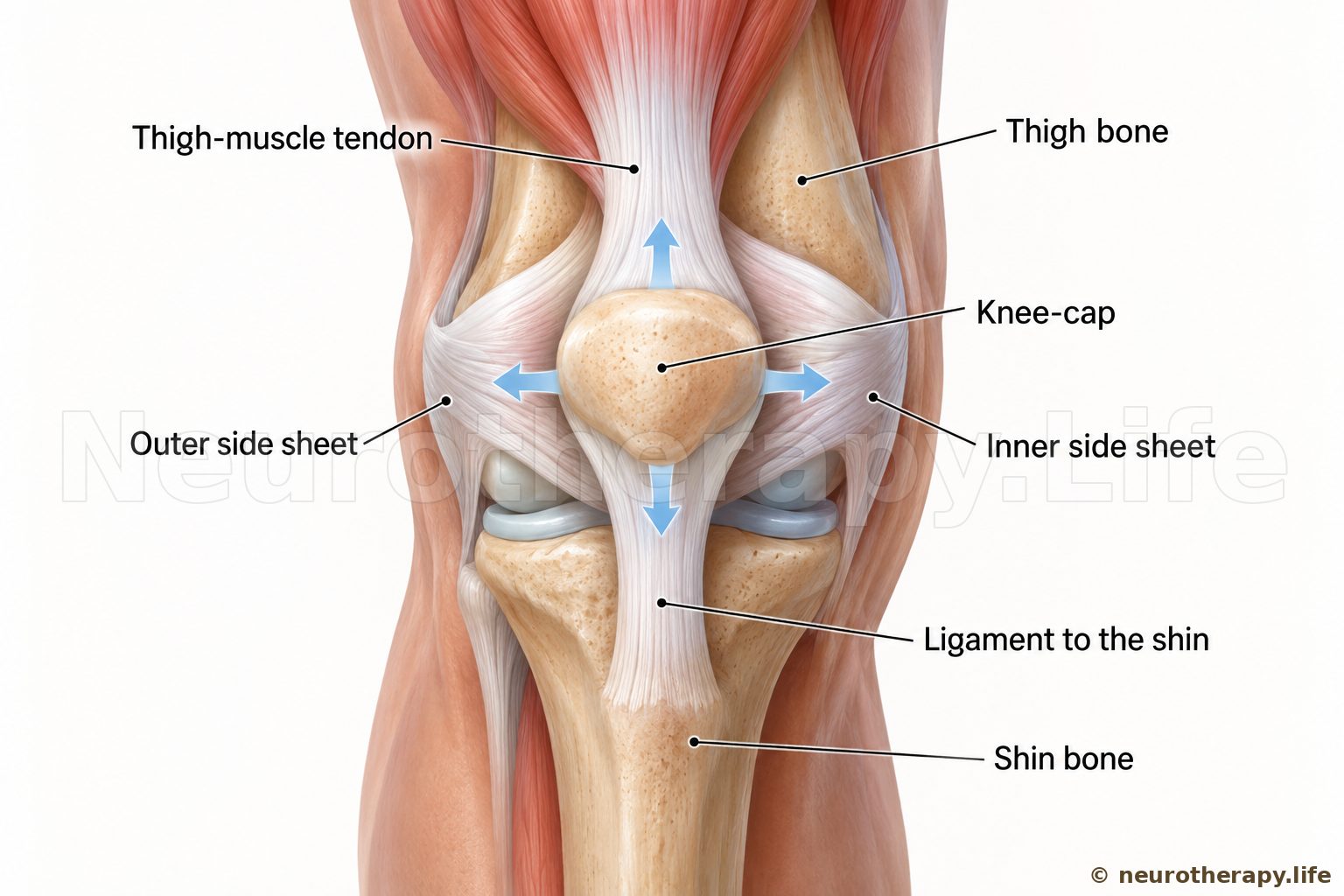
On a card, the knee-cap is drawn as a bare open circle, and arrows through it show what is being done.
The knee-cap is held at four sides. Knee Cap Free aims to let it glide freely in every direction.
Where it is given
Where is Knee Cap Free given?
PositionLying on the back
Body areaThe front of the knee — thigh above, area below, the sides and corners of the knee-cap — lying on the back or seated
You lie straight on your back, or sit, with the knee completely loose and the whole body relaxed. A braced leg clamps the cap into its groove, so the therapist waits until the leg is heavy and soft.
The work covers the thigh above the knee, the area just below the knee, the sides of the knee-cap and finally the cap itself. The more troublesome knee is done first; the other can be done afterwards.
How it is given
How is Knee Cap Free given?
How this point is given — the tool, the pressure, the count and the exact movement — is deliberately not described here. Watch the demonstration video on this page, and learn the method hands-on from a trained Neurotherapist before giving it. Please do not give any point from a written description alone: a point given in the wrong place or the wrong way can do harm.
Feels likeA gentle kneading around the knee, then the cap loosening
The exact technique is taught hands-on in the Neurotherapy (LMNT) course. See the course →
What it does
What does Knee Cap Free do?
The teaching says the tissues above and below the knee-cap get pulled during work and become caught in the cap. Knee Cap Free unsticks the cap. Body science recognises that the tissue around a knee-cap can tighten so the cap loses its glide, which both hurts and stiffens the knee — and clinics test a cap by moving it up, down, in and out.
Makes the knee-cap loose and frees it from the muscles beneath it.
Reduces the stiffness of the knee.
Relaxes the thigh muscles above the knee and the muscles around the bone below it.
What comes with Knee Cap Free in the knee sequence?
The knee treatments are given as a sequence, each preparing the tissue for the next. Back of Knees comes first, face down, before the patient is turned over.
Back of Knees — The partner treatment behind the joint, face down — both knees.
Giriraj — Carries the thigh tissue back upward after the cap is free.
In knee pain with pain and inflammation at Mu°, A. Heparin is given with (6) Adr and Knee Cap Free added; the teaching reports the knee much better after a single treatment.
A teaching case, put together from several patients: a woman with two years of knee pain had been through physiotherapy, oil massage and tablets. When the therapist finally pushed her knee-cap gently sideways with a flat palm, it did not move at all — not stiff, but stuck. Her digestion was worked first, then the knee sequence with Knee Cap Free, and as the cap began to glide again her pain eased.
A composite case written to teach the reasoning — not one patient’s file.
Common questions
Why must I let my leg go completely loose?
Because the knee-cap sits inside the tendon of the thigh muscle. If you tighten the muscle, even to help, the tendon clamps the cap into its groove and the treatment works against a locked bone.
Why is my worse knee done first?
So it gets the therapist's freshest hands, before the session runs long. It is written that way on purpose.
Will this put back worn cartilage?
No. Nothing in this therapy puts cartilage back. What it aims for is a knee-cap that glides and a knee that hurts less and moves better.
Is Back of Knees skipped if I am already lying on my back?
It should not be. The face-down treatment comes first, before you are turned over; skipping it leaves the back of the knee unsoftened.
Surprising facts
1A knee-cap really has four corners
The knee-cap is tethered at four sides: the thigh-muscle tendon above, the patellar ligament below, and a fibrous sheet on each side. It can get stuck in any of those four directions.
The cartilage on the back of the knee-cap is the thickest in the human body, because the cap is pressed hard against the thigh bone every time you climb stairs or squat.
By holding the tendon away from the joint, the knee-cap increases the leverage of the thigh muscle, so the knee straightens with less effort.
Source: Gray's Anatomy, 41st ed., knee.
Watch
घुटने के दर्द का 100% पक्का इलाज |Treatment & Exercises | Knee Pain Permanent Relief Without Surgery
A home routine for the knees: thumb pressure along the thigh and shin, zig-zag massage above and below the knee, easing the kneecap, and massage behind the knee, then simple exercises such as tapping, a towel roll under the knee and pressing a fist between the knees. It is shared for relief and to strengthen the muscles around the knee.
Test yourself
Research
Emerging evidence
A randomised trial of massage for knee osteoarthritis (wear-and-tear arthritis) found that people who received regular massage for eight weeks had less pain and stiffness and better function than those who waited. It studied Swedish massage, not Neurotherapy (LMNT), but it supports hands-on work around a worn knee.
This page explains what a Neurotherapy (LMNT) treatment is for; it is not a self-treatment guide and does not diagnose. Neurotherapy (LMNT) works alongside your medical care — keep taking the medicines your doctor prescribed.
Ready to begin?
Send COURSE for course details, or your name, age and health issue for a consultation.