The River: Heparin and the Heparin Formulas
Blood is safe while it keeps moving. Neurotherapy (LMNT)'s Heparin family is built on one idea: the liver and the lungs make the body's own anti-clotting chemical, and the pancreas helps break down old clots, so these organs are gently activated to keep the river of blood open.
Overview
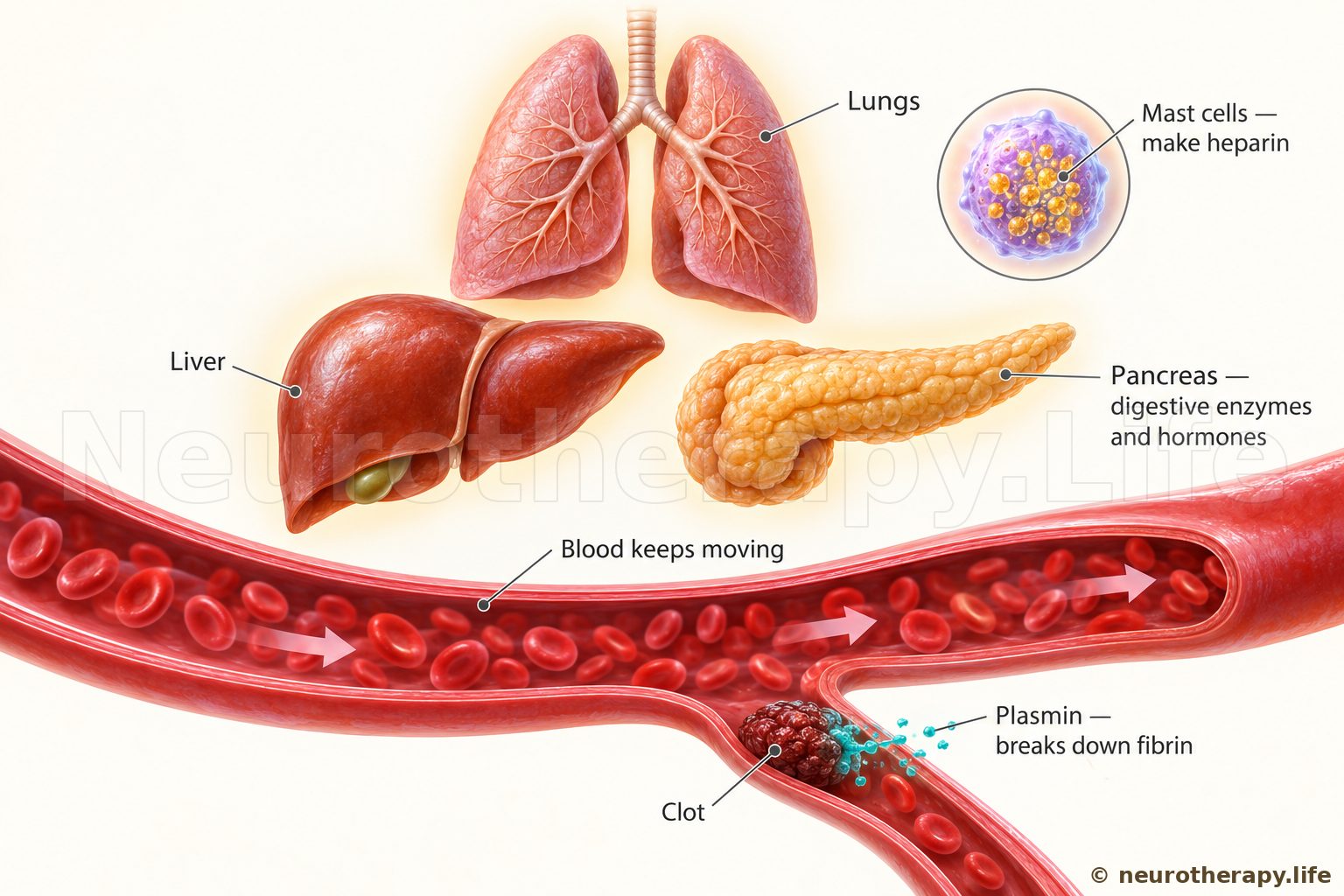
Blood is safe while it keeps moving. Neurotherapy (LMNT)'s Heparin family is built on one idea: the liver and the lungs make the body's own anti-clotting chemical, and the pancreas helps break down old clots, so these organs are gently activated to keep the river of blood open.
Blood is safe while it moves
Guruji taught one plain fact about blood. As long as it keeps moving fast, there is no danger. If it stops somewhere, or slows down a lot, it begins to set. Setting is called clotting, which means the blood turns from a liquid into a soft solid plug.
Clotting protects us. Without it, a small cut would bleed and bleed. But a clot that forms inside a vessel, where nobody wanted it, is just as dangerous. So the body stands between two dangers every second: bleeding that will not stop, and clotting that should not happen.
For the second danger, nature made a chemical called heparin. Heparin is the body's own anti-clotting chemical. Its work is to stop clots from forming. It does not melt a clot that has already set; it prevents the next one.
Why the liver and the lungs?
Heparin is stored in mast cells, which are guard cells that sit in the tissue around blood vessels. In Guruji's teaching, most of the body's heparin comes from the mast cells of the liver and the lungs, and the rest is spread thinly through every tissue.
Why there? Because these are the two places where the body slows its own blood on purpose. Inside the liver, blood creeps through narrow, winding channels so that old red cells and germs can be picked out and cleared. Inside the lungs, blood slows in tiny air sacs so that carbon dioxide can leave and oxygen can enter. Slow blood is blood that could set, so heparin is made exactly there.
Think of a river that splits into many narrow creeks so every drop can be checked. The water slows almost to a stop, and silt starts to settle. So, at that very stretch, something is added to the water to stop the silt. That something is heparin. From this, Guruji drew the key idea: if the liver and lungs are activated, heparin can be made, and new clots can be prevented.
How a clot is built, and how it is taken apart
When a vessel is hurt, a chain starts. The liver sends two clotting proteins, prothrombin and fibrinogen, to the spot. Platelets, the tiny cell pieces that seal leaks, break open there. With the help of calcium and vitamin K, the chain ends in fibrin, a fine net that catches red cells and closes the hole.
Small clots form every day and are cleared every day. Inside each clot waits a protein called plasminogen. Hours after an injury, the vessel lining releases tPA, a slow enzyme, which turns plasminogen into plasmin. Plasmin digests the fibrin net and the clot dissolves. If this clearing does not work well, clots can grow and block blood flow, which may lead to paralysis or other disease.
- Heparin stops new clots from forming.
- Plasmin opens clots that have already formed.
- Plasmin resembles trypsin, the protein-digesting enzyme of the pancreas — the clue behind the pancreas in this family.
P. Heparin: one formula, two errands
From this physiology Guruji built the parent formula, P. Heparin. It works through three points: Pan for the pancreas, Liv for the liver, and Ch. Only for the lungs. Each has a named job. The pancreas is there to help digest the fibrin of an old clot. The liver and lungs are there to make heparin, so that no new clot forms. One formula, two errands: open what is shut, and keep the rest open.
Why the pancreas? The therapy is honest that this step is an inference. Plasmin looks like trypsin, and the pancreas makes trypsin. Like two boys on a road who look alike and might be brothers, perhaps the pancreas helps make plasmin too. The 'perhaps' is the therapy's own and stays in place. What is reported without a perhaps is what was seen in patients.
Two kinds of result gave the formula its name, Plasmin Heparin. First, many women who passed clots in their periods reported that, after one or two treatments, clots did not come in the next period, often for years. That is a heparin-like result. Second, heart and paralysis patients reported easier breathing and steady improvement over months, read by the therapy as blockages opening. That is a plasmin-like result. No laboratory measured heparin in anyone's blood; the name rests on what patients reported and what was observed.
One parent, many children
Every other Heparin formula is the parent with one change: a point placed in front, a last step replaced, or the strength of the pancreas step changed. The letter in front of each name tells you what it is aimed at. A therapist who knows the letters can read a card at a glance.
The formula is chosen by the patient's findings, not by the disease name. One useful clue is the returning-pain test: if pain eases after a session but comes back a few hours later or next morning, the therapy reads it as a sign of a clot in that area, and a suitable Heparin formula is chosen next time. The exact choice, points and method are taught hands-on in the course.
- P — Plasmin: the parent, which may be given to all patients when nothing else steers the choice.
- A — Acid: for the patient tender at Mu°, for example some knee pain and diabetic foot problems.
- G — prostaglandins: inflammation, and some period clots and pain.
- J — joints: night cramps and aching with weakness.
- M — Medulla: repeated headache, eye, nose and brain problems.
- T and TT — Thymus: an old blow, once any wound has healed.
- X — the tenth cranial nerve: repeated stomach and digestive trouble.
- F, Anti F and Multi: old clots, unwanted growths such as fibroids or cysts, and many old blockages.
The kidney that raises the pressure
Guruji also used P. Heparin for a raised lower blood-pressure number, the diastolic. When the kidney gets too little blood, it releases renin, a chemical that narrows vessels all over the body to push more blood through itself. The whole body then pays in raised pressure. Guruji reasoned that a clot narrowing the kidney's artery could be one cause, and that opening it could quiet the signal. Many patients were seen with a lower diastolic reading after a few sessions. Medicines are never stopped on this basis; that decision stays with the doctor.
Key points
- Blood is safe while it moves; slowed or stopped blood begins to clot.
- Heparin, the body's own anti-clotting chemical, is made mostly by mast cells of the liver and the lungs — the two places where blood is slowed on purpose.
- Plasmin dissolves clots that have already formed; the pancreas is included because plasmin resembles trypsin — an inference the therapy marks as 'perhaps'.
- P. Heparin works through Pan, Liv and Ch. Only: open old clots and prevent new ones.
- Every other Heparin formula is the parent with one change; the letter in its name tells its purpose.
- Findings choose the formula — such as pain at Mu°, or pain that returns after a few hours of relief.
- No Heparin treatment is given while there is bleeding or an open wound.
Topics in this guide
Go deeper
P. Heparin (plasmin)
The parent formula in full detail
A. Heparin (acid)
The Heparin for the patient tender at Mu°
Multi Heparin
The heaviest member, for many old blockages
Thrombosis (blood clots)
Clots inside the vessels
Paralysis and stroke
Paralysis and stroke
Pan
The pancreas point
Liver
The liver — the body's great filter
Vitamin and Gene Formulas: B₁₂, Folic Acid and the Genes Treatments
Next: what the body cannot make for itself
Safety: when it is held back
- If there is bleeding now, or an open wound, no Heparin treatment is given until the wound has healed. Wound healing
- Bleeding that will not stop — very heavy periods, or a small cut that bleeds for hours — must be checked by a doctor to find the cause. Neurotherapy (LMNT) works alongside that care, never instead of it. Period problems (irregular, heavy or painful)
- Tell the therapist if you take a blood-thinner. Keep taking it exactly as prescribed; the work is given lighter, and any new bruise or bleeding must be reported.
- Pan is normally not given in fits, convulsions or seizures — its own entry allows it only within the Heparin formula. Pan is never given in schizophrenia. Pan
- Liv is not given in liver cancer, and Ch. Only is not given in lung cancer. In any cancer, never (10) Pan, Thymus, Pit, Lu+Sh, Rt.Ov/Lt.Ov or (30) Medulla — so G. Heparin, which carries (30) Medulla, is never used in cancer. Cancer care: Neurotherapy (LMNT) support
- G. Heparin is not given in heart disease. Where Adr is added, its own bars come too: not in septicaemia, HIV/AIDS or cancer, and not in high blood pressure. ADR
- If blood pressure falls after sessions, do not stop or reduce your tablets. Keep a note of your readings and let your own doctor decide. High blood pressure
Guruji says
“It is a property of blood that as long as it keeps moving fast there is no danger. But if it stops anywhere, or its speed becomes very slow, it will begin to set.”
“If we provoke the liver and the lung, then heparin can be made, and in the future we can be saved from clots forming.”
Common questions
Why do you press my thigh and chest when the problem is in my brain?
Because the work is on the organs that make the body's own clot-control chemicals — the liver, the lungs and the pancreas. Whatever the body makes, the blood carries where it is needed. It is like clearing a canal from the sluice gate, not from the middle of the field.
My periods come with clots and pain. Everyone says it is normal.
It is common, which is not the same as normal. This is one of the problems the Heparin family is written for, and many women have reported that clots stopped in the next cycle. Please also have it checked by a doctor, because heavy or changing bleeding deserves a known cause.
My doctor has put me on a blood-thinner. Can I still take this?
Tell the therapist exactly what you take, and keep taking it. The work is given lighter, and you will be asked about any new bruise. If you are bleeding anywhere, treatment waits until it has healed.
My father had a stroke years ago. Is it too late?
Not necessarily. Paralysis is the home ground of this family, and patients with old paralysis have reported benefit. Progress is slow and is judged over weeks, alongside his doctor's care and any physiotherapy.
Watch

Shows how to give yourself the Pan (pancreas) point in the fold at the top of the thighs: 8 Pan, 2 Pan, and 2 Pan × 6 with a one-minute gap, counting so that each press lasts six seconds.

A practical demo by Dr. Diwakar Shukla on how to give 1, 2 and 8 Pan — the pancreas point — to support a weak pancreas.

Shows how to find the Pan (pancreas) point in the fold at the top of both thighs, and how to give 1 Pan, 2 Pan, 2 Pan × 6 and 8 Pan with the feet, holding chairs for support. It is used to support the pancreas in diabetes and indigestion.
Test yourself
Research
- Strong evidence
A review of mast cells. It describes how these cells, found near blood vessels in almost every tissue, store heparin and other chemicals in granules and release them when needed.
Explore more
Organs
Body systems
Diseases
Points
Formulas
Topics
Read more
This page explains what a Neurotherapy (LMNT) treatment is for; it is not a self-treatment guide and does not diagnose. Neurotherapy (LMNT) works alongside your medical care — keep taking the medicines your doctor prescribed.