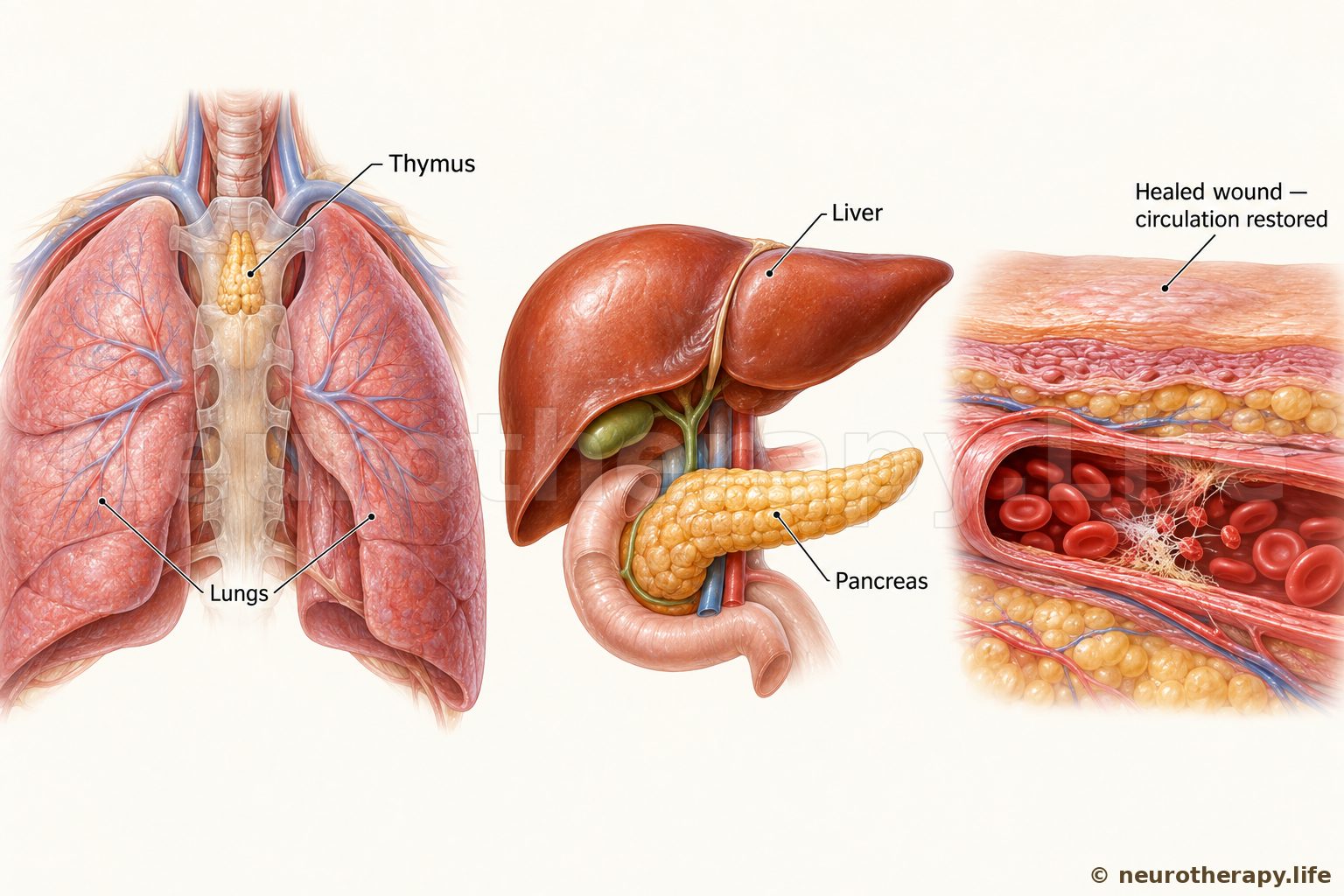
T. Heparin is the Neurotherapy (LMNT) Heparin formula for an ordinary blow — after an accident or an operation — given only once the wound has dried. It is the parent P. Heparin with a thymus-and-chest step in front, at single strength, to improve the circulation of the injured place.
Overview
What is the T. Heparin formula?
Heparin is a natural substance in the body that stops blood from clotting where it should not. Neurotherapy (LMNT) has a whole family of Heparin formulas, aimed at clots and poor circulation. Their parent is P. Heparin, which works through the pancreas, the liver and the chest.
Each family member adds a prefix in front of the parent. In T. Heparin, the 'T' stands for thymus: a thymus-and-chest step is placed first, at single strength. Its double-strength sister is TT. Heparin.
It is written for the blow. When a blow lands, blood sets into a clot below and watery serum collects above it. The Injury treatment clears the serum first. Once the wound has dried, T. Heparin is given to increase the circulation at that place.
T. Heparin adds a thymus-and-chest step to the parent Heparin formula, to restore circulation after an ordinary blow has healed over.
What it is for
What is T. Heparin used for?
For an ordinary blow, once the wound has dried — to increase the circulation at that place.
After an accident or an operation.
As the step that follows the Injury treatment, which clears the collected serum first.
Points it works through
Which points does T. Heparin work through?
(4) Thymus+Chest (8) Pan (7) Liv (8) Ch. Only
The thymus-and-chest step, with the armpits, in front of the parent P. Heparin. They are listed here as a set, with what each contributes. The exact method is taught hands-on in the Neurotherapy (LMNT) course. This page lists the points of the formula and what each one contributes; it does not describe how any point is given. For the method, watch the demonstration video of each point on its own page and learn hands-on from a trained Neurotherapist. Please do not give a formula from a written description alone.
Thymus + Chest, over the breastbone and chest, here at single strength — the step that makes this formula 'T'. It reaches the thymus gland and the lungs.
The pancreas point on both thighs. The teaching links it with digesting the fibrin of a clot, since plasmin, the clot-dissolving enzyme, resembles the pancreas's trypsin.
Chest Only, a soft glide from chest to shoulders, reaching the lungs — the other place where much heparin is made.
Position:Lying on the back (supine), with no pillow for the chest step.
The exact technique is taught hands-on in the Neurotherapy (LMNT) course. See the course →
How it works
How does T. Heparin work?
The teaching notes that blood moves slowly through the narrow channels of the liver and the air sacs of the lungs, so it is in danger of setting there. That is why mast cells make heparin in exactly those places. Rousing the liver and the lungs, the reasoning goes, helps the body make its own heparin.
The thymus-and-chest step in front adds the thymus gland, one of the body's defence organs, to that work. At single strength it suits the ordinary blow; a deeper or older blow takes the double-strength form, TT. Heparin.
Timing is the key. A clot is the scaffolding a wound heals on, so no Heparin formula is given while a wound is open. The switch from the Injury treatment to T. Heparin is decided by a finding under the hand — the wound has dried — not by the calendar.
Its family
Which formulas are related to T. Heparin?
T. Heparin belongs to the Heparin family, built on P. Heparin, and follows the Injury treatment in the course for a blow.
P. Heparin (plasmin) — The parent formula, which T. Heparin carries unchanged after its first step.
TT. Heparin — The double-strength sister, for the deeper or older blow and a haematoma after a blow.
Wound healingOnly once the wound has closed — never on an open wound
After an accident or operation
Thrombosis (blood clots)To keep circulation moving at a healed injury site, alongside medical care
Safety: when it is held back
No Heparin formula while blood is flowing or a wound is open — heparin stops blood clotting, so the wound would not heal. T. Heparin is given only after the wound has dried. Wound healing
Thymus and Thymus + Chest are not given in pregnancy, polio, inflammatory disease, heart disease, diabetes, rheumatoid arthritis, autoimmune disorders or kidney disease. Such patients need a Heparin form without the thymus step. Th + Ch
In cancer, Neurotherapy (LMNT) never gives Thymus, (10) Pan, Pit, Lu+Sh, Rt.Ov/Lt.Ov or (30) Medulla — so T. Heparin is not given in cancer. Cancer care: Neurotherapy (LMNT) support
Where Thymus + Chest is given, the armpits must be given too. The two sides are kept even. Armpit
Pan is not given in schizophrenia. Liv is not given with cancer in the liver. Chest Only is not given in lung cancer. Pan
A wound that is spreading red, increasingly painful, discharging pus or with fever — and any non-healing wound on a diabetic foot — is sent to a doctor, not treated. People on blood thinners need their doctor's advice before any Heparin formula. How to tell a patient to see a doctor
No. While the wound is open, a clot is what lets it heal. The Injury treatment comes first; T. Heparin follows once the wound has dried.
What is the difference between T. and TT. Heparin?
T. Heparin has the thymus-and-chest step at single strength, for an ordinary blow. TT. Heparin has it at double strength, for a deeper or older blow, or a haematoma after a blow.
I have diabetes. Can I have this formula?
Not this one. Thymus + Chest is barred in diabetes, so your therapist will choose a Heparin form without the thymus step.
Why does the therapist also work on my armpits?
The teaching says that wherever Thymus + Chest is given, the armpits must be given too. Without them the step is incomplete.
Surprising facts
1Mast cells are heparin's warehouses
Heparin is stored in the granules of mast cells, immune cells that sit along blood vessels and are especially common in the lungs, the liver and the gut lining.
Source: Krystel-Whittemore M, Dileepan KN, Wood JG. Mast Cell: A Multi-Functional Master Cell. Front Immunol. 2016;6:620.
2A bruise changes colour as it heals
As the body breaks down the pooled blood, haemoglobin turns into green biliverdin and then yellow bilirubin — which is why a bruise goes from blue-purple to green and yellow.
Source: Guyton & Hall, Textbook of Medical Physiology, 14th ed. — destruction of haemoglobin; bilirubin formation.
3The thymus is largest in childhood
The thymus, behind the breastbone, trains T cells. It is largest around puberty and then slowly turns mostly into fat with age.
Source: Gray's Anatomy, 41st ed. — the thymus; age-related involution.
Test yourself
Research
Strong evidence
This review explains how the body dissolves clots through plasmin and keeps clotting and clot-breaking in balance — the body science behind the whole Heparin family.
This page explains what a Neurotherapy (LMNT) treatment is for; it is not a self-treatment guide and does not diagnose. Neurotherapy (LMNT) works alongside your medical care — keep taking the medicines your doctor prescribed.
Ready to begin?
Send COURSE for course details, or your name, age and health issue for a consultation.