Your skin is your largest organ — about two square metres of living, self-repairing cover that keeps germs out and water in, feels every touch, cools you with sweat and makes vitamin D from sunlight. It renews its outer layer roughly every month, and because it sits where everyone can see it, it is often the first place where trouble inside the body shows.
Overview
What is the skin?
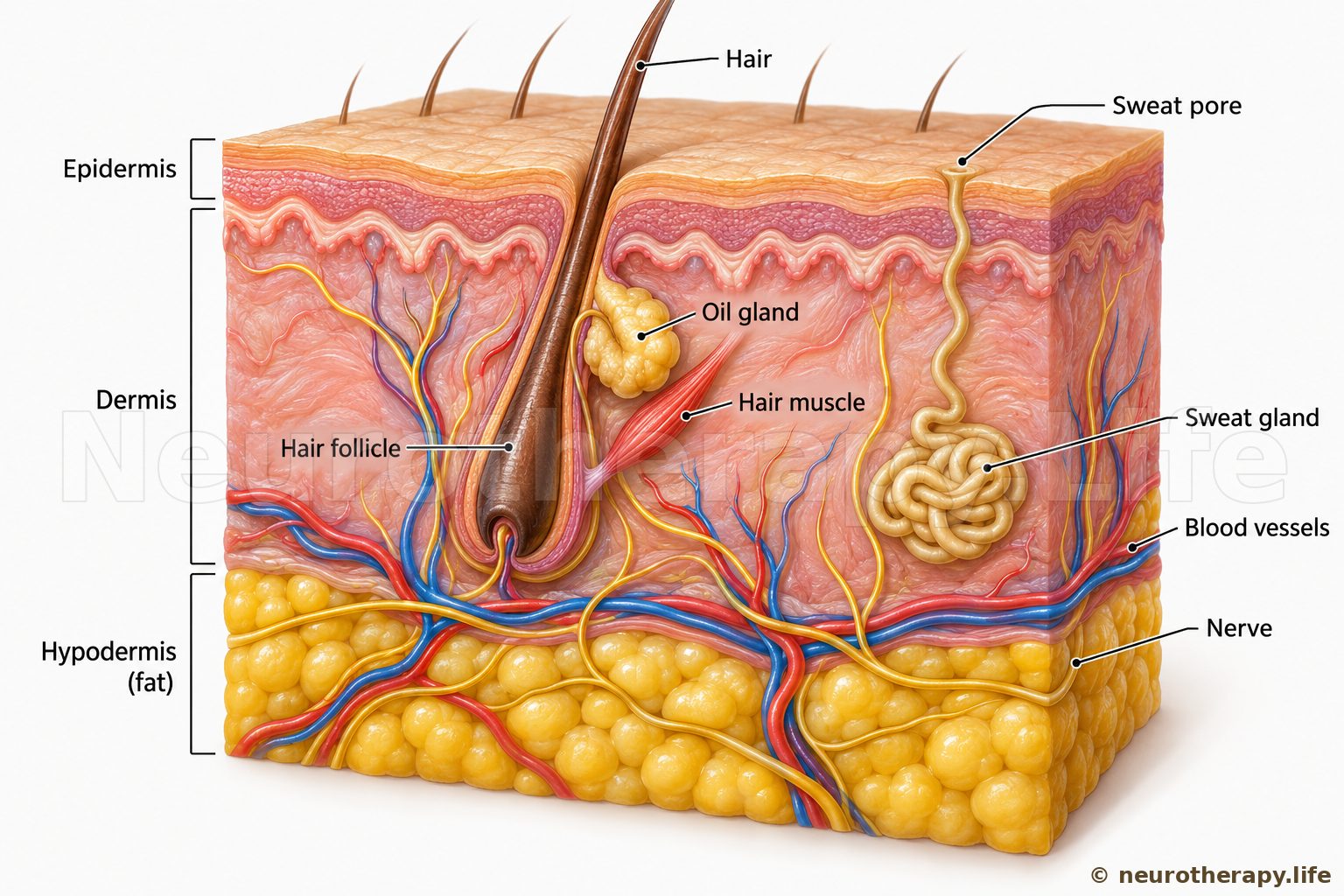
The skin is the organ that covers your whole body. It has three layers: a thin outer layer (the epidermis) that you see and touch, a thick, strong middle layer (the dermis) full of blood vessels, nerves, glands and hair roots, and a deeper layer of fat (the hypodermis) that cushions and insulates you.
Together with the hair, nails, sweat glands and oil glands, the skin makes up the body system of skin and hair. It is the body's first wall against the outside world, and it is never idle — sweating, sensing, repairing and defending even while you sleep.
Guruji's teaching reads the skin as a report card. It found that people with almost any skin problem had pain at the Gal (gall bladder) point and were often constipated, and it lists dry skin, pimples, psoriasis and itchy dry rashes among the signs of a body short of water and running acidic. So in LMNT, skin work usually begins inside — at digestion.
Three layers, one organ: the thin outer epidermis, the busy middle dermis, and the cushioning fat beneath.
Function
What does the skin do?
The skin is a wall, a thermostat, a sense organ, a factory and a guard post all at once. Most of its work goes on without you noticing — until something goes wrong.
Protects the body from germs, dirt, chemicals, injury and the sun's ultraviolet rays.
Keeps water and salts inside the body so that you do not dry out.
Controls body temperature — by sweating and by widening or narrowing its blood vessels.
Feels touch, pressure, vibration, heat, cold and pain through millions of nerve endings.
Makes vitamin D when sunlight falls on it — the first step in letting calcium into the bones.
Guards the body with its own immune cells and a film of germ-killing substances in sweat and oil.
Gets rid of a little salt and waste in sweat — LMNT teaching counts it among the organs of excretion.
New cells are born
At the bottom of the epidermis, a single row of cells keeps dividing to make new skin cells.
They move up and toughen
As they rise, the cells fill with a tough protein called keratin and lock together.
They become the shield
By the time they reach the surface they are flat, dead and packed like roof tiles, with oils between them — a waterproof shield.
They flake away
The oldest cells are shed unnoticed, tens of thousands every minute, and the whole outer layer is replaced in about a month.
How does the skin work with other organs?
Skin — The skin, hair, nails and their glands together make the skin and hair system.
Hair — Every hair grows from a pocket in the skin, with its own oil gland and tiny muscle.
Heart, blood and circulation — Blood vessels in the dermis open to release heat and close to keep it in; they also feed the skin.
Nervous system and brain — Nerve endings carry touch and pain to the brain; automatic nerves run the sweat glands and the hair muscles.
Gall bladder — In LMNT teaching, bile is antiseptic and laxative, and pain at Gal is found in almost every skin problem — so the gall bladder is central to skin work.
Thyroid — A slow thyroid makes the skin dry, rough and cool. LMNT teaching says the thyroid, the gall bladder and the female hormones together take care of the skin.
Lymph and immunity — Immune cells in the skin catch germs at the surface; the nearest lymph nodes take over if germs get in.
Anatomy
What are the parts of the skin?
The skin has three layers, and in them sit the 'appendages' — hair, nails and glands.
Epidermis — the outer layer
Thin, with no blood vessels of its own; fed from the layer below.
Keratinocytes — The main skin cells; they make keratin and form the tough, waterproof surface.
Melanocytes — Pigment cells at the base that make melanin, the brown-black colour that shields against the sun.
Langerhans cells — Immune sentries that catch germs and carry news of them to the lymph nodes.
Merkel cells — Touch cells, especially many in the fingertips.
Horny layer (stratum corneum) — The top layers of flat, dead cells with oils between them — the real barrier.
Dermis — the middle layer
Thick and strong; this is where the skin's 'machinery' lives.
Collagen and elastin — Protein fibres that give the skin strength and stretch. They thin with age and sun, which is how wrinkles form.
Blood vessels — Feed the skin and help control heat: they widen to lose heat (you flush) and narrow to save it (you turn pale).
Nerve endings — Different kinds sense light touch, pressure, vibration, heat, cold, itch and pain.
Sweat glands — Millions of coiled tubes that pour sweat onto the surface to cool you.
Oil (sebaceous) glands — Open into hair follicles and release sebum, the oil that keeps skin and hair supple. Blocked, they give pimples.
Hair follicles and hair muscles — Pockets where hairs grow, each with a tiny muscle that makes the hair stand up.
Hypodermis — the fat layer
Fat cells — Store energy, keep in warmth and cushion bones and muscles against blows.
Connective tissue — Anchors the skin to the muscles beneath while letting it slide.
Nails
Nail plate — Hard keratin that protects the tips of the fingers and toes and helps pick up small things.
Nail root and moon (lunula) — The living part under the skin fold where the nail grows; changes in the nail can reflect health inside.
Where is the skin located?
The skin covers the entire outside of the body. At the lips, nostrils, eyelids and the other openings it turns into the moist lining (mucous membrane) of the inside passages, so there is no gap anywhere.
It is not the same everywhere. It is thinnest on the eyelids and thickest on the palms and soles, which take the most wear. The palms and soles have no hair and no oil glands but many sweat glands; the scalp has the most hair; the face, chest and back have the most oil glands — which is where pimples appear.
LMNT uses the skin as its doorway. Many treatments are rubs rather than presses — the toe-finger rubs, the chest rubs and Feather Touch — given so that the nerves under the skin are roused but the skin is never broken.
Healthy skin is smooth, soft, slightly elastic and a little oily, with fine lines and tiny openings (pores) for sweat and hair. Its colour, from very pale to very dark, comes mainly from melanin, with a touch of pink from blood and yellow from carotene.
On the fingertips, palms and soles the surface is folded into ridges that form fingerprints and help grip. With age the skin becomes thinner, drier and less springy, and wrinkles and age spots appear, much faster on skin that has had a lot of sun.
How big is the skin?
An adult's skin covers about 1.5 to 2 square metres — roughly the size of a single bed sheet — and weighs about 3.5 to 4 kilograms, making it the largest organ of the body.
It is about half a millimetre thick on the eyelids and several millimetres thick on the soles and the upper back. It holds two to four million sweat glands, and its outer layer is replaced roughly every month.
Conditions and disorders
What conditions and disorders affect the skin?
Skin problems are among the commonest reasons people see a doctor. Some start in the skin itself; many are the skin reporting something happening inside — in digestion, the glands, the blood or the immune system.
Itchy, inflamed or scaly skin
ItchingAn urge to scratch — from dry skin, allergy, infection or illness inside the body.
Skin diseaseEczema, rashes and other skin troubles; LMNT teaching finds pain at Gal in almost all of them.
PsoriasisThick, silvery, scaly patches from skin cells being made far too fast.
AllergyHives, rashes and itching when the defence system overreacts to something harmless.
GangreneSkin and tissue die when the blood supply fails, as in some diabetic feet.
Burning feetBurning or tingling skin of the feet, often from nerve trouble.
What are common signs of a skin problem?
Itching, burning or stinging
Redness, a rash, bumps or blisters
Dry, rough, cracked or scaly patches
Pimples, blackheads or boils
White, dark or discoloured patches
A new mole, or one that changes in size, shape or colour, itches or bleeds
A sore that does not heal in a few weeks
Spreading redness, warmth and swelling with fever — an infection needing a doctor the same day
What tests check the health of the skin?
Examination and dermoscopy — A skin doctor (dermatologist) looks closely at the skin, often with a magnifying light called a dermoscope.
Skin scraping (KOH test) — A few flakes are checked under a microscope for fungus.
Wood's lamp — An ultraviolet lamp that makes some fungal infections and white patches easier to see.
Patch test — Small amounts of common substances are taped to the back for two days to find a contact allergy.
Skin biopsy — A tiny piece of skin is removed under local anaesthetic and examined — the surest test for a suspicious mole.
Blood tests — For example blood sugar, thyroid tests, vitamin B₁₂ or allergy (IgE) levels, when the skin may be reporting a problem inside.
How are skin conditions treated?
Moisturisers and gentle care — Restoring the skin's oily barrier is the base of treatment for dry, itchy skin.
Creams and ointments — For example anti-inflammatory, antifungal or antibiotic creams — prescribed and timed by a doctor, since strong creams can thin the skin if overused.
Tablets — For widespread infection, severe acne, psoriasis or allergy, when creams are not enough.
Light therapy (phototherapy) — Measured doses of ultraviolet light, used for psoriasis and vitiligo under supervision.
Procedures — Freezing warts, removing cysts or suspicious moles, and scar treatments.
Treating the cause inside — Controlling blood sugar, correcting a slow thyroid or a vitamin shortage often improves the skin too.
Neurotherapy (LMNT)
LMNT teaching approaches the skin from the inside. Guruji found that people with almost any skin problem had pain at the Gal point and many were constipated. Bile has two chief qualities — it is antiseptic and it is laxative — so the gall bladder was worked. The itching eased, but only for a few hours, because these people's stomachs were always upset. The conclusion shaped the New Gal formula: first put the stomach right, and only then will the gall bladder work properly. The teaching also reads the skin by the two kingdoms: dry, scaly skin, itchy dry rashes, pimples, warts and psoriasis belong with a body short of water and running acidic, while 'weeping' rashes with watery discharge belong with the alkaline side. The findings of the day — above all pain at Mu° or Liv° — decide which treatment is given.
Points
Gal — The gall bladder point. Pain here is the most common finding in skin problems in LMNT teaching. Gal is not given in leukaemia or other raised white-cell diseases, nor in asthma.
(1) Pt. Gal × 6 treatments — Single-point Gal, repeated six times with rests, used inside New Gal (with toe-finger work on Gal) to stimulate the gall bladder.
Mu° — The gate for the Acid Treatment Formula: only when Mu° is clearly more painful than Liv° is ATF given.
(3) Swt — The sweat-gland point, added at the end of the acne form of ATF to provoke the sweat glands.
(4) Thrd — The teaching says oestrogen, progesterone, the gall bladder and the thyroid together take care of the skin; (4) Thrd is named for dandruff, scaling, rough skin and wrinkles, and to help wounds and skin disease heal. Not for heart patients (give (2) Thrd), nor in bamboo spine, spur or asthma.
Th + Ch — Taught to help wounds fill and to fade old wound marks and burn scars — with its long list of bars, and always with the armpits.
Feather Touch — The lightest treatment there is: fingertips stroke the skin so gently that powder on it is not wiped off. The hairs standing up is the sign it has reached the skin's nerves.
Five formulas as one: the Fast treatment, a mild Ajay Normal, (6) TF 'Gal' with (1) Single-point Gal × 6, (15) Medulla, then the Chole treatment. It gives most benefit where the right-side points (Gal, Liv) are painful, and works best after the Vater formula.
(8) Pan (1) Gal (3) Mu° (1) acid (4) Thymus + Chest (3) Swt. Adr is deliberately left out, because the teaching holds that pimples come from viral infection. Not in diabetes.
(3) Gal (7) Liv (8) Lt Parkhoo — the teaching lists darkening of the skin over the knuckles and pigmentation of the face among the signs of B₁₂ deficiency.
“Neurotherapy (LMNT) treats according to the condition of the body.”
— Dr. Lajpatrai Mehra
Never do this
Emergency: hives or swelling of the lips, tongue or throat with difficulty breathing or faintness — call 108/112 at once. This is a severe allergic reaction (anaphylaxis). Allergy
Spreading redness, heat and swelling, a red streak up a limb, or fever with a skin wound needs a doctor the same day. Pressure and rubbing are never given over broken, burnt, infected or inflamed skin. Wound healing
A mole that has changed, a new lump, or a sore that has not healed in a few weeks needs a doctor's opinion this week — never 'treated and watched'. How to tell a patient to see a doctor
Acne that continues into adult life together with irregular periods or unusual hair growth deserves a doctor's assessment; the teaching says to say so, and go on treating. Acne (pimples and blackheads)
ATF is given only when there is more pain at Mu° than at Liv°. Form (a) ends in (6) Adr, which is not given in high blood pressure, septicaemia, HIV or cancer. In the acne form, Adr is not given; Thymus + Chest in it carries its own bars (not in diabetes, pregnancy, heart disease or autoimmune disease). ATF for pimples and acne
New Gal ends in the Chole treatment, which contains (10) Medulla: not given in diabetes or cancer, and in heart patients only (10) Left Medulla. New Gal
Cancer: if the person has cancer, (10) Pan, Thymus, Pit, Lu + Sh, Rt. Ov / Lt. Ov and (30) Medulla are never given — the therapist changes the plan. Cancer care: Neurotherapy (LMNT) support
Keep using the creams and medicines your doctor prescribed, and never stop a steroid tablet suddenly on your own. Neurotherapy (LMNT) works alongside your medical care, never instead of it.
Care
How can I keep my skin healthy?
Good skin care is mostly simple, daily and gentle — and in LMNT teaching it begins with water and digestion.
Drink enough water
Guruji said no other drink can take the place of water. In his teaching, dry skin, pimples and dandruff belong with a body short of water.
Keep the bowel regular
Constipation keeps company with many skin problems in LMNT teaching. Eat on time, chew well and do not ignore hard stools.
Oil first, then plain water
The daily rules suggest a little oil at the openings and over the body before the bath, then a rinse with plain water and no soap on the body. Hands are different — always wash them with soap before food and after the toilet.
Moisturise dry skin
Apply oil or a plain moisturiser on slightly damp skin after bathing; avoid very hot water and harsh scrubbing.
Morning sun, not midday sun
Ten to fifteen minutes of gentle morning sun helps the skin make vitamin D; cover up and use shade in the strong midday sun to prevent burning and early ageing.
Wear loose, clean clothes
Tight, sweaty clothing rubs the skin and encourages fungal infections in the folds.
Check your skin and your feet
Look for changing moles and non-healing sores; if you have diabetes, check your feet every day.
Common questions
Why is the skin called the body's largest organ?
Because it is one continuous organ with its own layers, cells, blood supply, nerves and jobs — and it weighs more and covers more area than any other. In an adult it spreads over about 1.5 to 2 square metres and weighs about 3.5 to 4 kilograms.
Can problems inside the body show on the skin?
Often. A slow thyroid makes the skin dry and rough; diabetes slows healing and invites infections; vitamin B₁₂ shortage can darken the skin over the knuckles; liver trouble can turn it yellow. LMNT teaching goes further, linking most skin problems with the gall bladder, digestion and the acid–alkali balance.
Is soap bad for the skin?
Harsh soaps and very hot water can strip the skin's natural oils and worsen dryness and itching. LMNT's daily rules suggest oiling before the bath and rinsing the body with plain water — but hands must always be washed with soap before eating, after the toilet and before touching a patient.
Does drinking water really help the skin?
If you are short of water, yes — dry skin, cracked lips and hard stools can all improve. Drinking far more than you need does not make healthy skin 'extra healthy'. In LMNT teaching, water deficiency sits at the root of the dry, acidic skin picture.
Why does LMNT treat skin problems through the stomach and gall bladder?
Because Guruji found pain at the Gal point in almost every skin patient, many with constipation. Bile is antiseptic and laxative, but working the gall bladder alone helped only for hours, because the stomach was upset. So the New Gal formula puts the stomach right first, then works the gall bladder.
Can Neurotherapy (LMNT) be taken with skin creams and tablets?
Yes. LMNT is given alongside medical care. Keep using what your doctor prescribed, and tell your therapist about every medicine — especially steroid tablets, which must never be stopped suddenly.
What should I ask my doctor or therapist?
What exactly is this rash or patch, and is it infectious?
Could my skin problem be linked to my thyroid, sugar, vitamins or digestion — and which tests would show it?
How long should I use this cream, and what happens if I stop?
Which moles or spots should I keep an eye on?
Which soaps, oils or products should I avoid?
(To the therapist) Is my Mu° or Liv° painful today, and which formula does that point to?
Surprising facts
1Your largest organ is about a bed sheet
Spread out flat, an adult's skin covers about 1.5 to 2 square metres and weighs around 3.5 to 4 kilograms — more than the liver, the brain or any other single organ.
Source: Cleveland Clinic, 'Skin: Layers, Structure and Function' (about 8 lb and 22 sq ft).
2You get a new outer skin about every month
Cells born at the base of the epidermis take about four weeks to rise to the surface, harden and flake away. You shed tens of thousands of dead skin cells every minute without noticing.
Source: Gray's Anatomy — epidermal turnover about 4 weeks; American Academy of Dermatology / Cleveland Clinic on daily shedding of skin cells.
3Your sweat carries its own antibiotic
Sweat is not just salt water. Sweat glands release a small germ-killing protein called dermcidin, which sits on the skin in a thin film with the skin's oils. The skin is not a clean surface that dirt lands on — it is a self-defending organ.
Source: Schittek B et al., Nat Immunol 2001;2:1133–1137 (dermcidin); LMNT source 38.9 DID YOU KNOW.
4Everyone has about the same number of pigment cells
Dark skin and light skin have roughly the same number of melanocytes. The difference in colour comes from how much melanin they make, and of which type — a shield shaped over thousands of years by how strong the sunlight was where our ancestors lived.
Source: Gray's Anatomy — melanocyte density; Jablonski NG, 'The evolution of human skin and skin color', Annu Rev Anthropol 2004;33:585–623.
5Goosebumps are made by tiny muscles
Beside the root of every hair sits a thread-thin muscle. When it contracts it pulls the hair upright and the skin around it into a bump. These muscles are run by the same automatic nerves as the sweat glands and the skin's blood vessels — which is why LMNT's Feather Touch uses the hairs standing up as its sign.
Source: Gray's Anatomy — arrector pili muscles and sympathetic supply; LMNT source 37.40 DID YOU KNOW.
6Your skin is a vitamin factory
Under the skin lies an inactive form of vitamin D waiting for sunlight. Ultraviolet light starts the change, and the liver and kidneys finish it. That is why people who work outdoors rarely lack vitamin D, and why LMNT's daily rules suggest ten to fifteen minutes of gentle morning sun on the spine.
Source: Holick MF, N Engl J Med 2007;357:266–281; LMNT source 12.3-7 (FROM AYURVEDA AND YOGA box).
7Your fingerprints were set before you were born
The ridges on your fingertips form in the womb during the first half of pregnancy and never change pattern afterwards. They are unique — even identical twins have different fingerprints.
Source: MedlinePlus Genetics (NIH), 'Is fingerprint pattern determined by genetics?'
8The skin can report a vitamin shortage
Darkening of the skin over the knuckles can be a sign of vitamin B₁₂ deficiency and often fades once the vitamin is replaced. LMNT teaching lists the same sign — blackness over the knuckles of both hands, with pigmentation of the face — in its B₁₂ deficiency picture.
Source: StatPearls, 'Vitamin B12 Deficiency' (cutaneous hyperpigmentation of the knuckles); LMNT source 34.12.
Your skin in numbers
~1.5–2 m²of surface in an adult
~3.5–4 kgin weight — the largest organ
~4 weeksto renew the outer layer
2–4 millionsweat glands
~0.5 mmthickness on the eyelids — the thinnest skin
Yoga
Cooling breath Śītalī
Benefits
Gives a feeling of coolness, helpful on hot days when the skin feels heated and itchy.
Slows the breath and calms the mind; stress is a common trigger for itching and flare-ups.
Simple and quick — two or three minutes are enough.
How to do it
Sit comfortably with a straight back.
Roll the tongue into a tube and let it stick out a little. (If you cannot roll it, breathe in through the gaps of closed teeth instead.)
Breathe in slowly through the rolled tongue, feeling the cool air.
Close the mouth and breathe out slowly through the nose.
Repeat 8 to 10 times.
Take care
Avoid it in cold weather, with a cold, cough or asthma, or with sensitive teeth. Low blood pressure: practise gently and stop if dizzy.
Triangle pose Trikoṇāsana
Benefits
Stretches the sides of the body, the legs and the chest.
Gets the circulation moving, including the blood flow to the skin.
Improves balance and posture.
How to do it
Stand with feet about a metre apart; turn the right foot out and the left foot slightly in.
Raise both arms to shoulder level.
Breathing out, bend sideways to the right from the hips and rest the right hand on the shin or a chair.
Stretch the left arm straight up and look up if comfortable. Hold for a few breaths.
Come up breathing in, and repeat on the other side.
Take care
Do not look up if you have neck trouble or dizziness — look straight ahead. Avoid it with a recent back, hip or knee injury, uncontrolled blood pressure or in late pregnancy. Use a chair for support if balance is poor.
Resting pose Śavāsana
Benefits
Deep relaxation eases the stress that often worsens eczema, psoriasis, acne and itching.
Helps sleep, during which the skin does much of its repair.
Suitable for almost everyone.
How to do it
Lie on your back with a small towel under the head.
Let the legs fall slightly apart and the arms rest a little away from the body, palms up.
Close your eyes and let each part of the body go heavy, from the feet to the head.
Breathe naturally and stay for 5 to 10 minutes.
Come out by rolling onto one side and getting up slowly.
Take care
If lying flat makes you breathless, rest propped up on pillows and tell your doctor. In late pregnancy, lie on the left side instead.
Watch
Gal Point (Gallbladder) - How to Give 1 Gal, 3 Gal & 1 Point Gal | Practical Training for Students
A practical training demo on the Gal (gall bladder) point: how to give 1 Gal, 3 Gal and 1 Point Gal, used to support bile flow and digestion.
शरीर में Acid बढ़ जाए तो क्या करें? | Blood pH Balance Treatment | LMNT Acid Treatment Formula
Shows the Acid Treatment formula step by step: (8) Pan, (3) Gal, (5) Mu°, 3 Acid on the side of the right thigh, (4) Chest Only, and (6) Adr on the upper back, given without breaks. It is used to support the body's acid–alkali balance when acid is raised.
Note: the Acid Treatment formula is given only when the Mu° point is tender, and (6) Adr is not given in high BP, diabetes, cancer or HIV — the therapist checks first.
Test yourself
Research
Strong evidence
Researchers discovered that human sweat glands make a protein, dermcidin, that kills bacteria such as E. coli and Staphylococcus — showing that sweat is part of the skin's own defence.
This review describes the skin as home to a rich community of bacteria, fungi and viruses that differs between oily, moist and dry areas, and explains how these friendly microbes help keep harmful germs out — and how an upset balance is linked with conditions such as eczema and acne.
A major review explains how the skin makes vitamin D from sunlight, how the liver and kidneys activate it, and how common deficiency is worldwide — with its effects on bone and muscle.
This page explains how the body works; it does not diagnose. Neurotherapy (LMNT) works alongside your medical care — keep taking the medicines your doctor prescribed, and see a doctor for any new or severe symptom.
Ready to begin?
Send COURSE for course details, or your name, age and health issue for a consultation.