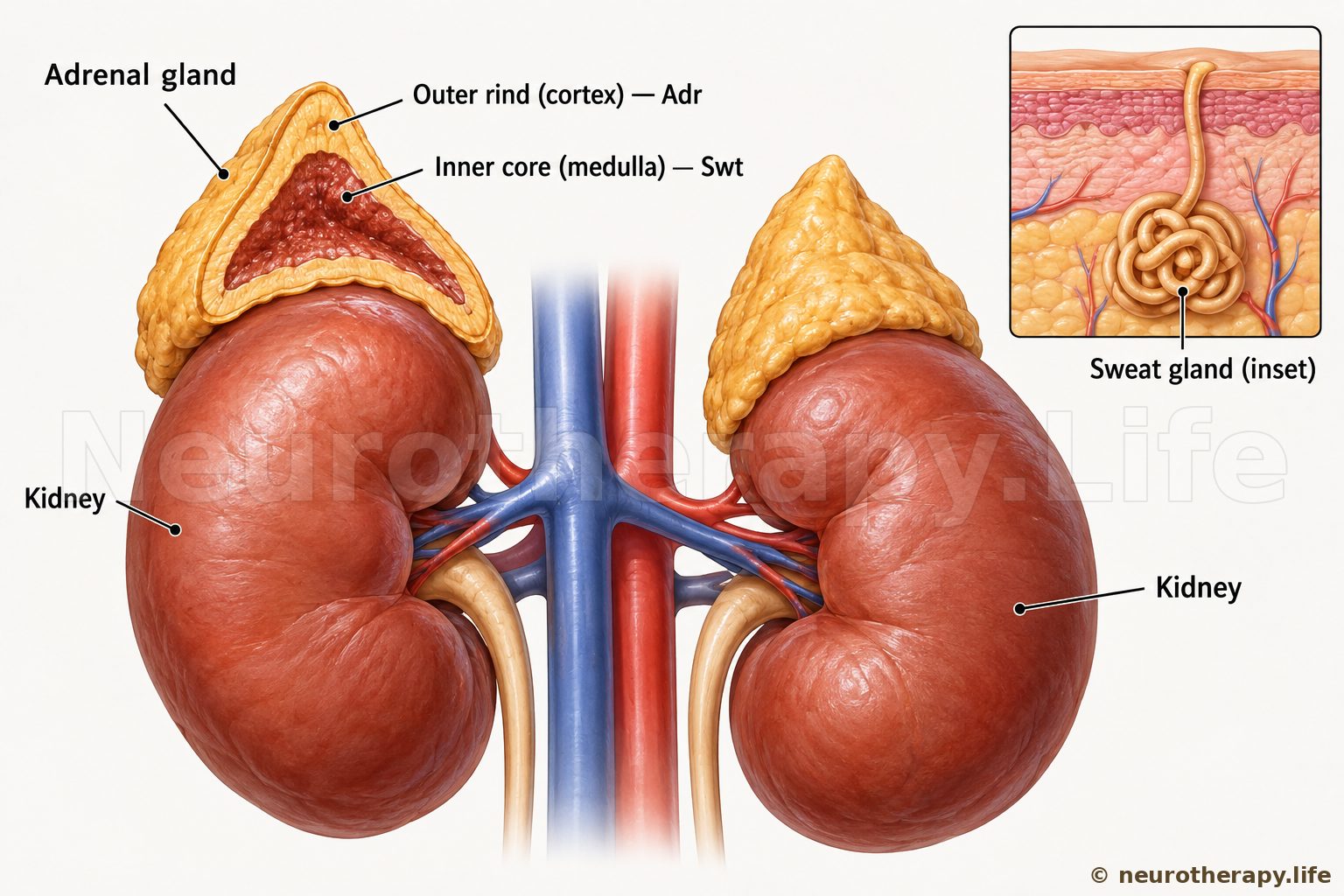
Swt is the Neurotherapy (LMNT) point named for sweat. It is given on the middle of the back, lying face down, and is aimed at the inner core of the adrenal gland and at the sweat glands. Its number and its side decide which of several quite different treatments you receive.
Overview
What is the Swt point?
Swt is short for sweat. The adrenal glands are two small caps that sit on top of the kidneys. Each is really two glands in one wrapper: an outer rind, the cortex, and an inner core, the medulla. Swt is aimed at the core; its partner point, Adr, is aimed at the rind.
The adrenal core makes the body's two 'fright' chemicals: adrenaline (epinephrine) and noradrenaline (norepinephrine). They speed the heart, open or narrow passages and vessels, and slow the gut. Neurotherapy (LMNT) teaching also uses Swt to stimulate the sweat glands, which are run by the same nerve system.
Swt is a chemical point, and it has been seen that different numbers give different effects. Its side matters just as much: Left Swt opens a narrowed passage, Right Swt narrows a widened one. So (3) Swt, (6) Swt, (6) Left Swt and (6) Right Swt are separate treatments, each with its own uses and its own cautions.
Each adrenal gland is two glands in one. Swt is aimed at the inner core; Adr at the outer rind.
Where it is given
Where is Swt given?
PositionLying face down
Body areaBeside the spine (never on it) in the middle of the back, about the level where the shoulder blades end — left of the spine for Left Swt, right for Right Swt; lying face down
You lie face down with pillows under the chest so that the chin rests and the head stays straight.
Swt is given in the groove beside the spine in the middle of the back, at about the level where the lower tip of the shoulder blade lies. Left Swt is on the left of the spine, Right Swt on the right; plain Swt takes both. The exact spot and the count are shown in the demonstration video.
How it is given
How is Swt given?
How this point is given — the tool, the pressure, the count and the exact movement — is deliberately not described here. A demonstration video for this point is being prepared; until it is on this page, learn the method hands-on from a trained Neurotherapist before giving it. Please do not give any point from a written description alone: a point given in the wrong place or the wrong way can do harm.
The number written before a point's name is not a strength setting. Each numbered form is a separate named treatment with its own method and timing, taught hands-on in the course.
The number before itChooses the treatment; it is not a strength setting
The exact technique is taught hands-on in the Neurotherapy (LMNT) course. See the course →
What it does
What does Swt do in the body?
Neurotherapy (LMNT) teaching describes Swt as stimulating the adrenal core and the sweat glands, with each numbered and sided form aimed at a different effect. Body science confirms that the adrenal core makes adrenaline and noradrenaline and that these really do open and narrow passages and slow the gut; how a press on the back reaches the gland is the therapy's own explanation from long clinical experience.
(3) Swt — the mildest form: to reduce the smell of sweat or of urine, and for pimples.
(6) Swt — through noradrenaline, to slow the movement of the intestines in loose motions. Given without a side.
(6) Left Swt — the opening side: to open a narrowed valve, duct or passage; for difficulty breathing in asthma; where the food pipe is narrowed; where a narrowed urine passage burns.
(6) Right Swt — the closing side: to narrow a widened passage; in loose motions; for difficulty breathing out in bronchitis; for leg swelling from varicose veins; for drops of urine on laughing or sneezing.
Swt in general — to stimulate the sweat glands.
Organs it reaches
Adrenal glands — The inner core of the adrenal gland — the source of adrenaline and noradrenaline.
Skin — The sweat glands, run by the same alarm nerve system.
Intestines — Noradrenaline slows the gut — the reason (6) Swt and (6) Right Swt are used in loose motions.
Lungs — Adrenaline opens the airways — the reason Left Swt is used for breathing in asthma.
Bladder — The bladder outlet can be opened or tightened — Left Swt for a narrowed passage, Right Swt for leaking drops.
Its family
What are the forms of Swt?
Each form is a separate treatment. A caution written against one form travels with that form; the general Swt cautions apply to all.
(3) Swt — The mildest form — smell of sweat or urine, and pimples.
(6) Swt — Without a side — to slow the gut in loose motions.
(6) Left Swt — The opening side — narrowed passages, asthma. Not in diabetes.
(6) Right Swt — The closing side — loose motions, bronchitis, leaking urine. Not in high blood pressure.
ADR — The partner point for the outer rind of the same gland.
What it is used for
What is Swt used for?
Swt is never chosen from a disease name alone. The therapist matches the right form and side to the findings — and checks the blocked list first.
Left Swt is paired with the left Medulla to open the way.
Safety: when it is held back
Blocking comes first. Before any treatment, the points not to be given for the patient's disease are marked on the diagnosis card. Where a caution and a use both apply, the caution wins. Conditions that block certain points: the six families
High blood pressure: Swt is blocked, because rousing the adrenal core can raise the pressure further. (6) Right Swt in particular is never given to a high blood pressure patient. High blood pressure
Heart disorders: Swt is blocked — firm pressure falls towards the heart, and the adrenal core can raise the pressure. (10) Medulla is never given on both sides in heart patients; only (10) Left Medulla. Angina (chest pain from the heart)
Diabetes: (6) Left Swt is never given, because adrenaline raises blood sugar. Diabetes
The face-down arrangement with pillows under the chest is compulsory. In cancer the absolute blocks apply: (10) Pan, Thymus, Pit, Lu+Sh, Rt.Ov/Lt.Ov and (30) Medulla are never given. Children get light treatment. Where pillows go during treatment, and where they never go
Heavy loose motions with blood, high fever, drowsiness or signs of dehydration need a doctor and fluids today. The prostate claim for Left Swt is written with a 'perhaps' and is never promised. Neurotherapy (LMNT) works alongside medical care, never in place of it. How to tell a patient to see a doctor
Common questions
Why does my card say Left Swt and my friend's Right Swt?
Because they are opposite treatments. The left side opens a narrowed passage; the right side narrows a widened one. The side is part of the treatment, not a detail.
I have high blood pressure. Can I take Swt?
No. Swt is on the blocked list for high blood pressure, because rousing the adrenal core can push the pressure higher. Your therapist will choose other points.
Does Swt make me sweat?
It is aimed at stimulating the sweat glands, which is why it is named Swt. What you feel during the treatment is a firm press beside the spine.
How is Swt different from Adr?
Both are given on the middle of the back, but Adr is aimed at the outer rind of the adrenal gland (cortisol, salt, sugar), while Swt is aimed at the inner core (adrenaline, noradrenaline) and the sweat glands.
Surprising facts
1A nerve that became a gland
The cells of the adrenal core are nerve cells that never grew a fibre. Instead of passing a message to the next nerve, they release it straight into the blood — which is why a fright reaches your heart in seconds.
Source: Hall JE, Hall ME. Guyton and Hall Textbook of Medical Physiology, 14th ed. Elsevier, 2021 — the adrenal medulla.
2Two cousins, two effects on blood pressure
Adrenaline opens the vessels inside working muscles, so the lower number of a blood pressure reading can fall. Noradrenaline mostly narrows vessels and raises both numbers — the same split the left and right Swt entries are built on.
Source: Hall JE, Hall ME. Guyton and Hall Textbook of Medical Physiology, 14th ed. — effects of epinephrine and norepinephrine.
3Sweat glands break the rule
Sweat glands are run by the 'fight or flight' nerves, yet those nerves use acetylcholine at the sweat gland — the messenger usually used by the 'rest and digest' side.
Source: Hall JE, Hall ME. Guyton and Hall Textbook of Medical Physiology, 14th ed. — sympathetic cholinergic fibres to sweat glands.
4Millions of sweat glands
Your skin holds roughly two to four million sweat glands. On a hot day they can pour out more than a litre of sweat an hour.
Source: Baker LB. Physiology of sweat gland function. Temperature (Austin). 2019;6(3):211–259.
This page explains what a Neurotherapy (LMNT) treatment is for; it is not a self-treatment guide and does not diagnose. Neurotherapy (LMNT) works alongside your medical care — keep taking the medicines your doctor prescribed.
Ready to begin?
Send COURSE for course details, or your name, age and health issue for a consultation.