Also called: treatment for leaking urine, no control over urine
The incontinence treatment is the Neurotherapy (LMNT) formula for urine that leaks with a sneeze or a hard laugh, seen especially in middle-aged women. It works on the right side, which the teaching says narrows a slack passage, together with a point that tightens the muscles around the pelvis.
Overview
What is the incontinence treatment?
As some people grow older, urine comes away by itself when they sneeze or laugh hard. The teaching says this is found especially in middle-aged women, because by that age the muscles below the navel have become loose. This is called incontinence — loss of control over urine.
The teaching sets it beside a familiar picture: it is just like a child wetting the bed. The same idea — a passage that should close and does not — runs through both.
The treatment uses the Neurotherapy (LMNT) 'polarity rule': the same points given on the left open what is too tight, and given on the right close what is too slack. For a leaking bladder, it is the right side.
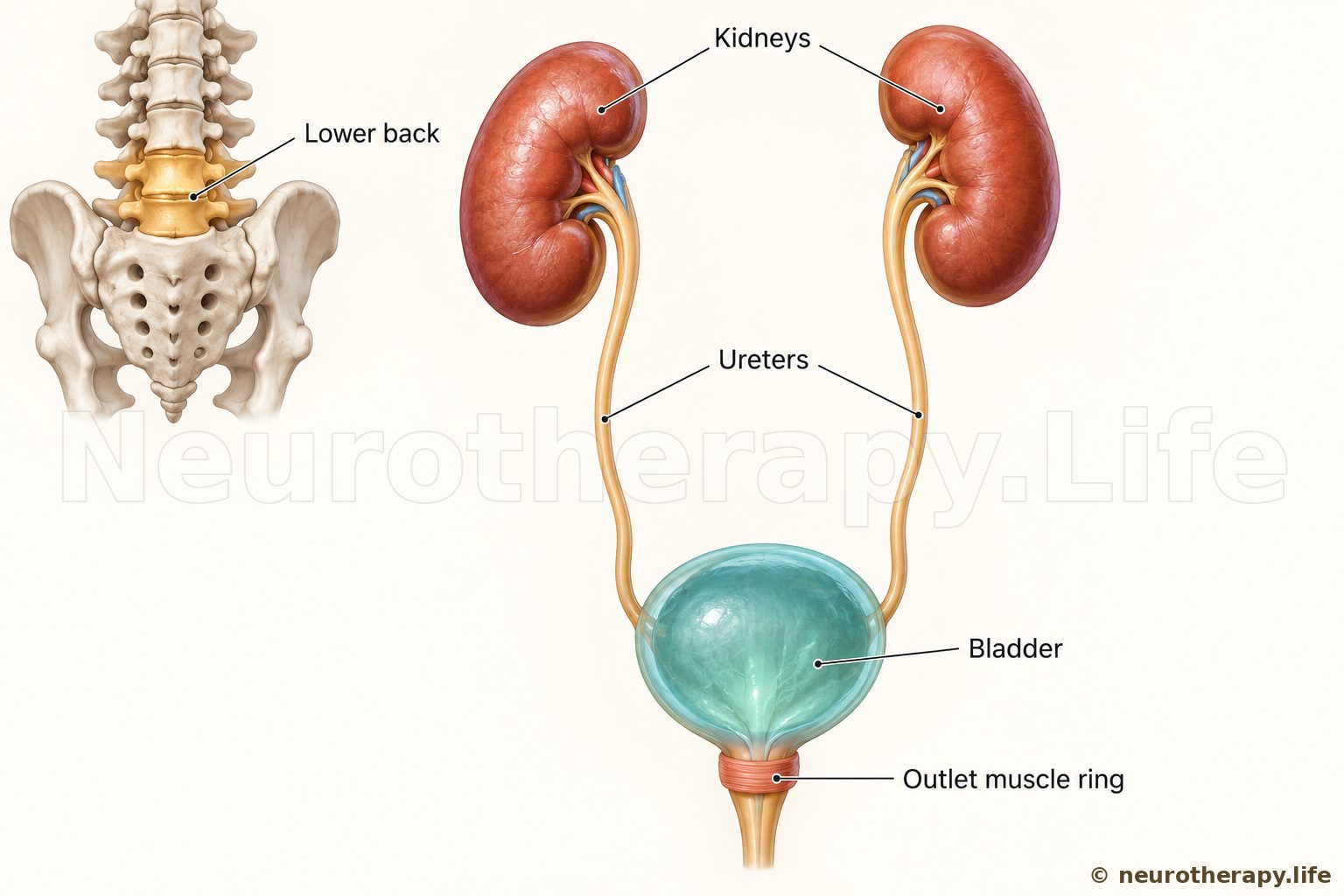
Control over urine depends on the ring of muscle around the urethra and the pelvic floor below it — the muscles this treatment aims to tighten.
What it is for
What is the incontinence treatment used for?
For urine that leaks with a sneeze, a cough or hard laughter — especially in middle-aged women.
To help narrow the opening for urine, which the teaching says the right-sided points do.
To help tighten the muscles around the pelvis — especially those of the anus and the urinary sphincter — so that control over urine returns.
Points it works through
Which points does the incontinence treatment work through?
(15) Right Medulla (6) Right Swt × 3 treatments + Piles triangle
The treatment works through three points: one at the neck, one on the back, and one at the base of the spine. They are listed here as a set, with what each contributes. The exact method is taught hands-on in the Neurotherapy (LMNT) course. This page lists the points of the formula and what each one contributes; it does not describe how any point is given. For the method, watch the demonstration video of each point on its own page and learn hands-on from a trained Neurotherapist. Please do not give a formula from a written description alone.
Around the sacrum at the base of the spine, face down. It tightens the muscles around the pelvis, especially the anal and urinary sphincters.
Position:Seated for the neck point; lying face down (prone) for the back and the base of the spine.
The exact technique is taught hands-on in the Neurotherapy (LMNT) course. See the course →
How it works
How does the incontinence treatment work?
In Neurotherapy (LMNT), the side a point is given on is part of what it does. The teaching's polarity rule says the left-sided Medulla-and-Swt pair opens or widens sphincters, while the right-sided pair narrows them. The same two points, opposite sides, opposite complaints.
So a narrow urinary sphincter with a forceful stream is given the left pair, and a slack one that leaks is given the right pair. The Triangle for Piles is then added to tighten the pelvic muscles themselves — the same muscles that hold back both stool and urine.
Body science agrees on one point: control over urine depends on the ring of muscle around the urethra and on the pelvic floor, and in women these often weaken with age and childbirth. Pelvic floor exercises taught by a physiotherapist are well proven, and fit well alongside this treatment.
Its family
Which formulas are related to the incontinence treatment?
It belongs to the polarity treatments of the Medulla family, where the side decides the effect.
(6) Right Swt — The right-sided Swt treatment that closes what is too open.
Complement System — Another formula from the same closing group of polarity and cranial-nerve treatments.
What it is used for
When is the incontinence treatment used?
It is used for leaking urine from a slack passage. It always works alongside medical care.
Bladder control
Urinary problemsUrine leaking with a sneeze, cough or hard laughter
Bed-wettingThe teaching calls incontinence the same picture as bed-wetting in children
Women's health
Uterine prolapseListed with incontinence among the women's problems the therapy works on; each has its own treatment
Safety: when it is held back
New loss of control of the bladder or bowel together with back pain, weakness, or numbness around the seat is an emergency. The session stops and the patient goes to hospital at once. How to tell a patient to see a doctor
Burning, pain, blood in the urine, fever, or leaking that started suddenly needs a doctor first, to look for infection or another cause. Urinary problems
The Triangle for Piles is not given to those who are passing little urine. Triangle for Piles
The side is the treatment. The left-sided pair does the opposite — it opens sphincters — so the sides are never swapped. This is one reason the treatment is given only by a trained therapist. Why a point for the right side is given on the left limb
(15) Medulla is not given while (2) Pan is being given for a tumour. (15) Medulla
For children who wet the bed, treatment is always light, and a doctor should first rule out infection, constipation or diabetes. Bed-wetting
Keep taking the medicines your doctor prescribed. Neurotherapy (LMNT) works alongside your medical care, never instead of it.
Common questions
Is leaking urine just a normal part of getting older?
It is common, especially in women after childbirth and in middle age, but it is not something you simply have to accept. Tell your doctor, and ask about pelvic floor exercises; this treatment can be used alongside.
Why does it matter which side is treated?
In this therapy, the left-sided pair opens and the right-sided pair closes. A leaking bladder needs closing, so the right side is used.
Will I need to undress?
The points are at the neck, the back and the base of the spine, given lying face down. Your therapist explains each area first, uses a covering cloth, and a chaperone can be present.
Surprising facts
1Pelvic floor training really works
A large review of trials found that women who did pelvic floor muscle training were far more likely to report improvement in stress incontinence than women who did not.
Source: Dumoulin C, Cacciari LP, Hay-Smith EJC. Pelvic floor muscle training versus no treatment, or inactive control treatments, for urinary incontinence in women. Cochrane Database Syst Rev. 2018;10:CD005654.
2Bladder control is run from the brainstem
A small 'micturition centre' in the pons of the brainstem coordinates the bladder squeezing and the sphincter relaxing at the same moment. The higher brain decides when it is allowed.
Source: Fowler CJ, Griffiths D, de Groat WC. The neural control of micturition. Nat Rev Neurosci. 2008;9(6):453–466.
3You have two urinary 'valves'
There is an inner sphincter you cannot control by will, and an outer one of muscle you can squeeze on purpose. Coughing and sneezing test the outer one most.
Source: Guyton & Hall, Textbook of Medical Physiology, 14th ed. — micturition; internal and external urethral sphincters.
Test yourself
Research
Strong evidence
This Cochrane review of randomised trials found that pelvic floor muscle training helps women with stress urinary incontinence — leaking with coughs, sneezes or effort — and recommends it as a first treatment.
This review explains how the brain, the brainstem and the spinal cord work together to store urine and release it — the nerve control behind bladder continence.
This page explains what a Neurotherapy (LMNT) treatment is for; it is not a self-treatment guide and does not diagnose. Neurotherapy (LMNT) works alongside your medical care — keep taking the medicines your doctor prescribed.
Ready to begin?
Send COURSE for course details, or your name, age and health issue for a consultation.