Also called: Triangle, The bed-wetting point, ट्रायंगल फॉर पाईल्स, बवासीर
Triangle for Piles is a face-down Neurotherapy (LMNT) treatment given across the triangle-shaped bone at the base of the spine, always pushing toward the head. It strengthens the pelvic muscles and tightens the sphincters, so it is used for piles, fissure, fistula, prolapse and bed-wetting — but never for someone who passes too little urine.
Overview
What is Triangle for Piles?
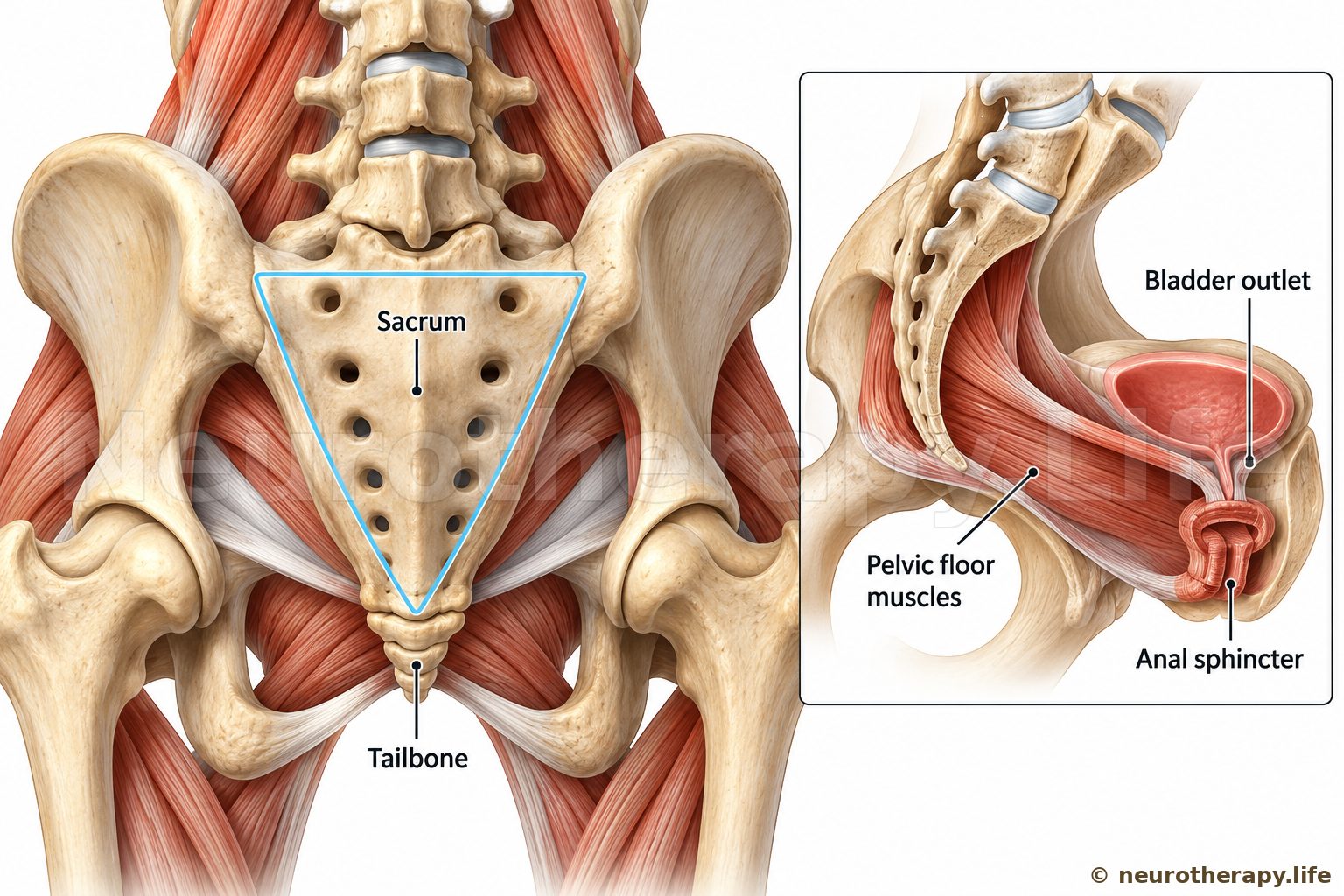
It takes its name twice over. It is given for piles — बवासीर, swollen cushions of blood vessels at the anus — and it is given across the triangle of the sacrum, the broad, triangular bone at the base of the spine.
In the source teaching, piles, anal fissure (a tear at the opening), fistula (a small abnormal tunnel near the anus) and prolapse of the rectum are one family. All four are diseases of acid, and one chief cause is hard constipation. They share one more thing: the flesh-muscles have become loose.
Triangle for Piles answers exactly that. It strengthens the muscles of the pelvis and tightens the sphincters — the ring muscles of the bladder, the uterus and the anal opening. That is why the same treatment helps a child who wets the bed and a woman whose uterus has slipped down.
The treatment works across the triangle of the sacrum, and is aimed at the pelvic muscles and sphincters below it.
Where it is given
Where is Triangle for Piles given?
PositionLying face down
Body areaThe sacrum, at the base of the spine
You lie face down with one and a half pillows under the chest — compulsory for every face-down treatment — so the head stays straight.
The work is over the sacrum, the flat triangular bone just above the cleft of the buttocks, from near the tailbone up to the top of the sacrum. The therapist stands beside you, carrying their weight on two chairs.
How it is given
How is Triangle for Piles given?
How this point is given — the tool, the pressure, the count and the exact movement — is deliberately not described here. A demonstration video for this point is being prepared; until it is on this page, learn the method hands-on from a trained Neurotherapist before giving it. Please do not give any point from a written description alone: a point given in the wrong place or the wrong way can do harm.
The number written before a point's name is not a strength setting. Each numbered form is a separate named treatment with its own method and timing, taught hands-on in the course.
Feels likeBeing lifted upward, not pushed into the floor
The exact technique is taught hands-on in the Neurotherapy (LMNT) course. See the course →
What it does
What does Triangle for Piles do?
In the source teaching, it strengthens the muscles of the pelvis and tightens the sphincters. From that come its uses:
Piles (बवासीर), anal fissure, fistula and prolapse of the rectum.
Control of urine in children who wet the bed, and in the elderly.
In women, prolapse of the uterus and excessive bleeding during menstruation.
Organs it reaches
Bowel — The anal canal and rectum, where piles form
Never to those who pass little urine. It tightens the sphincters — exactly what is not wanted where urine already comes with difficulty. Urinary problems
Bleeding from the back passage is investigated before any treatment of the sacrum — especially with a change in bowel habit or weight loss, and especially past fifty. How to tell a patient to see a doctor
It is a jerk treatment, so it is not used in pregnancy, nor on thin or fragile bones — osteoporosis, long-term steroids, or a bone that broke from a trivial knock. Osteoporosis
A raised number of rounds is written only for a day or two in very severe piles, and the card is then changed back.
A long-distance driver in his fifties came with piles that had been bleeding for months, and an unnoticed weight loss. Nothing was done at the sacrum until his bowel had been examined; his constipation work began at once. The examination found only large piles, and Triangle for Piles was then given with the push toward the head — once the chairs had been moved so that it no longer felt like being pushed into the floor. The bleeding stopped some weeks later.
A composite case written to teach the reasoning — not one patient’s file.
Common questions
Why is a piles treatment given on the back?
Because the aim is the pelvic muscles and sphincters, which are reached across the sacrum. The upward push is meant to lift and firm the tissues that have become loose.
Is it given for bed-wetting in children?
Yes — the same tightening of the sphincters is why it is used for children who wet the bed, always as light treatment.
I have bleeding with my stools. Can I just have this treatment?
Not first. Bleeding from the back passage must be checked by a doctor, especially with weight loss or a change in bowel habit. The constipation work can begin meanwhile.
Why does it matter which way the push goes?
Pushed toward the head it lifts and tightens; pushed toward the floor it becomes a different treatment with the opposite effect. That is why the chairs are set before the heels.
Surprising facts
1Everyone has 'piles' cushions
The cushions inside the anal canal are normal anatomy that help keep the passage closed. Piles are what happens when these cushions swell and slide down.
Source: Lohsiriwat V. Hemorrhoids: from basic pathophysiology to clinical management. World J Gastroenterol 2012;18(17):2009-17.
2Five bones fused into one
The sacrum begins as five separate vertebrae that fuse into a single triangular bone by early adulthood.
Source: Standring S (ed). Gray's Anatomy, 41st ed. Elsevier, 2016.
3Nerves through little windows
Rows of small openings in the sacrum let the sacral nerves pass to the buttock and forward to the bladder and bowel.
Source: Standring S (ed). Gray's Anatomy, 41st ed. Elsevier, 2016.
Test yourself
Research
Strong evidence
A review of haemorrhoids: they are the swelling and downward slide of the normal anal cushions, which help keep the anus closed. It explains why straining and constipation matter so much.
This page explains what a Neurotherapy (LMNT) treatment is for; it is not a self-treatment guide and does not diagnose. Neurotherapy (LMNT) works alongside your medical care — keep taking the medicines your doctor prescribed.
Ready to begin?
Send COURSE for course details, or your name, age and health issue for a consultation.