Also called: Prolapse Point, P. point, प्रोलैप्स पॉइंट
P point is the Neurotherapy (LMNT) treatment for women whose womb has moved down from its place, as shown on a sonography report. It is given on the middle of both thighs and is always followed at once by (6) WD — the two are one instruction and are never separated.
Overview
What is P point?
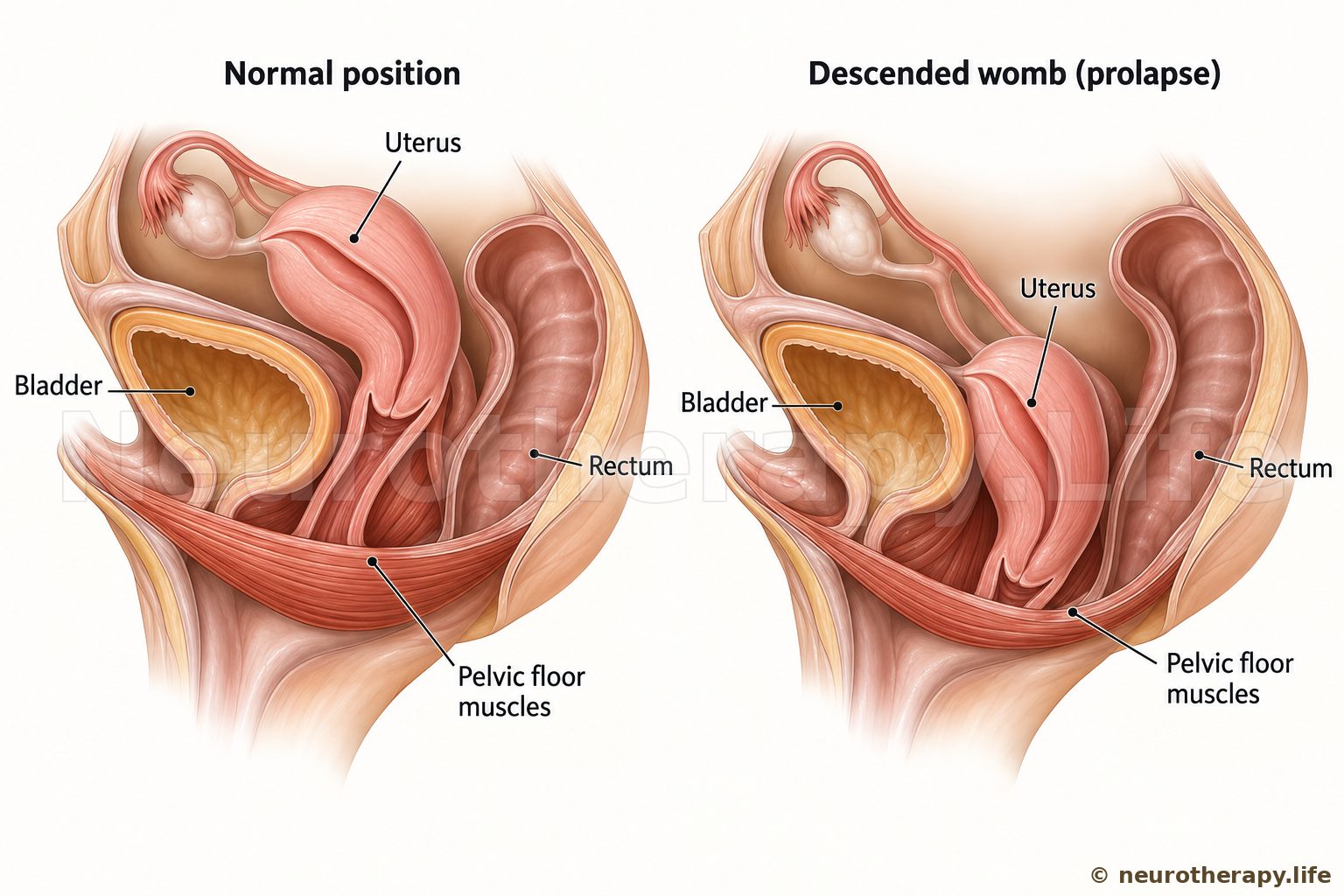
P stands for prolapse. In medicine, a prolapse of the uterus means the womb has slipped down from its normal place into the vagina, because the muscles and ligaments of the pelvic floor — the hammock of muscle at the base of the pelvis — have become loose.
Neurotherapy (LMNT) defines prolapse broadly: any organ shifting from its place because the muscles have stayed loose. It classes prolapse as a sign of acidosis (too much acid in the body), in the same family as constipation and piles.
P point is given only to women in whom sonography shows the womb has moved. The teaching describes it as first loosening the uterine muscles further, which is why (6) WD must follow immediately to set the womb back. P point alone is half a treatment.
Do not confuse it with Thrd 'P' (a thyroid point) or Ton 'P' (a parotid point). They share a letter and nothing else.
In a uterine prolapse the womb sits lower because the pelvic floor has become slack.
Where it is given
Where is P point given?
PositionLying on the back
Body areaThe muscles of the middle part of both thighs
The woman lies on the mat with both thighs within the therapist's reach. P point is given on the muscles of the middle part of the thigh, on each thigh in turn.
As with many Neurotherapy (LMNT) points, the place of treatment is far from the organ it is meant to help. Nothing presses on the belly or the pelvis.
How it is given
How is P point given?
How this point is given — the tool, the pressure, the count and the exact movement — is deliberately not described here. A demonstration video for this point is being prepared; until it is on this page, learn the method hands-on from a trained Neurotherapist before giving it. Please do not give any point from a written description alone: a point given in the wrong place or the wrong way can do harm.
Always followed by(6) WD, immediately
The exact technique is taught hands-on in the Neurotherapy (LMNT) course. See the course →
What it does
What does P point do in the body?
The teaching describes P point and (6) WD as two halves of one action: P point loosens the uterine muscles further, and WD, which increases the flow of blood in the uterus, lets the descended womb set back into its own place. This is the therapy's own explanation from clinical experience; whether a womb has gone back is something only a medical examination can decide.
For women whose womb has moved from its place, shown on sonography.
Used with the four symptoms the teaching links to prolapse: severe pain below the navel and in the back, white discharge, irregular periods, and difficulty conceiving.
The teaching holds that, with (6) WD following, the need for an operation can be avoided — a decision that stays with the woman's gynaecologist.
Organs it reaches
Uterus (womb) — The organ that descends in prolapse — what P point and (6) WD aim to set back.
Muscles — The pelvic floor muscles whose slackness lets the womb descend.
Bladder — Often affected by the same slack floor: leaking or difficulty passing urine.
Its family
Which points go with P point?
P point has one partner it can never be without, and several neighbours used for the same complaint.
WD — Its compulsory partner: (6) WD follows P point immediately, every time.
Ton 'P' — Called unmatched for setting a prolapsed womb back — but never given to a woman who still wishes to have children.
Triangle for Piles — Strengthens the pelvic muscles and tightens the sphincters of bladder, uterus and anus.
Thrd 'P' — Not related — a thyroid point that only shares the letter P.
What it is used for
What is P point used for?
P point has one use, and its indication includes the evidence: a sonography showing the prolapse.
The descended womb
Uterine prolapseProlapse of the uterus shown on sonography — always with (6) WD after it.
InfertilityNamed with prolapse in the teaching; the couple stays under their doctor's care.
Safety: when it is held back
P point is never given alone: (6) WD must follow immediately, or the woman can be left with still more trouble. WD
Only where sonography has shown the prolapse. The report is part of the indication. Uterine prolapse
Not in pregnancy or in the weeks after a birth; not after recent abdominal, pelvic or hip surgery; not in fragile bones (frail elders, long-term steroids, osteoporosis); not in anyone on blood-thinning medicine. Pregnancy care
Send to a doctor, do not treat: bleeding after the menopause; any bleeding with a new or worsening descent; a protruding part that is ulcerated or bleeding; difficulty passing urine or repeated urine infections; pelvic pain with fever. How to tell a patient to see a doctor
Treat alongside the gynaecologist's plan, never in place of the appointment. Only an examination can say whether the womb has moved back.
No treatment during the first four days of the period, except in the named exceptions; consent and a chaperone are part of every women's treatment. Consent, dignity and a chaperone during treatment
A teaching case
Teaching case: the date for an operation
A teaching case, put together from several patients: a woman in her late thirties came with a descended womb and a surgery date weeks away. The therapist found three loads behind it — a long cough, daily straining at stool and lifting heavy sacks — and gave P point with (6) WD alongside digestive work and plain advice on lifting. Her dragging feeling eased over the weeks, and at review her gynaecologist chose a support ring and pelvic floor exercises and postponed the operation; the therapist told her plainly that it was a postponement, not a cure.
A composite case written to teach the reasoning — not one patient’s file.
Common questions
Will P point mean I do not need an operation?
The teaching holds that with (6) WD the need for an operation can be avoided, and many prolapses are managed without surgery. But only your gynaecologist's examination can say what has changed. Keep your appointments.
Why do I need a sonography report first?
Because the indication itself says P point is for women in whom sonography shows the prolapse. Other conditions can feel similar.
Can I have P point while pregnant?
No — not in pregnancy, and not in the weeks after giving birth.
What else can I do at home?
Ease the loads on the pelvic floor: get a long cough seen, avoid straining at stool, and lift heavy things the right way or not at all. These often matter as much as any treatment.
Surprising facts
1Very common, often silent
Some degree of pelvic organ prolapse is found on examination in a large share of women who have had children, though many never notice symptoms.
Source: Standard gynaecology teaching on pelvic organ prolapse prevalence (e.g. NICE guideline NG123, Urinary incontinence and pelvic organ prolapse in women).
2Not every prolapse needs surgery
Guidelines offer pelvic floor muscle training and supportive pessaries (rings) as first options for many women before any operation.
Source: NICE guideline NG123 (2019), Urinary incontinence and pelvic organ prolapse in women: management.
3Coughing and lifting count
Long-term coughing, constipation with straining and repeated heavy lifting all raise pressure inside the abdomen and are known risk factors for prolapse.
Source: Standard gynaecology teaching on risk factors for pelvic organ prolapse (raised intra-abdominal pressure).
This page explains what a Neurotherapy (LMNT) treatment is for; it is not a self-treatment guide and does not diagnose. Neurotherapy (LMNT) works alongside your medical care — keep taking the medicines your doctor prescribed.
Ready to begin?
Send COURSE for course details, or your name, age and health issue for a consultation.