Ton 'T' is the Neurotherapy (LMNT) rubbing treatment over the cheek and the side of the neck that stimulates the tonsils. It is given for tonsil infection and a sore throat, it is always followed at once by the Sangam points, and it is held back in diabetes, autoimmune disease, inflammation, pregnancy and the growing years.
Overview
What is Ton 'T'?
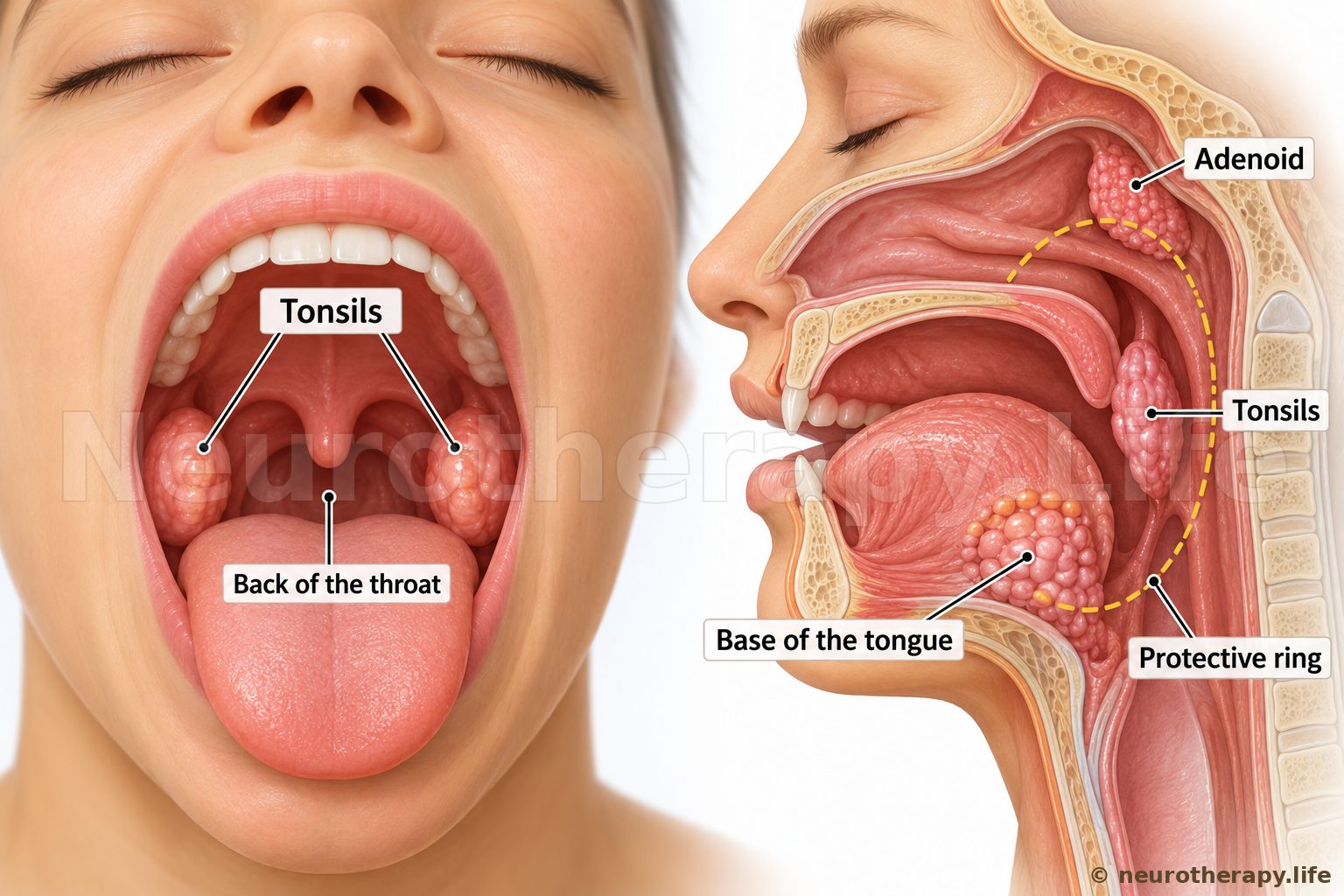
The 'T' stands for tonsils. The tonsils are two soft, almond-shaped patches of defence tissue at the back of the throat, one on each side. They are among the first guards to meet germs that are breathed in or swallowed.
Ton 'T' is the twin of Ton 'P'. Both are the same three rubs at the same three places on the cheek and neck; only the counts are exchanged. In the source teaching, Ton 'T' is given for tonsil infection, and it is also beneficial for trouble or soreness in the throat.
Ton 'T' is one of the therapy's inseparable pairs: it is always followed at once by the Sangam points. Given without them, it is not a smaller treatment — it is an incomplete one.
The tonsils guard the entrance to the throat. Ton 'T' is named for them.
Where it is given
Where is Ton 'T' given?
PositionSitting
Body areaCheek, below the cheek, and the side of the neck — both sides
No fixed position is written; you are placed so that the face and the side of the neck can be reached comfortably, usually sitting.
The same three places as Ton 'P', on each side: the cheek in front of the ear, below the cheek from the chin toward behind the ear, and the side of the neck where it meets the shoulder. The front of the throat is never pressed.
How it is given
How is Ton 'T' given?
How this point is given — the tool, the pressure, the count and the exact movement — is deliberately not described here. A demonstration video for this point is being prepared; until it is on this page, learn the method hands-on from a trained Neurotherapist before giving it. Please do not give any point from a written description alone: a point given in the wrong place or the wrong way can do harm.
Always followed byThe Sangam points, at once
NeverOn the front of the throat
TwinTon 'P' — same places, different counts
The exact technique is taught hands-on in the Neurotherapy (LMNT) course. See the course →
What it does
What does Ton 'T' do?
In the source teaching, Ton 'T':
Stimulates the tonsil glands in the neck.
Is given for tonsil infection.
Is beneficial for trouble in the throat, or soreness of the throat.
Organs it reaches
Lymph nodes — The tonsils are lymph tissue, part of the same defence network
Not in diabetes, rheumatoid arthritis, any autoimmune disorder, inflammation, or kidney disorders. Autoimmune disorders
Not in pregnancy, and not in the teenage years or to young people up to child-bearing age, especially women — it is thought to have some relation with infertility. Teenage years (care for teenagers)
Keep every stroke to the side and back of the neck. A hard, fixed, painless lump in the neck is investigated, not rubbed.
A badly inflamed throat with high fever, drooling, a muffled voice, or difficulty opening the mouth or swallowing needs a doctor the same day. How to tell a patient to see a doctor
Because the two are written as one instruction. The therapy treats them as an inseparable pair, so a therapist who stops after Ton 'T' has given an incomplete treatment.
Does Ton 'T' carry the same rule about having children as Ton 'P'?
At its own entry it does not, but it is named with Ton 'P' in the pregnancy list and the teenage list, so it is not given in pregnancy or to young people up to child-bearing age.
Can a child with tonsillitis have it?
Children get light treatment, and the growing years carry bars on this point. A child with a high fever, drooling or trouble swallowing must see a doctor first.
Surprising facts
1A ring of guards
The tonsils belong to Waldeyer's ring — a circle of defence tissue around the top of the throat that also includes the adenoid and the tonsil at the base of the tongue.
Source: Masters KG, Lasrado S. Anatomy, Head and Neck: Tonsils. StatPearls (NCBI), 2025.
2Busiest in childhood
The tonsils are most active between about 4 and 12 years of age, reach full size around puberty, and then slowly shrink.
Source: Masters KG, Lasrado S. Anatomy, Head and Neck: Tonsils. StatPearls (NCBI), 2025.
3Pockets that sample germs
The surface of the tonsils is folded into deep pits called crypts, where special cells catch germs and show them to the immune cells inside.
Source: Masters KG, Lasrado S. Anatomy, Head and Neck: Tonsils. StatPearls (NCBI), 2025.
Test yourself
Research
Strong evidence
A clinical anatomy reference on the tonsils: they form part of Waldeyer's ring, start the first immune response to breathed-in or swallowed germs, are most active in childhood and shrink after puberty.
This page explains what a Neurotherapy (LMNT) treatment is for; it is not a self-treatment guide and does not diagnose. Neurotherapy (LMNT) works alongside your medical care — keep taking the medicines your doctor prescribed.
Ready to begin?
Send COURSE for course details, or your name, age and health issue for a consultation.