Also called: Sangam, Sangam point, संगम, संगम पॉइंट
Sangam Points are three gentle places on the arm, hand and foot that are always given straight after Ton 'T', the throat-gland treatment. They are also used in cough and in any problem of the throat, and because they carry no jerk they stay open to frail patients.
Overview
What are the Sangam Points?
Sangam is the old Hindi word for a confluence — the place where rivers meet, like Prayag, where the Ganga and the Yamuna join. Neurotherapy (LMNT) gives this name to a treatment made of three places on the limbs.
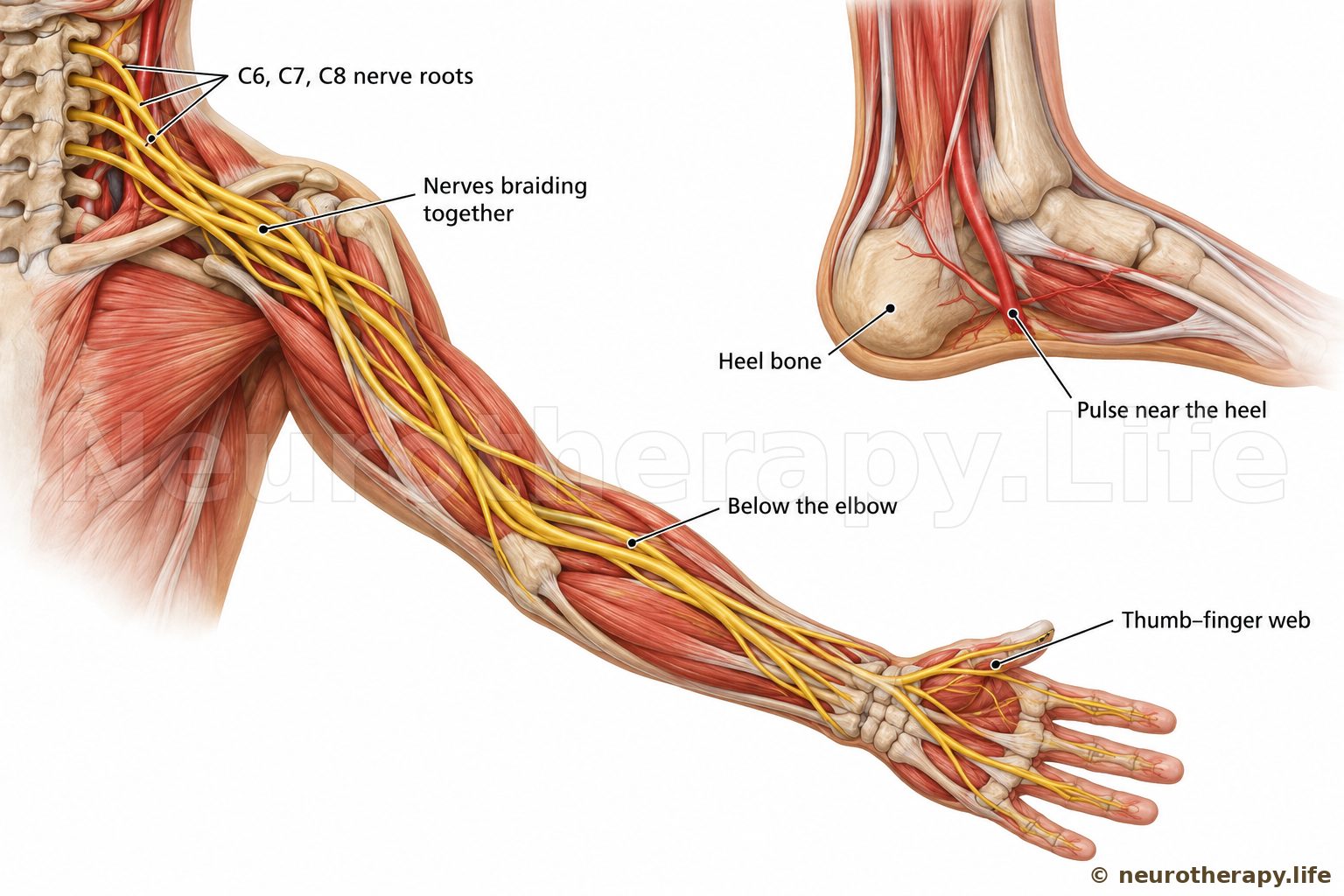
The first place is a little below the elbow, where the teaching says the C6, C7 and C8 nerves come together. These are nerves that leave the spinal cord in the lower neck and travel down the arm into the hand. A nerve network like this really is a confluence: separate streams from separate levels of the spine, braided together and shared out again.
The second place is the web between the thumb and the first finger. The third is just below the heel bone, at the spot where the pulse can be felt beating. Together they form the treatment that must always follow Ton 'T', and they are also useful in cough and in throat problems.
Sangam means confluence: nerves from the lower neck meet and braid together on their way into the arm and hand.
Where it is given
Where are the Sangam Points given?
PositionSitting
Body areaForearm just below the elbow; the thumb–first-finger web; just below the heel bone where the pulse beats
No fixed position is laid down. The patient is placed so that the forearm, the hand and the heel can all be reached comfortably — usually as they already are after Ton 'T'.
The three areas are: the forearm a little below the elbow joint; the web between the thumb and the first finger; and just below the heel bone, where the pulse beats.
How it is given
How are the Sangam Points given?
How this point is given — the tool, the pressure, the count and the exact movement — is deliberately not described here. A demonstration video for this point is being prepared; until it is on this page, learn the method hands-on from a trained Neurotherapist before giving it. Please do not give any point from a written description alone: a point given in the wrong place or the wrong way can do harm.
Comes afterTon 'T', always and immediately
The exact technique is taught hands-on in the Neurotherapy (LMNT) course. See the course →
What it does
What do the Sangam Points do?
The teaching gives Sangam two jobs: to complete Ton 'T', and to help in cough and in any problem of the throat. The nerves of the lower neck and arm and the pulse near the heel are real anatomy; how pressure at these places helps the throat is the therapy's own explanation, offered from clinical experience.
Completes Ton 'T', the treatment for the tonsil glands in the neck — without it, Ton 'T' counts as incomplete.
Is useful in cough.
Is useful in any problem of the throat, such as soreness.
Organs it reaches
Neck — The C6–C8 nerves begin in the lower neck; the throat glands Ton 'T' works on lie here too.
Spinal cord — Where the three nerve streams of the 'confluence' start.
Blood vessels — The third place sits where a pulse can be felt near the heel — a check of the foot's blood supply.
Lymph nodes — The tonsils are part of the body's lymph tissue, the defence system Ton 'T' supports.
Its family
Which points go with Sangam?
Sangam belongs to one of the few pairs in Neurotherapy (LMNT) that are never separated.
Ton 'T' — The tonsil-gland treatment that Sangam must always follow.
Ton 'P' — The parotid-gland sister of Ton 'T' — same places, different emphasis, its own restriction.
P point — Another never-separated pair: P point is always followed by (6) WD.
Ankle Point — Another gentle, no-jerk point at the ankle from the same group of problem-based treatments.
What it is used for
What are the Sangam Points used for?
Sangam is mostly given as the second half of Ton 'T'. On its own merit, it is useful in cough and throat trouble.
Because Sangam follows Ton 'T', check Ton 'T''s own bars first: it is not given in diabetes, rheumatoid arthritis, autoimmune disorders or inflammation. Ton 'T'
Feel for the pulse near the heel. In a person with diabetes, a foot where no pulse can be felt is sent to a doctor, not treated. Gangrene
A badly inflamed throat with high fever, drooling, a muffled voice, difficulty opening the mouth or difficulty swallowing needs a doctor the same day. A hard, fixed, painless lump in the neck is investigated, not treated. How to tell a patient to see a doctor
“This treatment is given after Ton 'T'. All these points are also useful in cough, or in any problem of the throat.”
— Dr. Lajpatrai Mehra
Common questions
Why is it called Sangam?
Sangam means the meeting place of rivers. Below the elbow, nerves from three levels of the lower neck come together on their way into the hand — a confluence of nerves.
Can Sangam be given without Ton 'T'?
Yes — it is useful in its own right for cough and throat trouble. What may never happen is the reverse: Ton 'T' given without Sangam after it.
My mother has thin bones. Is Sangam safe for her?
Sangam carries no jerk, and it is among the treatments that stay open to frail patients. Her therapist will still check her whole card first.
Why does the therapist feel my pulse near the heel?
The third Sangam place is where that pulse beats. Finding it also tells the therapist that blood is reaching your foot — important in diabetes.
Surprising facts
1A real nerve 'confluence'
The nerves of the arm come from a network called the brachial plexus, formed by nerve roots C5 to T1. They split, merge and re-sort before reaching the hand — very like rivers meeting and parting.
Doctors check the pulses of the foot, including the one near the inner ankle and heel, at every diabetic foot examination. A missing pulse can be an early sign of blocked leg arteries.
Source: American Diabetes Association, Standards of Care in Diabetes — Retinopathy, Neuropathy and Foot Care.
3Tonsils are guards at the gate
The tonsils are lumps of lymph tissue at the back of the throat. They sample germs coming in through the mouth and nose and help train the body's defences.
Source: Guyton & Hall, Textbook of Medical Physiology, 14th ed.; NHS, Tonsillitis.
This page explains what a Neurotherapy (LMNT) treatment is for; it is not a self-treatment guide and does not diagnose. Neurotherapy (LMNT) works alongside your medical care — keep taking the medicines your doctor prescribed.
Ready to begin?
Send COURSE for course details, or your name, age and health issue for a consultation.