Vasanti is a very gentle Neurotherapy (LMNT) treatment for numbness in the limbs, especially in people with diabetes. With the soft middle of the sole, the therapist strokes the legs very softly upward, towards the body — and the hands too, when the numbness is there. Its softness is the whole of its safety.
Overview
What is Vasanti?
Vasanti is named after a person — the patient in whose case this treatment was first worked out. Like Shukla, Giriraj and Pradeep, the name is a receipt: it records where the treatment came from and whom to thank.
It is a physical treatment, not a chemical point for a gland. It works over the long nerves and the muscles of the legs and, when needed, the arms. Its purpose is narrow and clear: to help remove numbness in the limbs, especially in diabetic patients.
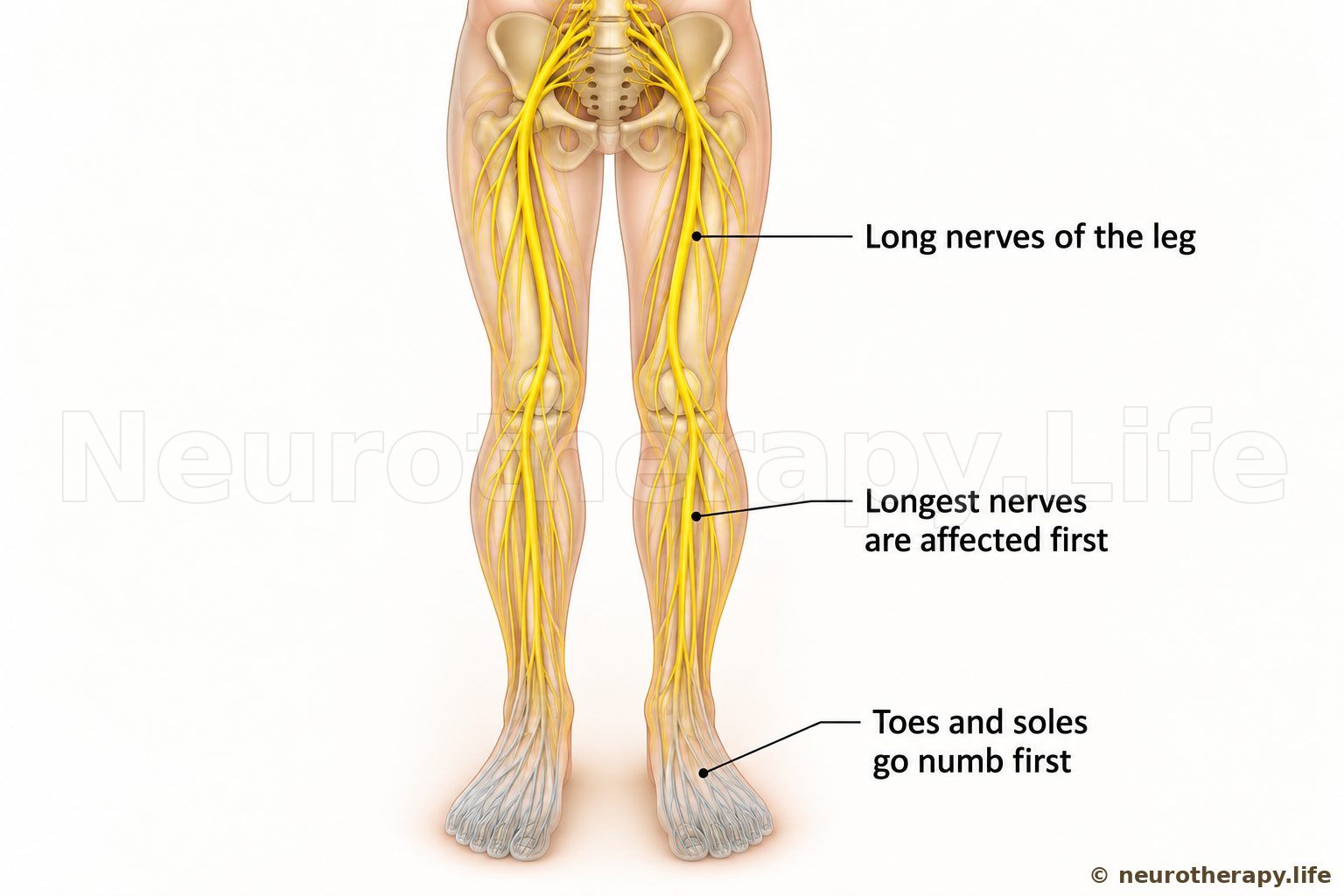
In long-standing diabetes the nerves of the feet can slowly die back, starting with the longest nerves, so the toes and soles go numb first. A foot that cannot feel cannot warn you when it is being hurt. That is why Vasanti is written to be given very softly — the patients it is meant for are the ones least able to say that a touch is too hard.
In diabetes the longest nerves suffer first, so numbness usually begins in the toes and soles.
Where it is given
Where is Vasanti given?
PositionLying on the back
Body areaBoth sides of each leg from heel to knee, the back of the calf, and — for numb hands — fingers to elbow
It is given in two positions. First you lie straight on your back, and the therapist stands between your legs; the work runs over both sides of each leg, from the heel up to the knee. Then you turn to lie face down, and the back of the calf is worked from below upward.
If the numbness is in the hands, the same soft work is given from the fingers up to the elbow. The direction is always towards the body — heel to knee, fingers to elbow.
How it is given
How is Vasanti given?
How this point is given — the tool, the pressure, the count and the exact movement — is deliberately not described here. A demonstration video for this point is being prepared; until it is on this page, learn the method hands-on from a trained Neurotherapist before giving it. Please do not give any point from a written description alone: a point given in the wrong place or the wrong way can do harm.
The exact technique is taught hands-on in the Neurotherapy (LMNT) course. See the course →
What it does
What does Vasanti do?
The teaching names one purpose for Vasanti, and names it plainly. How a soft stroke helps numb limbs is the therapy's own clinical observation; that diabetic numbness comes from damaged long nerves is textbook medicine.
Especially beneficial for removing numbness in the limbs in diabetic patients.
Given to the hands as well, from the fingers to the elbow, where the numbness is in the hands.
Carries no jerk and no weight, so it stays open to many patients who are blocked from heavier treatments — the elderly, and those with thin bones.
Organs it reaches
Muscles — The calf and leg muscles under the stroke, which also help pump blood back up the leg.
Blood vessels — The vessels of the leg, which carry blood to and from the feet.
OsteoporosisUnlike Shukla or the jerk treatments, Vasanti stays open to patients with thin bones.
Safety: when it is held back
Very softly, always. Numbness is not an invitation to press harder — a foot that cannot feel cannot tell you it is being hurt. Never body weight, never prolonged.
Check the feeling, do not just ask about it: with the patient's eyes closed, touch the sole lightly in a few places and ask where. Where feeling is reduced, light contact only.
Look at the skin of the feet before and after. Any blister, crack, ulcer, red patch, new hard place, or a hot swollen foot is referred to a doctor the same day, not treated. A foot ulcer outranks every point on the chart. How to tell a patient to see a doctor
Never work a calf that is swollen, warm and tender on one side only — it can be a blood clot. That finding ends the session and goes to a doctor. Thrombosis (blood clots)
Diabetic patients keep taking their diabetes medicines and keep their doctor's foot checks. Vasanti works alongside medical care, never instead of it. Diabetes
“This is especially beneficial for removing numbness in the limbs in diabetic patients.”
— Dr. Lajpatrai Mehra
Common questions
Why is Vasanti so gentle? Wouldn't firmer pressure work better on a numb leg?
No. A numb foot cannot feel when pressure is too much, and pain is what normally warns us before tissue is harmed. The softness is the safety of the treatment.
Who is Vasanti named after?
After the person in whose case the treatment was first found. Several treatments in this therapy carry such names, as a mark of thanks.
My hands are numb, not my feet. Can Vasanti help?
The teaching gives a form for the hands too, worked softly from the fingers up to the elbow. Numb hands also need a doctor's check for the cause.
I have thin bones. Is Vasanti safe for me?
Vasanti carries no jerk and no weight, and the teaching keeps it open for patients with thin bones — unlike some heavier treatments, which are closed to them.
Surprising facts
1Numbness starts at the far ends
Diabetic nerve damage usually affects the longest nerves first, so it begins in the toes and feet and slowly climbs — a 'stocking' pattern — before it reaches the hands.
Source: Pop-Busui R et al., Diabetic Neuropathy: A Position Statement by the American Diabetes Association, Diabetes Care 2017;40(1):136–154.
2Very common in diabetes
Nerve damage of this kind is one of the most common complications of diabetes; up to about half of people with long-standing diabetes develop it.
Source: Pop-Busui R et al., Diabetes Care 2017;40(1):136–154.
3Your calf is a second heart
Every time the calf muscles tighten, they squeeze the deep veins and push blood back up towards the heart; one-way valves stop it falling back.
Source: Guyton & Hall, Textbook of Medical Physiology, 14th ed. — the venous pump.
This page explains what a Neurotherapy (LMNT) treatment is for; it is not a self-treatment guide and does not diagnose. Neurotherapy (LMNT) works alongside your medical care — keep taking the medicines your doctor prescribed.
Ready to begin?
Send COURSE for course details, or your name, age and health issue for a consultation.