Also called: Feather touch, फ़ेदर टच, मोरपंख स्पर्श
Feather Touch is the lightest treatment in Neurotherapy (LMNT): the fingertips stroke the body as softly as a peacock's feather. It is used to send impulses through the whole body in paralysis, stiffness, pain and diseases of the brain — and it is the one treatment that stays open when almost everything else is closed.
Overview
What is Feather Touch?
Most Neurotherapy (LMNT) points use the weight of a foot or the firm press of a thumb. Feather Touch uses almost nothing: only the tips of the fingers, stroking the needed part of the body with a touch as soft as a peacock's feather. Its stated purpose is to send impulses — nerve messages — through the whole body.
That lightness is what makes it precious. There is no weight, no jerk, no position that must be held, and no bone under a heel. A newborn, a woman in the last weeks of pregnancy, a person whose bones break from a knock, a patient in the first days after a stroke, a child who will not be handled, someone in too much pain to bear a palm — for each of them most treatments are closed, and Feather Touch stays open.
It is also the plainest lesson that the therapist's own state matters. Guruji taught that hurry, irritation and ill-will travel down an arm as surely as pressure does — and that the touch should be given calmly, with the wish that the patient gets well.
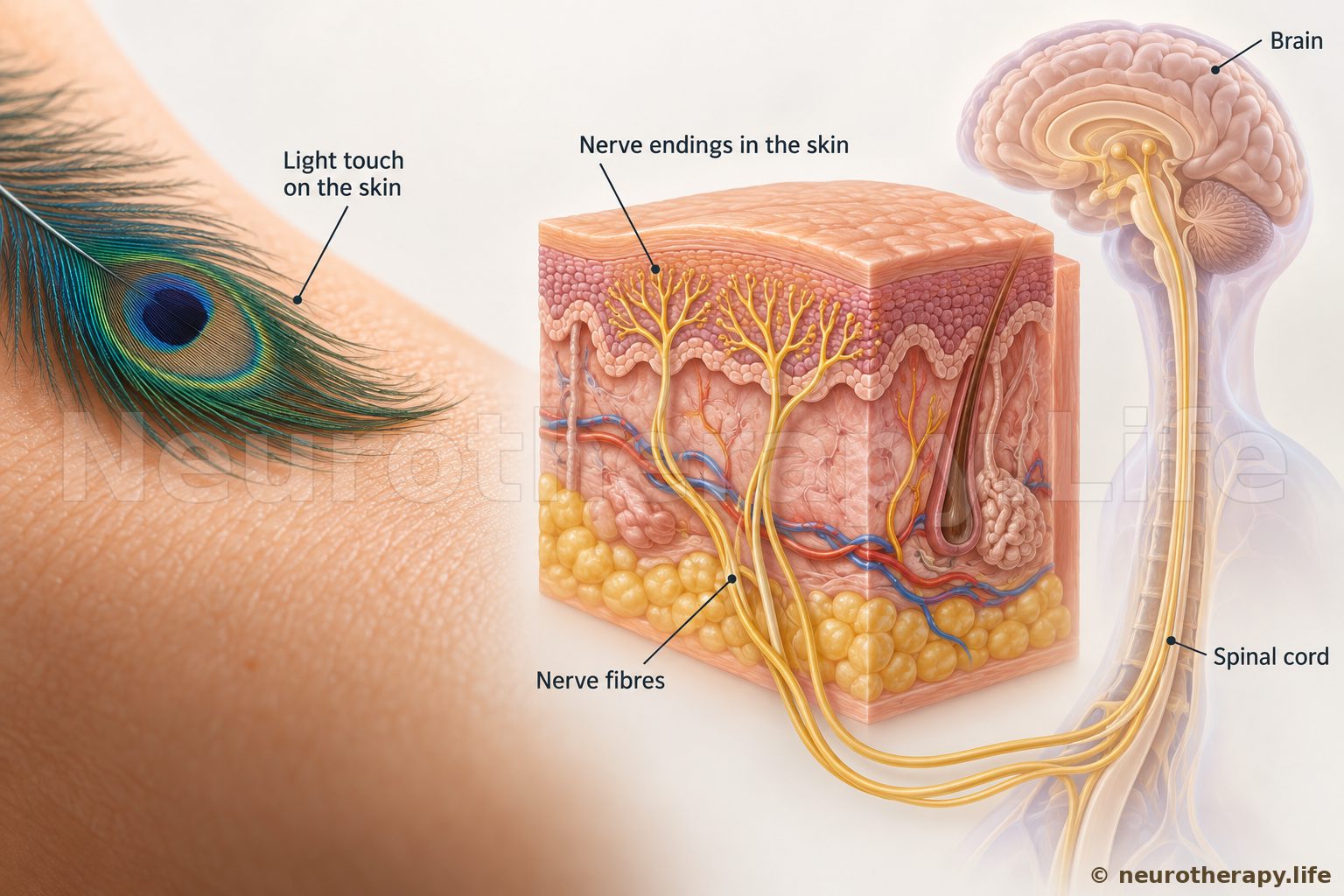
Even the lightest touch is picked up by nerve endings in the skin and carried to the spinal cord and brain.
Where it is given
Where is Feather Touch given?
PositionSitting
Body areaAny part of the body that needs it — in the full form, face, arms, chest, back and legs
Feather Touch can be given in any position the patient can manage. In its full form the patient usually sits on a stool, or stands if they prefer; a person who cannot sit or stand is treated lying down.
It is given on whatever part of the body needs it. The full route begins at the forehead and face and travels over the arms, the chest, the back and the legs, so that no place is left out.
How it is given
How is Feather Touch given?
How this point is given — the tool, the pressure, the count and the exact movement — is deliberately not described here. A demonstration video for this point is being prepared; until it is on this page, learn the method hands-on from a trained Neurotherapist before giving it. Please do not give any point from a written description alone: a point given in the wrong place or the wrong way can do harm.
The exact technique is taught hands-on in the Neurotherapy (LMNT) course. See the course →
What it does
What does Feather Touch do?
The source says it is given for sending impulses through the whole body, and that it is very beneficial in paralysis, stiffness, pains and all diseases of the brain. In Guruji's own account, the muscles relax deeply under it. These are clinical observations of the therapy; body science confirms that even the lightest touch is carried by its own nerve fibres to the brain.
Sends a gentle stream of touch signals through the skin to the spinal cord and brain.
Used in paralysis, stiffness and pain, and in diseases of the brain.
Used for the patient who can be given nothing else — the newborn, the frail, late pregnancy, brittle bones, the first days after a stroke.
Helps tense muscles let go, so other treatments given before or after it can work better.
Organs it reaches
Skin — Packed with nerve endings that pick up even a feather's touch.
Brain — Where touch signals arrive — the target of its use in brain disease.
Muscles — Stiff and tense muscles are meant to relax under it.
Spinal cord — Carries the touch signals up to the brain.
Its family
Which points go with it?
Feather Touch is a physical treatment from the group for uncommon problems, and in paralysis it is given alongside the other paralysis points.
Paralysis Clockwise — A paralysis treatment for the limbs, given with it in paralysis.
Opposite Point — Another paralysis point from the same group.
Shukla — A related point from the same group of uncommon problems.
Bending Forward — Given before or after Feather Touch when there is back pain.
Standing Point — Also given with it when there is back pain.
What it is used for
What is Feather Touch used for?
Its uses come from its own entry, and from its lightness: it can reach patients no other point can.
Brain and nerves
Paralysis and strokeParalysis, including the first days after a stroke, when firmer work at the neck is not allowed.
OsteoporosisBones so thin that they break from a knock.
Safety: when it is held back
Inflammatory disease: do not stroke the thymus area on the chest, nor the upper back from T1 to T6 — the thymus could be provoked. The rest of the route is given as usual. Inflammation
Feather Touch is never pressed harder 'to do something'. If the powder moves, the touch is too heavy.
A treatment is not the whole plan: whatever other treatments the patient needs are given before and after it.
A new stroke, or a passing weakness, numbness or loss of vision, is an emergency for a hospital first. Feather Touch works alongside medical care, never instead of it. How to tell a patient to see a doctor
“Just as, from the mere smell of a bhajiyā — or merely on hearing its name — water comes into the mouth, that is, the body begins to do its own work: this is the very logic of the Feather touch treatment.”
— Dr. Lajpatrai Mehra
“Do not hold a feeling of enmity towards anyone!”
— Dr. Lajpatrai Mehra
A teaching case
How Feather Touch was found
The therapy's recorded account: in 2007, at a Delhi airport gate, Guruji met an elderly woman in a wheelchair who could not walk a step because of her pains. With very little time, he spoke words of comfort and passed his soft fingers once down her cheek; she said her pain felt a little less and asked for it again, and after the second stroke she rose slowly and stood. Guruji was as surprised as anyone — and the treatment was then tried on many patients in different ways, and studied for months, before it was taught.
A composite case written to teach the reasoning — not one patient’s file.
Common questions
Can such a light touch really do anything?
Your skin has nerve fibres made for slow, gentle stroking, and they carry it to the brain. Patients have reported relief and relaxation with Feather Touch; it is given alongside, not instead of, medical care.
Why is powder put on my face?
It is a pressure check for the therapist. The touch must be so light that the powder is not wiped away.
Can it be given during pregnancy or to a newborn?
It is the one treatment that stays open for them, because there is no weight or pressure. It is still given only by a trained therapist, alongside the mother's and baby's medical care.
Why must my hands be loose?
Stiff, straight fingers are not relaxed fingers, and the full benefit does not come. Let your hands lie as loose as a sleeping child's.
Surprising facts
1Nerves made for stroking
Hairy skin contains slow nerve fibres called C-tactile afferents. They respond best to slow, gentle stroking at about the speed of a caress, and the brain reads their signals as pleasant.
Source: Löken LS et al., Coding of pleasant touch by unmyelinated afferents in humans, Nat Neurosci 2009;12:547–548.
2Your fingertips are sensitive
The fingertips are among the most densely nerve-supplied skin of the body, packed with touch receptors — which is why they are the right tool for the lightest treatment.
Source: Johansson RS, Vallbo ÅB, Tactile sensibility in the human hand, J Physiol 1979;286:283–300.
3The touch-sensitive plant
The lājvantī plant Guruji spoke of is Mimosa pudica, the 'touch-me-not', whose leaves fold within seconds when touched.
Source: Taiz L, Zeiger E, Plant Physiology and Development, 6th ed., Sinauer 2015 — nastic movements.
This page explains what a Neurotherapy (LMNT) treatment is for; it is not a self-treatment guide and does not diagnose. Neurotherapy (LMNT) works alongside your medical care — keep taking the medicines your doctor prescribed.
Ready to begin?
Send COURSE for course details, or your name, age and health issue for a consultation.