1The strongest tendon
The Achilles tendon, which joins the calf to the heel, is the thickest and strongest tendon in the body.
Source: Standard anatomy: Gray's Anatomy (41st ed.), calcaneal tendon; StatPearls, Achilles Tendon.
Also called: Bending forward point, बेंडिंग फ़ॉरवर्ड
Bending Forward is a gentle palm treatment down the back of the calf, round the heel and over the foot. It is given to people who get pain in the low back or the calves when they bend forward, and it is always given together with Standing Point.
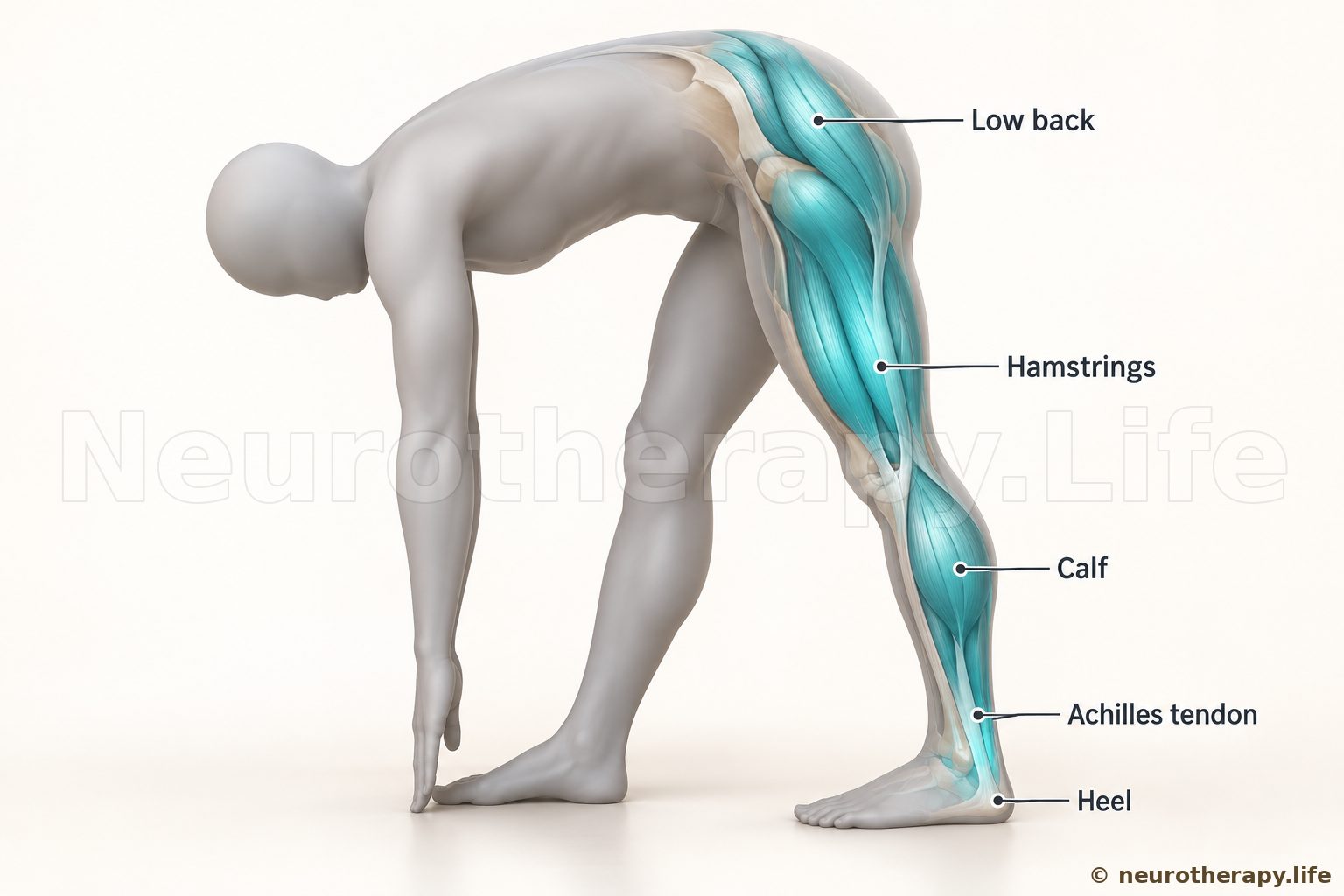
Bending Forward is a physical point named for the complaint it answers: pain in the low back or in the calves when a person bends forward. It works the nerves and muscles at the back of the calf and down into the foot.
It has a fixed partner. Bending Forward and Standing Point are given one after the other, and the pair is useful in both low-back pain and knee pain. Even other treatments point back to them: the teaching says that where there is back pain, Bending Forward and Standing Point must also be given.
Why the calf for a back problem? When you bend forward, the whole chain of tissue at the back of the body stretches at once — from the low back through the hamstrings and calf to the heel. Tightness anywhere along that chain can be felt as pain on bending.
It can be given with the patient seated on a chair, or lying on the back with the knees bent, both heels near the buttocks, and the knees pointing up but a little apart. This position flattens the low back and leaves the calf soft.
The area is the back of the calf from behind the knee down to the heel, the sides of the leg round the heel toward the toes, and the top of the foot.
How this point is given — the tool, the pressure, the count and the exact movement — is deliberately not described here. A demonstration video for this point is being prepared; until it is on this page, learn the method hands-on from a trained Neurotherapist before giving it. Please do not give any point from a written description alone: a point given in the wrong place or the wrong way can do harm.
The exact technique is taught hands-on in the Neurotherapy (LMNT) course. See the course →
The stroke lengthens and softens the tissue at the back of the calf and around the heel — the lower end of the chain that stretches every time you bend forward.
Bending Forward is never given alone — its partner follows it.
It is chosen when bending forward brings on pain, inside a plan built from the patient's findings.
“Before and after this treatment, also give whatever other treatments are necessary — for example, if there is back pain, then Bending Forward and Standing Point must also be given.”
Because bending forward stretches one long chain of tissue from the low back to the heel. Easing the lower end of the chain helps the whole chain bend more freely.
With knees bent and heels near the buttocks, the low back flattens and the calf goes soft, so the treatment works on relaxed tissue.
Yes. It can be given seated on a chair or lying on the back with knees bent.
The Achilles tendon, which joins the calf to the heel, is the thickest and strongest tendon in the body.
Source: Standard anatomy: Gray's Anatomy (41st ed.), calcaneal tendon; StatPearls, Achilles Tendon.
When the muscles at the back of the thigh are tight, the pelvis cannot tip forward easily, so more of the bend has to come from the low back.
Source: Standard biomechanics of lumbopelvic rhythm (physiotherapy texts).
Each hair has nerve endings wrapped around its root, so even a tiny pull on a hair is felt — which is why a pulled hair is an instant signal that a stroke is dragging.
Source: Standard physiology of hair follicle receptors (Guyton & Hall, somatic sensation).
This page explains what a Neurotherapy (LMNT) treatment is for; it is not a self-treatment guide and does not diagnose. Neurotherapy (LMNT) works alongside your medical care — keep taking the medicines your doctor prescribed.
Send COURSE for course details, or your name, age and health issue for a consultation.