Thrombosis (blood clots)
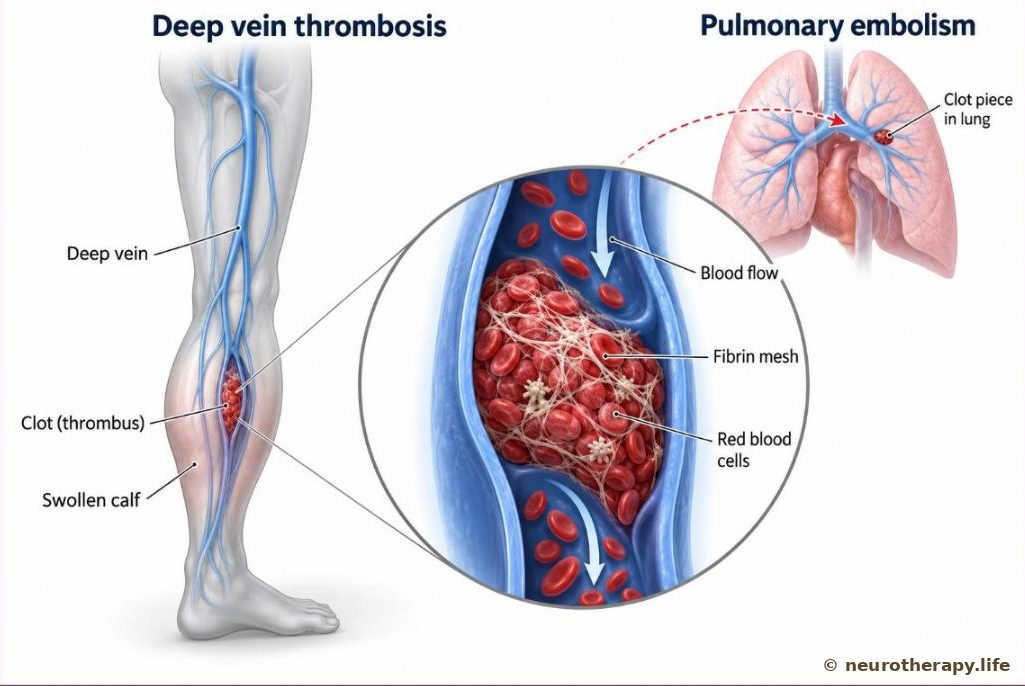
Thrombosis means a blood clot forming inside a blood vessel, where it should not. It can block blood flow — in a leg vein, the lungs, the heart or the brain — and some clots are an emergency.
- Up to 900,000 people in the United States are affected by a blood clot in a vein each year
- About 1 in 3 people who have had such a clot get another within 10 years
- A deep vein clot most often forms in the lower leg or thigh
Source: US Centers for Disease Control and Prevention (CDC); MedlinePlus (NIH); NHS
What is Thrombosis (blood clots)?
Clotting is a life-saver. When you cut yourself, blood sets into a plug and the bleeding stops. Later, the body dissolves the plug again. Thrombosis is when this happens inside a vessel with no wound to seal — and the clot stays or grows.
A clot in a deep leg vein is called deep vein thrombosis (DVT). A piece of it can break off and lodge in the lungs — a pulmonary embolism, which is an emergency. Clots in arteries can starve the heart or the brain of blood.
What are the symptoms?
- Throbbing pain in one leg, usually the calf or thigh
- Swelling in one leg
- Warm, red or darkened skin over the painful area
- Swollen, hard veins that are sore to touch
- Sudden breathlessness or chest pain — signs a clot may have reached the lungs
What causes it, and who is more likely to get it?
Not moving for long
- Being in bed or in hospital for three days or more
- An operation, especially on the legs or hips
- Long journeys of four hours or more
Body and health
- Age over 60
- Being overweight
- A clot before, or a blood-clotting disorder in the family
- Cancer or heart failure
- Varicose veins
Hormones and pregnancy
- The combined contraceptive pill or hormone therapy (HRT)
- Pregnancy, and the first six weeks after the birth
Habits
- Smoking
- Not drinking enough water
How is it found?
A suspected clot is checked in hospital, quickly. The NHS aims to scan a suspected leg clot within 24 hours.
Doppler ultrasound
A painless scan that shows the blood flowing through the veins, and whether a clot is blocking it.
D-dimer blood test
Measures pieces left behind when the body breaks down a clot. A normal result makes a clot unlikely.
Venography
An X-ray of the veins using a dye, used when the ultrasound is not clear.
A new, suspected clot goes to hospital before any Neurotherapy (LMNT). Later, the therapist asks for the scan report, the list of blood-thinning medicines, whether any wound is open, and — for women — whether the period is heavy that day.
How Neurotherapy (LMNT) sees Thrombosis (blood clots)
LMNT teaching starts from an everyday fact: small knocks keep landing on the body, and small clots keep forming in their thousands. The body opens them again by its own chemistry. Thrombosis, in this view, is what happens when that clean-up is not working.
How the body opens a clot
- A small knocka clot forms, with plasminogen waiting inside it
- tPAsome hours later, the vessel lining and the injured tissue release this activator
- Plasminafter about 24 hours, plasminogen becomes plasmin
- The clot dissolvesplasmin digests the fibrin threads that hold it together
If plasminogen or tPA are not made properly, LMNT teaching says, clots keep growing — blocking the flow in one place after another, and leading to paralysis or other disease. The Heparin family of formulas is built to support this clot-opening work, and P. Heparin is the parent formula written for thrombosis.
Whenever there is an obstruction or blockage in the blood circulation of any part of the body, then pain or numbness is felt in that part.
Neurotherapy (LMNT) treatment for Thrombosis (blood clots), step by step
Hospital first for a new clot
A swollen, hot, painful calf, or sudden breathlessness or chest pain, goes to hospital at once. Neurotherapy (LMNT) is support that comes later, alongside the doctor's treatment.
Examine, and check the gate
The therapist checks Liv° and Mu°. Before any Heparin formula comes the gate: is a wound open, or is a period flowing heavily? Then no Heparin at all until that has passed. If Mu° is painful, LMNT teaching chooses A. Heparin instead of P. Heparin.
P. Heparin
The parent formula of the Heparin family: (8) Pan, (7) Liv and (8) Ch. Only. LMNT teaching lists thrombosis, clots anywhere in the body, and too many platelets among its uses.
Ask the next day: how long did it last?
LMNT's returning-pain test: if a pain eased after treatment but came back a few hours later, a clot in that part is suspected. So the question on the second day is not "are you better?" but "how long did it last, and when did it come back?"
Points and formulas used
P. Heparin (plasmin)
The parent Heparin formula — written in LMNT to support the body's own work of keeping blood flowing and opening clots.
Works through
Open →Never do this
- Emergency: sudden breathlessness, chest pain or coughing up blood can mean a clot in the lungs — call 108 / 112 at once. A swollen, hot, painful calf needs hospital the same day.
- Never press, rub or massage a swollen, painful limb where a clot is suspected — a piece could break loose. That limb is left alone until a doctor has checked it.
- No Heparin formula while a wound is open, nor while a menstrual flow is heavy. open Wounds
- The bars of P. Heparin's own points: Pan is not given to people with schizophrenia, and in fits only inside the Heparin formula; Liv not in liver cancer; Ch. Only not in lung cancer. If tingling or numbness runs into the hand during Liv, the therapist releases at once. Pan
- If you take a blood thinner, tell your therapist — and never stop or change it on your own.
- Cancer: if the person has cancer, (10) Pan, Thymus, Pit, Lu + Sh, Rt. Ov / Lt. Ov and (30) Medulla are never given — the therapist changes the plan.
- Keep taking the medicines your doctor prescribed. Neurotherapy (LMNT) works alongside your medical care, never instead of it.
Watch

Shows the P. Heparin formula: (8) Pan at the top of the thighs, (7) Liv on the thigh and forearm, and (8) Chest Only with the palms on the chest. In the video it is given as the last part of the Angina treatment, to support circulation.
How P. Heparin is given — (8) Pan, (7) Liv and (8) Ch. Only.
From Ayurveda and the kitchen
Test yourself
What research says
- Strong evidence
Explains how the body dissolves clots: the activator tPA turns plasminogen into plasmin, which breaks down the fibrin mesh of the clot — and the clot's own fibrin speeds this up. This is the same chain LMNT teaching describes.
Chapin JC, Hajjar KA. Fibrinolysis and the control of blood coagulation. Blood Rev. 2015.
No clinical trial of Neurotherapy (LMNT) in thrombosis has been published yet. Improvements reported by neurotherapists are clinical observations.
For you
Long journeys
On trips of four hours or more, get up and walk, stretch your legs, and drink enough water.
After an operation or a long illness in bed
Move as soon as your doctor allows. Tell them at once about a painful, swollen leg.
Women on the pill, pregnant or just delivered
These times raise the risk of clots. Know the warning signs and do not ignore one swollen, painful leg.
This page explains; it does not diagnose. Neurotherapy (LMNT) works alongside your medical care — keep taking the medicines your doctor prescribed, and see a doctor for any new or severe symptom.