1The protein factory
The liver makes most of the proteins circulating in your blood — about 85 to 90% of them.
Source: Trefts E, Gannon M, Wasserman DH. The liver. Current Biology 2017;27(21):R1147–R1151.
Also called: Liver, Liv point, लिवर पॉइंट
Liv is the Neurotherapy (LMNT) point named for the liver, the body's largest gland and its main chemical workshop. It is given on the left arm and the left thigh together while you lie on your back, and it has the widest list of uses of any point — with one firm bar: never in cancer of the liver.
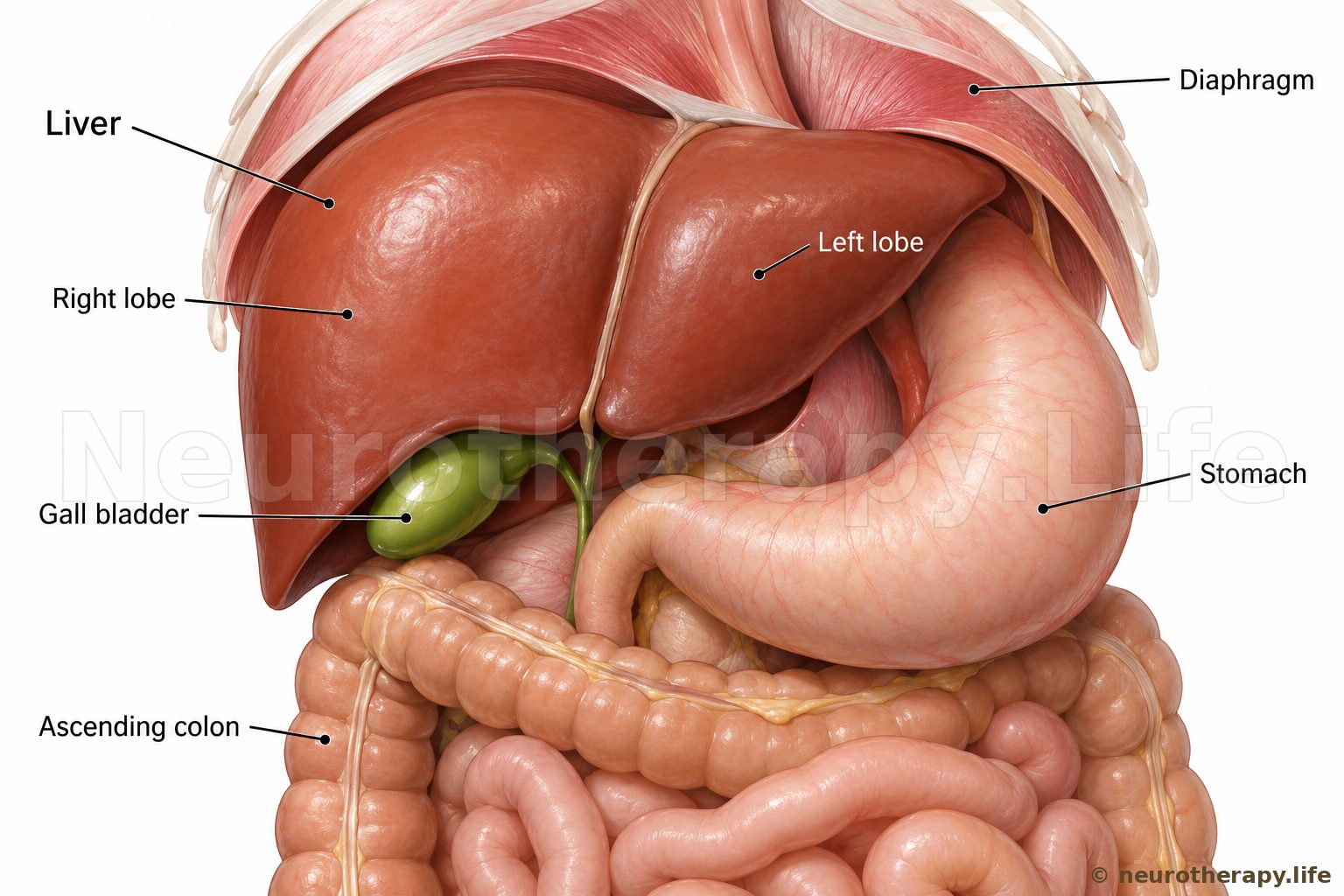
Liv is short for liver. The liver is a large, soft, reddish-brown organ that fills the upper right part of the belly, tucked under the lower ribs and the dome of the diaphragm (the breathing muscle). In an adult it weighs about one and a half kilograms.
The liver does hundreds of jobs. It makes bile to digest fat, stores sugar and releases it when you need it, makes most of the proteins that float in your blood, cleans drugs and waste from the blood, and keeps a store of vitamins such as B₁₂. Special cleaning cells inside it, called Kupffer cells, catch germs that arrive from the gut.
In Neurotherapy (LMNT), Liv is one of the everyday digestive points given lying on the back. The name records where tenderness is found when the liver is struggling — a sore spot to the right of the navel — not the place where the therapist works. Tenderness there does not mean the liver is damaged; it is one of the things the therapist will work on.
You lie flat on your back with a pillow under both thighs and a flat, soft pillow under the left hand and forearm. Nothing goes under the head or the back.
Liv is given on two places at the same moment: the left forearm a finger or two below the elbow — on the muscle, never on the bony elbow — and the left thigh. (Earlier text on this page said 'above the elbow'; the authors have corrected this to below the elbow.)
Why the left side, when the liver is on the right? Neurotherapy (LMNT)'s map follows a crossing rule: the left limbs answer pains on the right of the navel, and the right limbs answer pains on the left. Its mirror-twin Mu is given on the right forearm and right thigh.
How this point is given — the tool, the pressure, the count and the exact movement — is deliberately not described here. Watch the demonstration video on this page, and learn the method hands-on from a trained Neurotherapist before giving it. Please do not give any point from a written description alone: a point given in the wrong place or the wrong way can do harm.
The number written before a point's name is not a strength setting. Each numbered form is a separate named treatment with its own method and timing, taught hands-on in the course.
The exact technique is taught hands-on in the Neurotherapy (LMNT) course. See the course →
Neurotherapy (LMNT) teaching describes Liv as a way of rousing the liver and the part of the large bowel that lies beside it. Body science confirms that the liver really does these jobs; how a press on the arm and thigh reaches them is the therapy's own explanation, drawn from long clinical experience.
Each form is its own named treatment. The liver-cancer bar travels with every one of them.
The teaching says Liv may be given in almost any disease — after the blocked list has been checked first.
The first formula, for everyday digestive complaints.
The Normal formula with Spl left out.
Ordinary constipation — Liv serves the middle of the ascending colon.
Headache, brain disease and paralysis.
The Heparin formula used at the end of the heart (Angina) treatment.
To open the doorway the bile comes through.
The alkali formula, given only after the undigested-food work.
The vitamin D and calcium formula — the liver is its first stage.
The liver holds the body's store of B₁₂.
Blood pressure that has fallen suddenly after blood loss.
Knee pain and tired legs after exertion.
“When we stimulate the liver, it will make only those things which the body needs at that time. It will not make those things which are already present in the body in sufficient quantity.”
No. Tenderness at Liv shows a place the therapist will work on; in this system it is connected with the working of the liver, but it does not mean there is damage. Only proper tests can tell you about the liver itself.
Neurotherapy (LMNT)'s map crosses over: the left limbs answer pains on the right of the navel. The point is named for the pain it answers, not for the limb it is given on.
It usually means the placement needs fixing — an uneven pillow under the hand, a chair leg too close, or an elbow that does not lie flat. Tell your therapist; it is easily corrected.
No. Liv is support alongside your doctor's diagnosis and treatment. A high or lasting fever needs tests the same day.
The liver makes most of the proteins circulating in your blood — about 85 to 90% of them.
Source: Trefts E, Gannon M, Wasserman DH. The liver. Current Biology 2017;27(21):R1147–R1151.
Kupffer cells are the liver's resident clean-up cells. They sit in the blood channels and catch germs and debris arriving from the gut.
Source: Trefts E et al., Current Biology 2017;27:R1147–R1151.
The liver is the only internal organ that can regrow lost tissue: after part of it is removed in surgery, the rest grows back to nearly full size within weeks.
Source: Michalopoulos GK, Liver regeneration, J Cell Physiol 2007;213:286–300; Guyton & Hall, Textbook of Medical Physiology.
The liver holds a reserve of blood and can squeeze several hundred millilitres back into circulation when blood is lost — the reason Liv opens the Angiotensin No. 2 formula.
Source: Guyton & Hall, Textbook of Medical Physiology (liver as a blood reservoir).
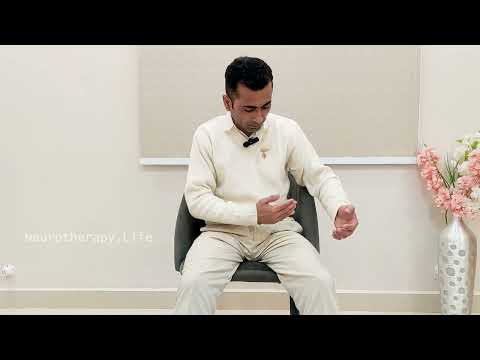
Shows where the Liv (liver) point sits on the thigh and forearm, and how to give 1, 3 and 7 Liv, and 1 point Liv × 6 with a one-minute gap. It is used to support the liver and weak digestion.

Shows how to give yourself 1 point Gal and 1 point Liv on the left thigh and forearm, six times with a one-minute gap. It is shared to support the liver in fatty liver and raised cholesterol, and as support during fever.
Note: for heart patients LMNT teaching gives 1 point Liv × 6 alone, without Gal.

Shows the Normal treatment given with the feet: (8) Pan at the top of the thighs, then (3) Gal, (3) Spleen, (7) Liv and (5) Mucus on the thighs and forearms, without breaks. It is used to support digestion.
A review of the liver's jobs: it stores and releases sugar, burns fat, makes about 85–90% of the proteins in the blood, helps regulate blood volume, and houses Kupffer cells, the resident immune cells that respond to germs arriving from the gut.
Trefts E, Gannon M, Wasserman DH. The liver. Current Biology. 2017;27(21):R1147–R1151.
This page explains what a Neurotherapy (LMNT) treatment is for; it is not a self-treatment guide and does not diagnose. Neurotherapy (LMNT) works alongside your medical care — keep taking the medicines your doctor prescribed.
Send COURSE for course details, or your name, age and health issue for a consultation.