(1) point Liv × 6 treatments (the single-point liver)
Also called: Single point liver, (1) Single point liver × 6 treatments, 1 point Liv × 6, सिंगल पॉइंट लिवर
(1) point Liv × 6 treatments is the gentlest, most widely used form of the liver point. The same places as Liv are taken one at a time with long rests between, and the small treatment is repeated through the day — for liver disease, for long and serious illness, and as the safe substitute when stronger points are blocked.
Overview
What is (1) point Liv × 6 treatments?
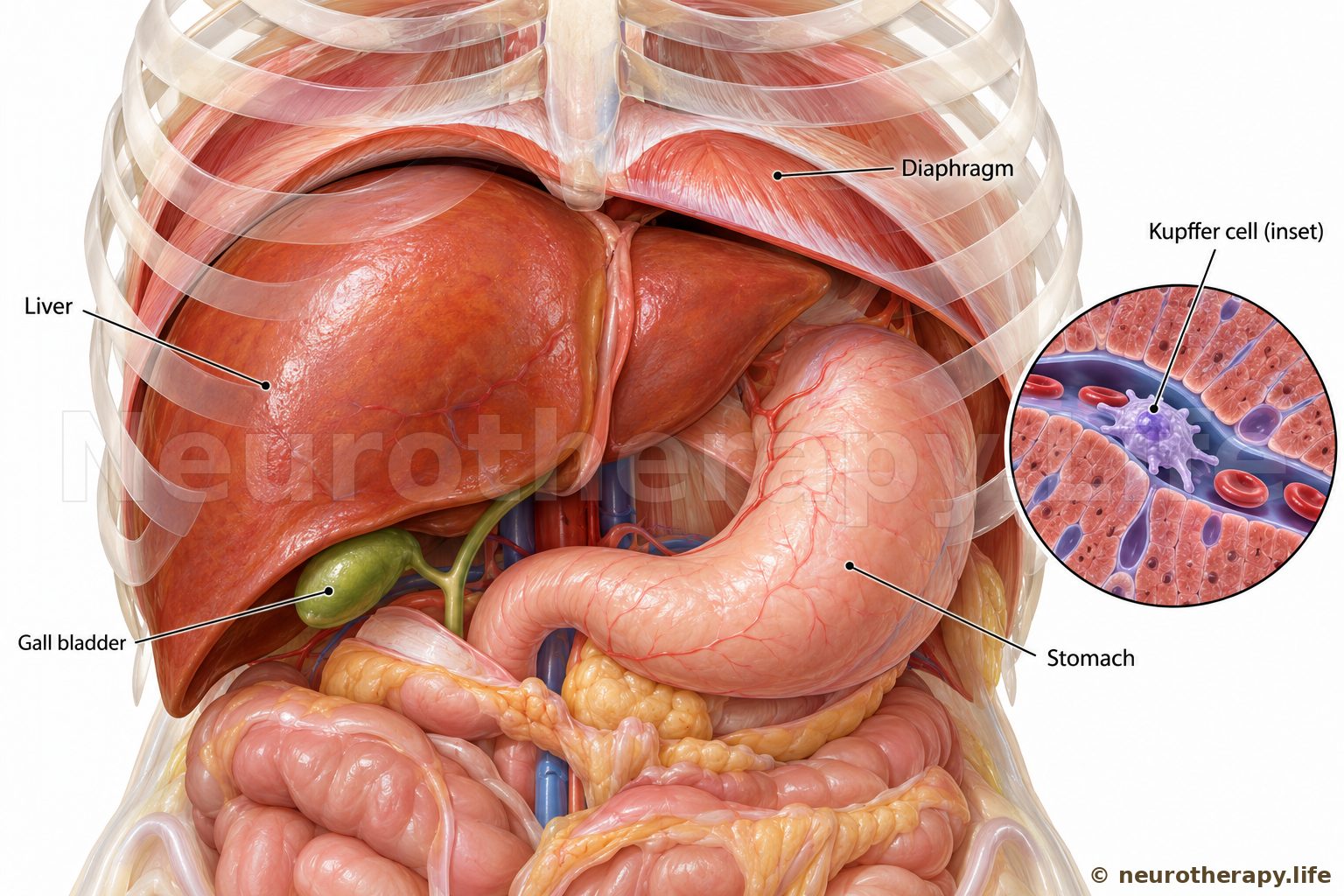
It is a named form of Liv, the liver point. The liver is the body's largest gland. It sits under the right ribs and cleans the blood, stores energy, makes bile for fat digestion and builds most of the proteins in the blood.
What makes this form different is spacing, not force. The word 'point' tells the therapist to take each place as a separate event, with a full rest in between. Teaching calls it a separate treatment, not a slower Liv: the rest belongs to the treatment.
Because it is so gentle, it is the liver form that can be given almost everywhere — and it is the form named again and again as the substitute when other points are blocked for a disease.
The liver fills the right upper belly. This gentle form of Liv is named for it.
Where it is given
Where is it given?
PositionLying on the back
Body areaLeft forearm (from just below the elbow towards the wrist) and the left thigh (from below the groin crease towards the knee), one place on each pressed together, lying on the back
You lie on your back with a pillow under both thighs and a flat pillow under the left hand. The places are those of Liv: the left forearm below the elbow and the left thigh below the groin crease. In this form one place on the forearm and one on the thigh are taken together, then the next pair, with a rest between them — the demonstration video shows the full form.
Why the left side for the liver, which is on the right? The Neurotherapy (LMNT) map crosses over: the left limbs answer the right side of the navel, where the liver's pain point lies.
How it is given
How is it given?
How this point is given — the tool, the pressure, the count and the exact movement — is deliberately not described here. Watch the demonstration video on this page, and learn the method hands-on from a trained Neurotherapist before giving it. Please do not give any point from a written description alone: a point given in the wrong place or the wrong way can do harm.
The number written before a point's name is not a strength setting. Each numbered form is a separate named treatment with its own method and timing, taught hands-on in the course.
The exact technique is taught hands-on in the Neurotherapy (LMNT) course. See the course →
What it does
What does it do in the body?
Teaching gives this form the widest list of any liver form. It is aimed at the liver's own work — cleaning, building blood and supporting digestion — without pushing fat digestion hard.
In liver disease — hepatitis, jaundice, cirrhosis and fatty liver.
In all serious or long-standing diseases — kidney disease, enlarged spleen, enlarged heart; in angina, in HIV and AIDS, in a clot in the brain, and in circulation problems.
For erythropoietin (the hormone that tells the bone marrow to make red cells), for B₁₂ deficiency, and to raise red cells or haemoglobin — especially in pregnant women.
To increase lung capacity, digestion, weight and immunity; and where white cells or ammonia are raised, or potassium is out of balance.
In fevers such as malaria and typhoid, and in every major illness.
Organs it reaches
Liver — The organ this form is named for and aimed at.
Blood — Used for haemoglobin, red cells and B₁₂ — the liver stores B₁₂ and makes a share of erythropoietin.
Heart — The safe liver form for heart patients, in place of a stronger fat-digesting pair.
Autoimmune disordersGiven with (30) Medulla and (6) Adr in autoimmune disorders, arthritis and polio.
Kidney diseaseOne of the few points permitted in kidney disorders.
AsthmaAsthma patients benefit from it with other treatments, where Gal, Spl and Thrd are blocked.
InfectionsFor infection in a diabetic patient, in place of the viral formula.
Cancer care: Neurotherapy (LMNT) supportIn lung cancer, where Chest Only and Thymus are blocked, this may be given in their place — never in cancer of the liver itself.
The elbow: the press goes on the muscle, never on the bony knobs or in the groove behind the inner knob. Pins and needles or numbness into the hand means release at once — numbness is a nerve being squashed, not the point working.
Two arms are never loaded: an arm carrying a dialysis fistula, and an arm that swells after breast surgery. In long-standing diabetes with loss of feeling in the hands, extra care is needed. Kidney disease
Liver disease is a doctor's diagnosis. Jaundice, cirrhosis and hepatitis need medical care; this treatment is given alongside it, never instead of it. Hepatitis
“If the stomach, the lungs and the kidneys work properly, then disease simply cannot come.”
— Dr. Lajpatrai Mehra
Common questions
Is this just a slower Liv?
No. It uses the same places, but taking them one at a time with rests makes it a separate treatment with its own uses. The rest belongs to it.
Why is it given several times a day?
In liver disease, teaching gives it through the day at intervals. Small, repeated signals suit a weak organ better than one strong session. The family is often taught to give it at home.
I have a heart problem. Is it safe for me?
It is the form named for heart patients, given in place of a stronger pair that raises cholesterol. Continue your heart medicines and tell the therapist about every report.
Can it treat my hepatitis on its own?
No treatment page can promise that. It is used to support the liver alongside your doctor's care, and patients have reported feeling better with it.
Surprising facts
1The liver can regrow
If a large share of a healthy liver is removed, the rest grows back to nearly full size within weeks — a power almost no other organ has.
Source: Guyton & Hall, Textbook of Medical Physiology, the liver as an organ — regeneration.
2A filter lined with cleaners
The liver's blood channels are lined with Kupffer cells, cleaning cells that swallow bacteria coming from the gut before they reach the rest of the body.
Source: Guyton & Hall, Textbook of Medical Physiology, the reticuloendothelial system of the liver.
3A share of the red-cell signal
The kidneys make most of the body's erythropoietin, but the liver makes the rest — the hormone that tells bone marrow to make red cells.
Source: Guyton & Hall, Textbook of Medical Physiology, regulation of red blood cell production.
4Years of B₁₂ in store
The liver stores vitamin B₁₂ in such quantity that the body can run on its reserve for a few years after intake stops.
Source: Guyton & Hall, Textbook of Medical Physiology, vitamin B₁₂ and red cell maturation.
Watch
LMNT Liv Point Self Treatment | Fatty Liver और कमज़ोर पाचन का पक्का इलाज | Natural Liver Detox
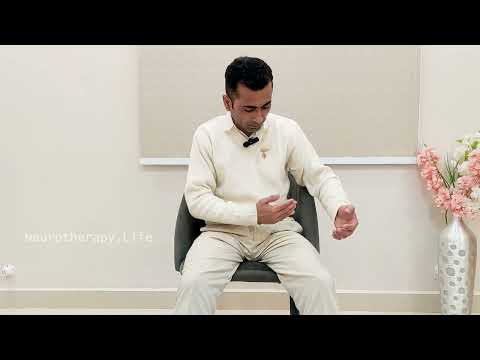
Shows where the Liv (liver) point sits on the thigh and forearm, and how to give 1, 3 and 7 Liv, and 1 point Liv × 6 with a one-minute gap. It is used to support the liver and weak digestion.
बुखार, थकान, Cholesterol और Fatty Liver का पक्का इलाज | 1 Gal 1 Liv Treatment | Natural Liver Detox
Shows how to give yourself 1 point Gal and 1 point Liv on the left thigh and forearm, six times with a one-minute gap. It is shared to support the liver in fatty liver and raised cholesterol, and as support during fever.
Note: for heart patients LMNT teaching gives 1 point Liv × 6 alone, without Gal.
This page explains what a Neurotherapy (LMNT) treatment is for; it is not a self-treatment guide and does not diagnose. Neurotherapy (LMNT) works alongside your medical care — keep taking the medicines your doctor prescribed.
Ready to begin?
Send COURSE for course details, or your name, age and health issue for a consultation.