(1) Pt. Gal × 6 treatments (the single-point gall bladder)
Also called: (1) point Gal × 6 treatments, Single point Gal, 1 Point Gal × 6, सिंगल पॉइंट Gal
(1) Pt. Gal × 6 treatments is the spaced form of Gal, the gall bladder point. The same places on the left thigh are taken one at a time with rests between, and it is used in viral fever with Gal pain, in skin disease — above all skin disease with constipation — and inside the HCl and New Gal formulas.
Overview
What is (1) Pt. Gal × 6 treatments?
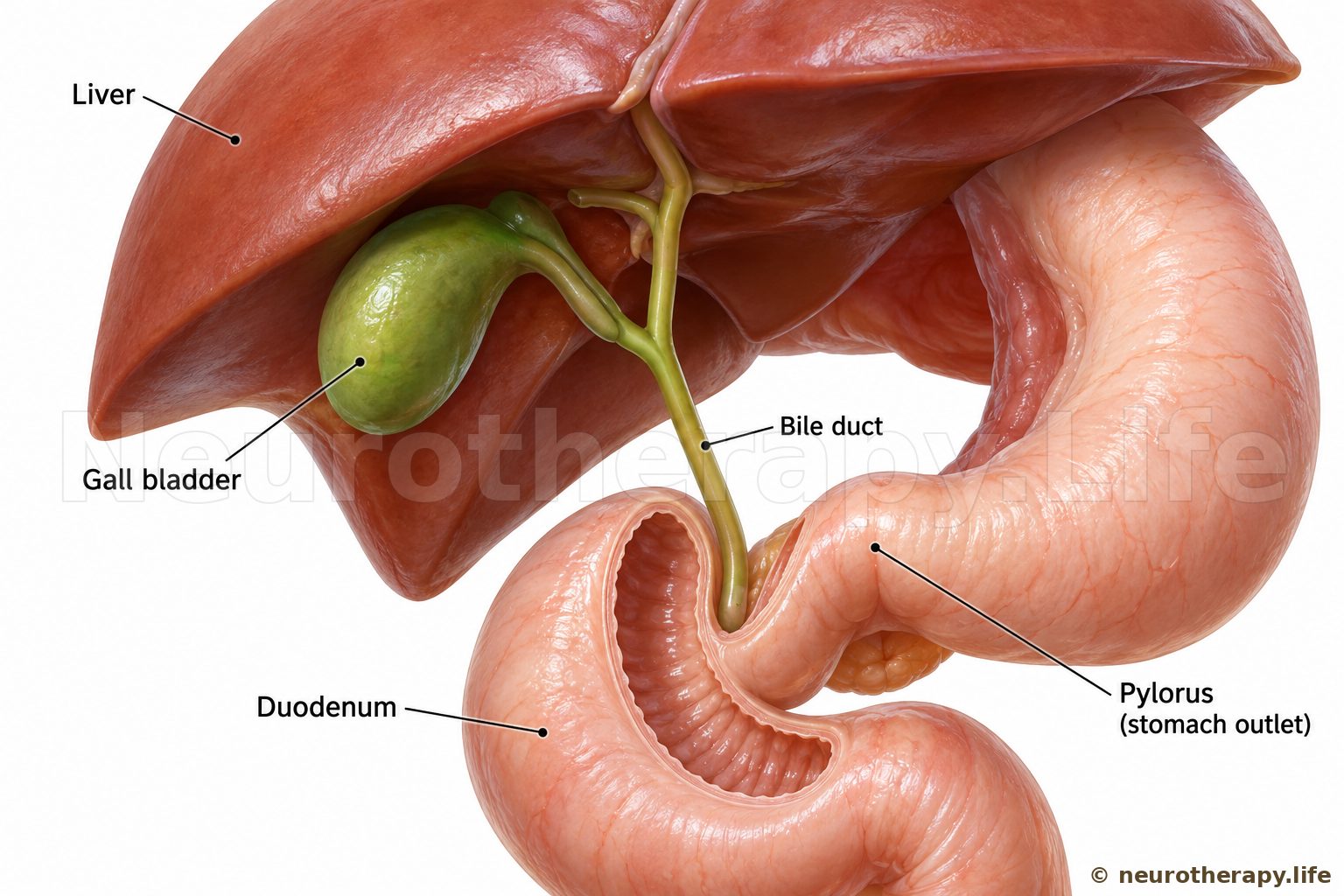
It is a named form of Gal, the point for the gall bladder. The gall bladder is a small pear-shaped bag under the liver. It stores bile — a bitter green-yellow juice made by the liver — and squeezes it into the gut when fatty food arrives.
The word 'point' changes how Gal is given. Instead of one continuous pass down the thigh, each place is taken as a separate event with a full rest in between. Teaching is clear that this is a separate treatment, not a slower Gal — and that the rest is what makes it so.
The '× 6 treatments' in its name says that six treatments are meant, not six presses. How they are spaced is taught in the course.
The gall bladder stores bile under the liver. The Gal point is named for it.
Where it is given
Where is it given?
PositionLying on the back
Body areaFront of the left thigh, from below the hip crease towards the knee
You lie on your back with a pillow under both thighs. It is given at the same places as Gal: down the front of the left thigh, from just below the hip crease towards the knee.
The gall bladder is on the right, yet the point is on the left thigh. That is the crossing rule of the Neurotherapy (LMNT) map: the left leg answers pain on the right of the navel.
How it is given
How is it given?
How this point is given — the tool, the pressure, the count and the exact movement — is deliberately not described here. Watch the demonstration video on this page, and learn the method hands-on from a trained Neurotherapist before giving it. Please do not give any point from a written description alone: a point given in the wrong place or the wrong way can do harm.
The number written before a point's name is not a strength setting. Each numbered form is a separate named treatment with its own method and timing, taught hands-on in the course.
The exact technique is taught hands-on in the Neurotherapy (LMNT) course. See the course →
What it does
What does it do in the body?
Gal is taught as a way of rousing the gall bladder so that bile is released in the right amount. This spaced form carries three named uses of its own.
In viral fever, when there is pain at the Gal point.
In all skin diseases — allergy, psoriasis, leucoderma (vitiligo) and others — and especially where the patient also has constipation, where teaching says the benefit is great.
In the HCl formula, to stimulate the part of the stomach near its outlet (the pylorus) and so produce gastrin — the hormone that tells the stomach to make its acid.
In the New Gal formula, with TF 'Gal', to stimulate the gall bladder — teaching gives a fuller course of it to a very restless child.
Organs it reaches
Gall bladder — The bile store this point is named for.
Stomach — In the HCl formula it is aimed at the stomach's outlet, where gastrin is made.
Skin — Skin disease, especially with constipation, is its best-known use.
Liver — The liver makes the bile the gall bladder stores.
Its family
How does it relate to the other Gal forms?
Every written form of Gal is its own treatment. The Gal cautions apply to all of them.
Gal — The parent gall bladder point — one continuous pass down the thigh.
(9) Gal — The form aimed at temperament — to calm excessive anger and restlessness.
With TF 'Gal', to stimulate the gall bladder — after the stomach has first been set right.
Safety: when it is held back
The Gal cautions stand for this form too. Raised white cells: not given in leukaemia, blood cancer or other diseases from a raised white cell count. Leukaemia (blood cancer)
Asthma: not given — Gal can increase inflammation in the lungs and increase the trouble. Asthma
Little urine: not given to those passing little urine. Teaching marks this as a matter of experience. Urinary problems
No. They can cover the same places, but (2) Gal runs straight through, while this form takes each place separately with rests. Teaching calls them two quite different treatments.
Why would a gall bladder point help my skin?
In this teaching the gall bladder takes part in caring for the skin, and skin disease with constipation is the use where the benefit is said to be great. It supports the skin alongside your doctor's treatment.
I have asthma and a skin problem. Can I have it?
No. Gal is blocked in asthma, and the block wins over the use. Your therapist will choose other points.
Surprising facts
1A small bag that concentrates
The gall bladder holds only a small cupful of bile, but it pulls water out and makes the bile several times stronger than when the liver made it.
Source: Guyton & Hall, Textbook of Medical Physiology, storage and concentration of bile in the gall bladder.
2Fat rings the bell
When fatty food reaches the small intestine, its lining releases the hormone cholecystokinin (CCK), which makes the gall bladder squeeze.
Source: Guyton & Hall, Textbook of Medical Physiology, emptying of the gall bladder.
3The acid switch sits at the outlet
Gastrin, the hormone that drives stomach acid, is made by G cells in the lower stomach near the pylorus — the very region the HCl formula aims this point at.
Source: Guyton & Hall, Textbook of Medical Physiology, gastric secretion and gastrin.
Watch
Gal and One Point Gal to Yourself | Master the LMNT Gal Point | Neurotherapy Student Tutorial
Shows how to give yourself the Gal (gall bladder) point on the left thigh: 1, 2 and 3 Gal pressed without a break, and 1 Point Gal × 6 with a one-minute gap each time. It is used to support bile flow and ease gas and heaviness after meals.
Gal Point (Gallbladder) - How to Give 1 Gal, 3 Gal & 1 Point Gal | Practical Training for Students
A practical training demo on the Gal (gall bladder) point: how to give 1 Gal, 3 Gal and 1 Point Gal, used to support bile flow and digestion.
This page explains what a Neurotherapy (LMNT) treatment is for; it is not a self-treatment guide and does not diagnose. Neurotherapy (LMNT) works alongside your medical care — keep taking the medicines your doctor prescribed.
Ready to begin?
Send COURSE for course details, or your name, age and health issue for a consultation.