1Small toes, many bones
Each foot has 26 bones, and 14 of them are in the toes alone — two in the big toe and three in each of the others.
Source: Standring S (ed.). Gray's Anatomy, 41st ed. Elsevier, 2016 — bones of the foot.
Also called: Toe Fingers, Toe Finger treatment, टो फिंगर
TF, short for Toe Fingers, is a Neurotherapy (LMNT) treatment given lying on the back, with a light rubbing at the joints of the toes. Together with NNS it is used to set the organs around the navel and to strengthen digestion, and each toe carries the code of an organ point.
TF stands for Toe Fingers — the toes. In this treatment the therapist sits facing the soles of your feet and works on the joints of the toes, rousing the nerves under the skin with a light rubbing.
TF is one of the navel-setting treatments. In Neurotherapy (LMNT), the navel is the centre of the abdomen's organs, and when it is 'upset' digestion suffers. TF and NNS (New Nabhi Set) given one after the other are taught to set all the organs of the navel, so that the stomach and intestines begin to work properly and protein is digested well.
Every toe carries a code — Gas, Gas 'I', Pan, Gal, Spl, Liv, Mu, Rt.Ov or Lt.Ov — the same organ points that are given on the thighs and arms. So a card can ask for TF on all the toes, or only on named toes, such as TF 'Gal' or TF 'Gal-Liv'.
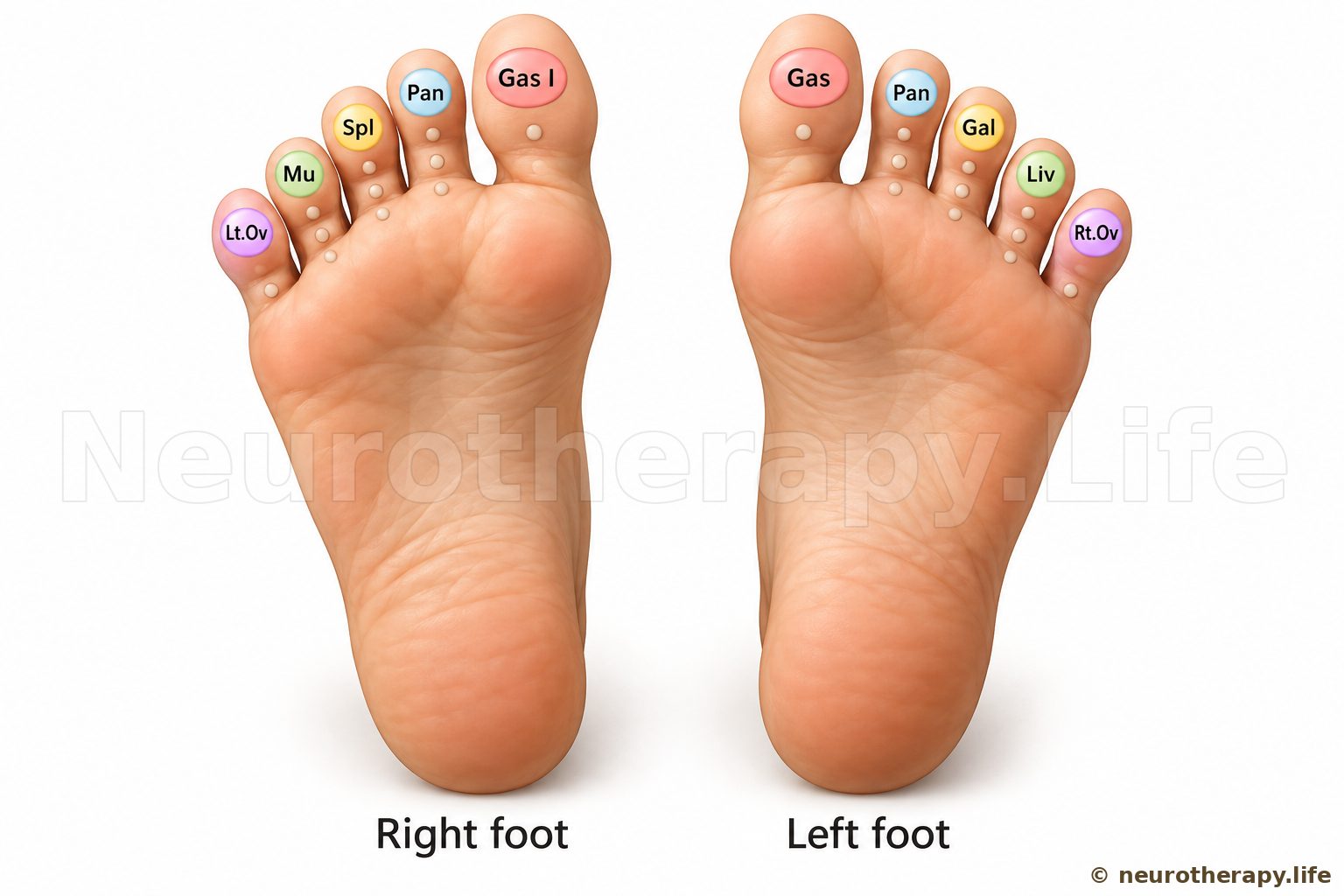
You lie straight on your back, both hands relaxed beside your thighs. The therapist sits comfortably facing the soles of your feet.
TF is given at the joints of the toes. When nothing else is written it covers all the toes of both feet. When a toe is named on the card — for example TF 'Gal-Liv', the middle toe of the left foot and the one beside it — only those toes are treated, and not the others.
How this point is given — the tool, the pressure, the count and the exact movement — is deliberately not described here. Watch the demonstration video on this page, and learn the method hands-on from a trained Neurotherapist before giving it. Please do not give any point from a written description alone: a point given in the wrong place or the wrong way can do harm.
The exact technique is taught hands-on in the Neurotherapy (LMNT) course. See the course →
Neurotherapy (LMNT) teaching describes TF as rousing the nerves under the skin of the toes and, with NNS, setting the organs around the navel so that digestion improves. Body science confirms that the toes are densely supplied with sensory nerves; the link between each toe and an organ is the therapy's own map, built from long clinical experience.
TF belongs to the navel-setting group. The same toe key serves TF, NNS and all forms of CNNS.
TF is mostly a part of formulas — setting the navel after abdominal work, or as a named-toe form of an organ point.
The standard order in which TF and NNS are given, and its changed forms.
Joint pain and RA — opens with ONS, TF and NNS to set the navel.
The Star formula for joint pain from the alkali side, keeping the navel-setting points.
For a blow or accident — TF 'Gal-Liv' stands alone as its first part.
TF 'Gal' with a single-point Gal, to stimulate the gall bladder.
Includes TF with Folded Legs and NNS as one of its parts.
In Neurotherapy (LMNT) each toe carries the code of an organ point, and TF with NNS is taught to set the organs around the navel, which helps digestion.
Because your card named them — for example TF 'Gal-Liv' means only the middle toe of the left foot and the one beside it. Named toes mean those toes and no others.
It is given lightly and never hard enough to break the skin. Your feet are checked first; any wound, redness or dark patch is shown to a doctor and not rubbed.
Usually NNS, the New Nabhi Set. The two together are the standard closing pair after abdominal work.
Each foot has 26 bones, and 14 of them are in the toes alone — two in the big toe and three in each of the others.
Source: Standring S (ed.). Gray's Anatomy, 41st ed. Elsevier, 2016 — bones of the foot.
The skin of the toes and sole is rich in touch and pressure receptors, which the body uses every second to keep its balance. A light rub there is felt very clearly.
Source: Kennedy PM, Inglis JT. Distribution and behaviour of glabrous cutaneous receptors in the human foot sole. J Physiol. 2002;538(3):995–1002.
In diabetes, nerve damage can make the feet numb, so a small wound may go unnoticed and become infected. Checking the feet every day is one of the most important habits for a person with diabetes.
Source: International Working Group on the Diabetic Foot. IWGDF Guidelines on the prevention and management of diabetes-related foot disease, 2023.
This page explains what a Neurotherapy (LMNT) treatment is for; it is not a self-treatment guide and does not diagnose. Neurotherapy (LMNT) works alongside your medical care — keep taking the medicines your doctor prescribed.
Send COURSE for course details, or your name, age and health issue for a consultation.