Also called: Alkaline Star formula, Alkaline Star treatment
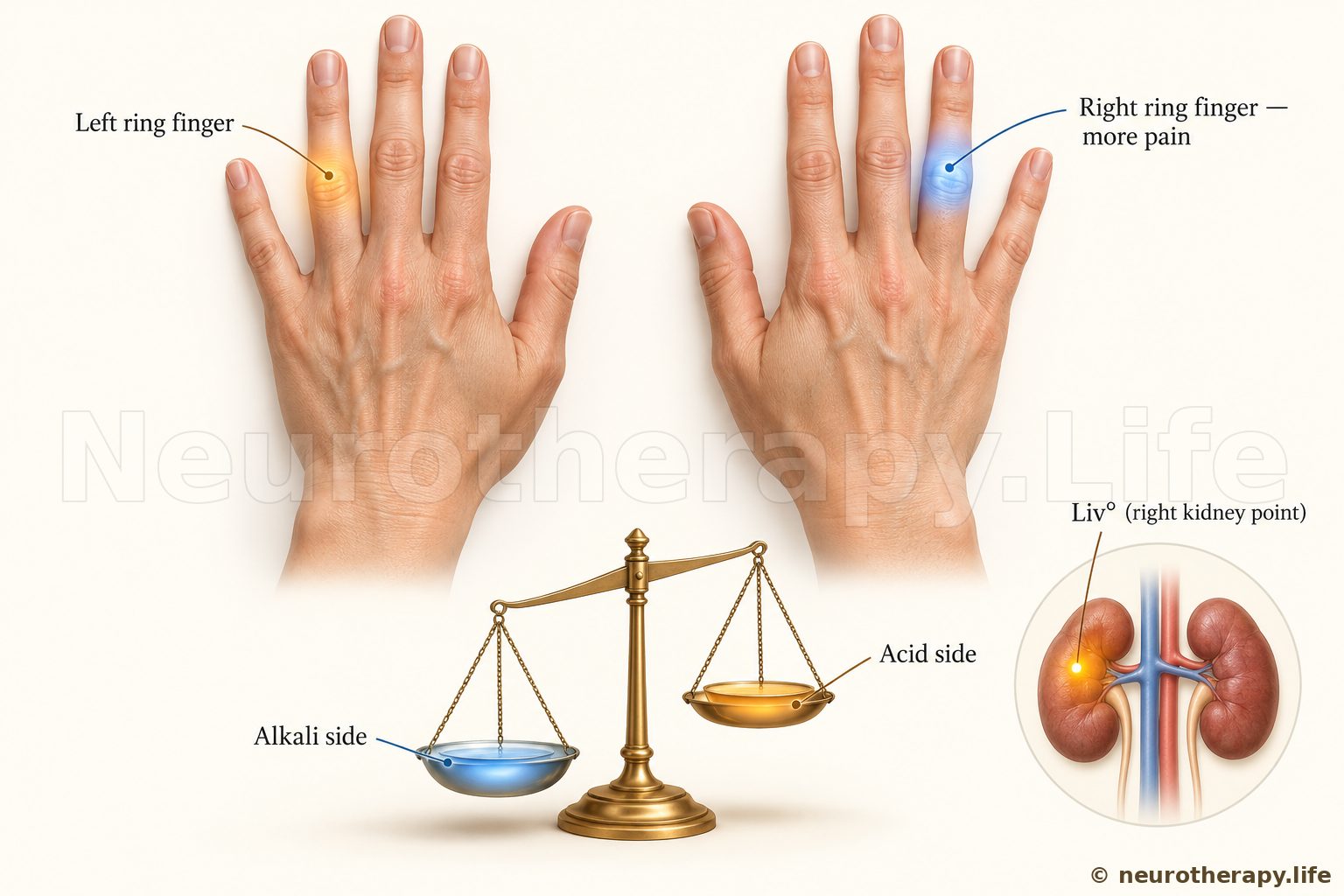
Alkaline Star is the joint-pain formula of the Star line for the patient whose pain comes from the alkali side — pain in both ring fingers with marked pain at Liv°, or more pain in the right ring finger. It keeps the navel-setting points of New Star Modified but turns the formula around to suit that patient.
Overview
What is the Alkaline Star formula?
The Star formulas are LMNT's line for joint pain. The family takes its name from an old idea linked with the birth chart (kundali); what is taught today is a set of points, each with a stated purpose. Over the years the line grew from Old Star to New Star to New Star Modified, the working formula for joint pain and rheumatoid arthritis (RA).
New Star Modified suits a patient leaning to the acid side: more pain at Mu° and in the left ring finger. But some joint-pain patients lean the other way — pain at Liv° and in the right ring finger. Given the acid-side formula, they are pushed further in the direction they already lean.
For them the Alkaline Star was made. The same navel-setting points stay at the front, but two digestive steps change places and an older form of the Ku point is brought back on purpose — because this patient's pain comes from the alkali side, not the acid side.
Alkaline Star is chosen when the joint pain leans to the alkali side: more pain in the right ring finger, or marked pain at Liv°.
What it is for
What is Alkaline Star used for?
For joint pain when both ring fingers hurt and the right kidney point, Liv°, is markedly tender.
For joint pain when the ring finger of the right hand hurts more than the left.
In place of New Star Modified for exactly these patients, who fall outside that formula's rule.
Points it works through
Which points does Alkaline Star work through?
(3) ONS (6) TF (3) NNS (6) WD (6) Gal (4) Ku-Old (20) ↑°↓
Listed here as a set, with what each contributes. The exact method, and how it differs from New Star Modified step by step, are taught hands-on in the Neurotherapy (LMNT) course. This page lists the points of the formula and what each one contributes; it does not describe how any point is given. For the method, watch the demonstration video of each point on its own page and learn hands-on from a trained Neurotherapist. Please do not give a formula from a written description alone.
The old form of Ku, at the tail of the spine. It is known to bring pain to Mu° — it raises acid, so alkali falls. That side effect is exactly why it is chosen here.
Round Arrow, along both sides of the spine, given after Ku to clear the road.
Position:Lying on the back (supine) for the navel-setting, WD and Gal steps, and face down (prone) for Ku and the Round Arrow.
The exact technique is taught hands-on in the Neurotherapy (LMNT) course. See the course →
How it works
How does Alkaline Star work?
LMNT teaching reads joint pain through a simple test: squeezing the middle joint of both ring fingers at once. More pain on the left points to the acid side; more pain on the right, with pain at Liv°, points to the alkali side. Checking the fingers and the kidney points takes only moments and needs no equipment.
Alkaline Star keeps the three navel-setting points of New Star Modified but changes four things: two of them are given more lightly, WD and Gal swap places, and the old Ku replaces the newer Ku hold. The old Ku is known to raise acid, which is a problem for an acid-side patient but the very tool an alkali-side patient needs.
Its family
Which formulas are related to Alkaline Star?
Alkaline Star is the fifth step in the Star line of joint-pain formulas.
New Star Modified — The working joint-pain formula for the acid side — more pain at Mu° and in the left ring finger. Alkaline Star replaces it for the alkali side.
New Star — The earlier form, without the navel-setting points in front.
Old Star — The first Star formula — short and quickly given.
July 2006 rebuild — In July 2006 New Star and Alkaline Star were broken apart and rebuilt into one staged protocol that pushes one way, checks the finger, pushes back, and re-centres.
Mukha Dhauti dosing for RA — Mukha Dhauti — a forceful out-breath for the acid-side RA patient, not for the alkali side.
All Joints Ghisai — The very light rubbing of every arm joint, added after the Star formula.
What it is used for
When is Alkaline Star given?
It is chosen from three quick findings — the two ring fingers and the two kidney points — not from the name of the disease.
Pain in both ring fingers is a reason to see a doctor, even if an RA test is negative — a negative test does not rule RA out. Rheumatoid arthritis (RA) and rheumatism
A hot, red, swollen single joint with fever needs a doctor the same day. Fever and viral fever
WD is given with both arms raised beside the head on pillows, never down at the sides. WD
Gal is not given in leukaemia, blood cancer or other conditions with a raised white cell count, nor in asthma. Gal
A teaching case — the woman who got worse on the 'right' formula
A teaching case, put together from practice: a retired woman with six years of pain in the knees, the right shoulder and both hands had been given New Star Modified elsewhere for three weeks and felt worse. On checking, Liv° was very tender and Mu° almost silent, and the right ring finger hurt more than the left. Only half the rule had been read — she was an alkali-side patient, and the Alkaline Star was the formula written for her.
A composite case written to teach the reasoning — not one patient’s file.
Common questions
Why does my therapist squeeze both ring fingers at once?
In LMNT teaching, the middle joint of the ring finger is a quick gauge of the acid–alkali balance. Comparing left with right tells the therapist which Star formula fits you.
Isn't New Star Modified the formula for joint pain?
It is the formula for one direction of joint pain — the acid side. For the alkali side, the Alkaline Star is written instead.
Does the name mean it has something to do with stars or astrology?
The Star line takes its name from an idea linked with the birth chart. Where an idea came from and whether a treatment helps are different questions. What is taught is a set of points, each with a stated purpose.
Should I keep taking my arthritis medicines?
Yes. Neurotherapy (LMNT) works alongside medical care. Never stop or change prescribed medicines without your doctor.
Surprising facts
1Cartilage has no blood supply
The smooth cartilage lining your joints has no blood vessels. It is fed by the joint fluid, which is squeezed in and out as you move — one reason gentle movement matters for joints.
Each hand has 27 bones, so both hands together hold about a quarter of the body's 206 bones — and many small joints for RA to reach.
Source: Gray's Anatomy, 41st ed. — bones of the hand.
3A negative test is not the last word
A good number of people with true rheumatoid arthritis test negative for rheumatoid factor. Doctors classify RA from the pattern of joints, how long it has lasted and blood markers together.
This page explains what a Neurotherapy (LMNT) treatment is for; it is not a self-treatment guide and does not diagnose. Neurotherapy (LMNT) works alongside your medical care — keep taking the medicines your doctor prescribed.
Ready to begin?
Send COURSE for course details, or your name, age and health issue for a consultation.