Also called: Mukha Dhauti dosing for RA, Mukha Dhauti in RA
In rheumatoid arthritis (RA), Neurotherapy (LMNT) uses Mukha Dhauti — a forceful out-breath through the mouth — for patients whose joint pain returns a few hours after treatment, with the left ring finger hurting more than the right. It is done seated, in sets with rests, and stopped as soon as the left ring-finger pain goes.
Overview
What is Mukha Dhauti in RA?
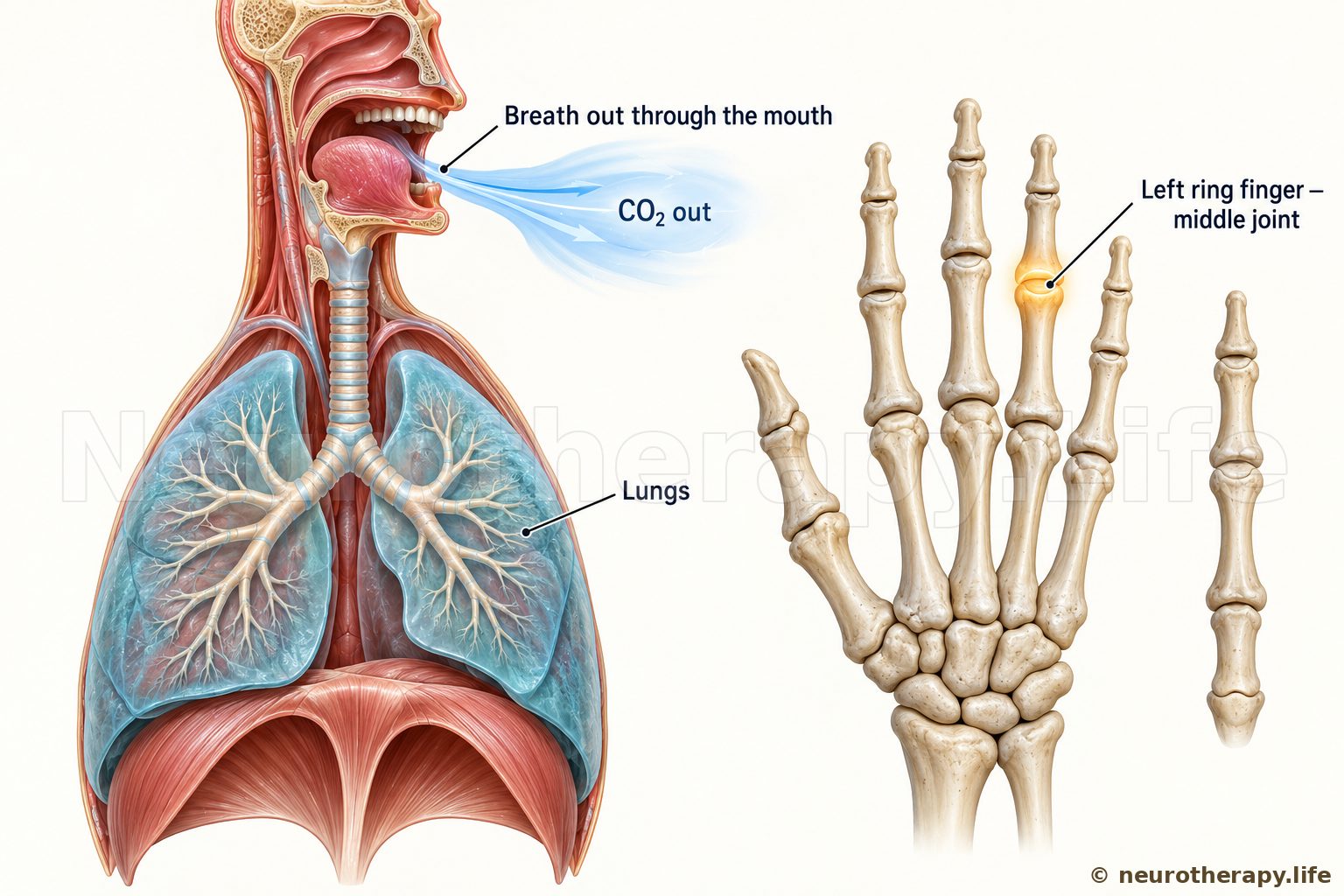
Mukha Dhauti is a breathing instruction, not a press. The patient breathes in normally through the nose and then throws the breath out forcefully through the mouth. The therapist's hands do nothing; the patient is taught and coached.
In RA it has its own use. Some patients feel very good straight after treatment, but within a few hours the joint pain comes back — and it comes back in the ring finger of the left hand. Neurotherapy (LMNT) reads this as acid rising again every few hours.
One reason offered is that the haemoglobin of RA patients often stays below normal, so less oxygen reaches the tissues. Mukha Dhauti is meant to let the trapped acid leave through the breath as carbon dioxide.
Mukha Dhauti is done seated. The left ring finger is the guide: it chooses the patient and tells you when to stop.
What it is for
Who is it for?
RA patients whose relief after treatment fades within a few hours.
Those who, along with joint pain, have much pain at Mu° or at the middle joint of the left ring finger — but not as much in the same finger of the right hand.
It is not an extra for everybody. A patient whose right ring finger is the worse one is not the patient it is written for.
Points it works through
What is involved?
Mukha Dhauti uses the breath, guided by two findings. The exact way of breathing, the sets and the rests are taught hands-on in the Neurotherapy (LMNT) course. This page lists the points of the formula and what each one contributes; it does not describe how any point is given. For the method, watch the demonstration video of each point on its own page and learn hands-on from a trained Neurotherapist. Please do not give a formula from a written description alone.
The left navel kidney point. Much pain here, with joint pain, is one of the signs that select this treatment.
Position:Seated on a chair — never standing, and never left alone while doing it.
The exact technique is taught hands-on in the Neurotherapy (LMNT) course. See the course →
How it works
How is it meant to work, and why the rests?
Carbon dioxide in the body forms carbonic acid. Neurotherapy (LMNT) holds that forceful breathing out lets the carbonic acid trapped in the joints leave as carbon dioxide, so the pain eases.
The rests between sets are not optional. As soon as Mukha Dhauti is done, the acid falls at once — but if too much acid goes out at one time, the alkali rises for a while, and the body may not be able to bear it. The same reason gives the stopping rule: when the left ring-finger pain goes, stop. Not reduce — stop.
The finger is checked again and again as the patient goes on. If the pain comes back after a couple of days, the breathing is begun again more gently, with the same stopping rule.
Its family
Which treatments are related?
Mukha Dhauti belongs to the Star treatments for stiffening joints and rheumatoid arthritis.
Alkaline Star — The Star formula for the RA patient on the alkali side — the opposite of the patient Mukha Dhauti is for.
New Star — One of the main Star formulas for joint pain.
Stop at once for light-headedness, tingling of the lips or fingers, cramping of the hands or feet, chest pain, a racing heart, or any change in vision. These are signs that too much has gone out at once.
Rest between sets is necessary, and the breathing stops as soon as the left ring-finger pain goes — even if the patient is enjoying it.
Take medical advice before teaching forced breathing to anyone with uncontrolled blood pressure, heart trouble or a recent heart event, fits, glaucoma or recent eye surgery, recent surgery of the belly or chest, a hernia, an active ulcer, pregnancy, or a past collapsed lung. How to tell a patient to see a doctor
Do it seated, never standing, and never alone.
RA medicines that protect the joints are never delayed or replaced. Neurotherapy (LMNT) works alongside medical care, never instead of it. Rheumatoid arthritis (RA) and rheumatism
A teaching case
Teaching case: when to stop
A woman with RA and a very painful left ring finger did Mukha Dhauti, with rests, morning and evening for two days. On the third day the finger was quiet, and she said the breathing made her feel wonderful and asked to continue. The answer was to stop, and to re-check the finger in two days. If the pain returned, she would begin again more gently with the same stopping rule.
A composite case written to teach the reasoning — not one patient’s file.
Common questions
Is Mukha Dhauti the same as kapalbhati?
It most resembles kapalbhati — repeated forceful breathing out, done in rounds with rests. In the old yoga texts, dhauti means a cleansing; using the word for a breathing practice is a modern usage.
Why does the left ring finger matter?
Neurotherapy (LMNT) reads more pain in the left ring finger than the right as a sign of the acid side. It both chooses the patient and tells you when to stop.
Can I do it at home?
Patients are taught it so they can also do it at home, but only after the therapist has checked that it is safe for them, and always seated, with rests and the stopping rule.
What if both my ring fingers hurt the same?
Then this is not the treatment written for you. It is for the patient whose left finger is clearly worse than the right.
Surprising facts
1You breathe out acid all day
Carbon dioxide joins water in the blood to form carbonic acid. How much carbon dioxide you breathe out changes the blood's pH within minutes.
Source: Hopkins E, Sanvictores T, Sharma S. Physiology, Acid Base Balance. StatPearls. 2022 (NBK507807).
2Overbreathing makes fingers tingle
Breathing out too much carbon dioxide too fast makes the blood briefly too alkaline. This lowers the free calcium in the blood and can cause tingling around the lips and fingers and cramping of the hands — exactly the warning signs to stop.
Source: Guyton and Hall Textbook of Medical Physiology, 14th ed., respiratory alkalosis and tetany.
3Anaemia is common in RA
Long-standing inflammation can hold back the making of red blood cells, so many people with rheumatoid arthritis have a mild anaemia, often called anaemia of chronic disease.
Source: Weiss G, Goodnough LT. Anemia of chronic disease. N Engl J Med. 2005;352(10):1011–1023.
Test yourself
Research
Strong evidence
This reference explains how breathing out carbon dioxide, which forms carbonic acid in the blood, changes the body's pH — the physiology behind using the breath to shift acid.
This page explains what a Neurotherapy (LMNT) treatment is for; it is not a self-treatment guide and does not diagnose. Neurotherapy (LMNT) works alongside your medical care — keep taking the medicines your doctor prescribed.
Ready to begin?
Send COURSE for course details, or your name, age and health issue for a consultation.