The Front of the Body II: Glands, Toes, Lymph, Chest and Arms
The second group of points given with the patient lying on the back finishes the front of the body: gland points given on the arms, navel setting from the toes, the lymph and chest group, the throat, and treatments for the breath and the limbs. It also teaches the most important safety rule in the therapy: the front of the neck is never pressed.
Overview
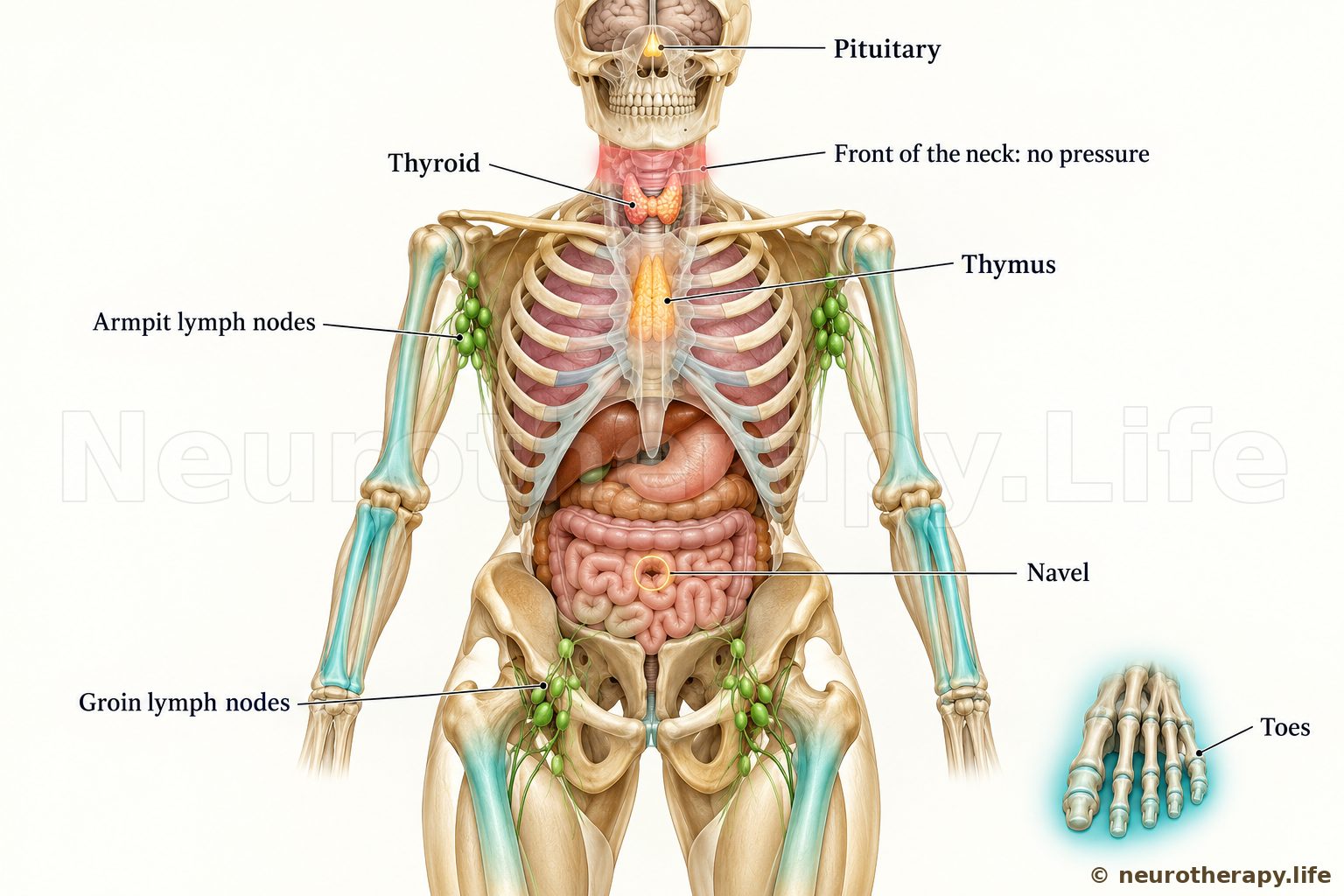
The second group of points given with the patient lying on the back finishes the front of the body: gland points given on the arms, navel setting from the toes, the lymph and chest group, the throat, and treatments for the breath and the limbs. It also teaches the most important safety rule in the therapy: the front of the neck is never pressed.
The rule that governs the head end
Several treatments here begin with the therapist above the patient's head, feet resting beside the neck on the way to the arms. Beside is the key word: the feet carry no weight there. No pressure falls on the front or the sides of the neck at any time, by foot or by hand, whatever a card says.
The reason is plain anatomy. On each side of the windpipe runs the great artery to the brain, and where it divides its wall carries pressure sensors that report blood pressure to the brain. Squeezing them tells the brain the pressure is too high; it answers by slowing the heart, and the patient may go pale and faint. The risk is greater in older people, after a recent stroke or mini-stroke, with a swelling or goitre in the neck, and on blood thinners.
Gland points on the arms
Rt. Ov. and Lt. Ov. are given with the sole on the forearms. Rt. Ov. is named for the right ovary but given on the left forearm, because in this therapy the arms answer pains between the navel and the groin, and each arm answers the opposite side. It is used to reduce pain below the navel on the right and to improve circulation to the right ovary and the appendix region; Lt. Ov. is its mirror. The ovaries lie deep in the pelvis; the point is named for the ache low in the belly on that side.
Pit, Para and Thrd 'P' are named for the pituitary, parathyroid and thyroid glands, and not one of them touches its gland. All three use the same movement on the arms, near the elbow and near the shoulder, and are told apart by the arm: Pit on both arms together, Para on the right arm, Thrd 'P' on the left. Thrd 'P' must never be confused with Thrd, a different point given at the throat. The exact method is taught hands-on in the course.
Setting the navel from the feet
This is where the whole therapy began: the folk work of setting the navel. In ONS (Old Nabhi Set) the therapist, standing at the foot end, holds the patient's two big toes in one hand, slowly raises both straight legs no higher than the therapist's own standing hands, holds, and lowers them very slowly. The patient must make no effort at all. It is used so that the organs around the navel settle back into their places. Because it is a heavy passive lift, it is not given with low back pain running below the knee, a disc problem, thin bones or long steroid use, recent surgery, a hernia, a replaced hip, or in pregnancy.
TF, NNS, CNNS and New CNNS work the toes with the thumb: rubbing the sides of each toe joint, bending the toe gently toward the sole, drawing along the top of the foot from the ankle, or gently pulling the toe forward. In this therapy each toe is linked to a particular place at the navel, so a tender toe points to a tender navel spot, and when the toe pain goes the related navel pain is said to go too. The thumb never presses on the tip of the toe. Where feeling has been lost from the feet, as in long-standing diabetes, firm or repeated pressure on the toes is not given.
Lymph and the chest group
Lymph looks like Pan but is not: it is given high on the thighs, close to the groin, with the weight on the heels and the heels touching. It rouses the lymph nodes of the thigh. The source makes a checkable prediction: a boil or injury on a toe makes the groin node on that side tender, and working it eases that tenderness at once. This matches anatomy — the groin nodes drain the whole leg and foot.
In the chest group the foot stops pressing and starts to slide — ghisai, the rub — in one direction only. Th. Only rubs over the breastbone with no pressure at all; Ch. Only rubs from the chest up to the shoulder, and the right or left side alone is used to ease pain at Liv° or Mu°; Armpit rubs through the armpit to rouse its lymph nodes and is used to support immunity; Th + Ch gives all three and is used as a pain-reliever after a blow or injury. There is a fixed limit on how many strokes may be given on one side at a time, because going past it can make some people feel sick.
- Thymus and Thymus Chest are withheld in inflammation and in auto-immune diseases; Ch. Only and Armpit may still be given.
- The chest work crosses the breast in women: explain first, keep the patient covered, ask each session, and offer a chaperone.
- Tingling, numbness or heaviness in the hand during Armpit means the foot lifts at once.
The throat, and points written to be withheld
Thrd is given with the flats of both palms on either side of the hollow of the throat, as a light push released at once; the patient is told beforehand that a cough may come. (4) Thrd raises the metabolism (the body's rate of building up and breaking down), which can burden a weak heart, so in heart patients (2) Thrd is used instead. Vocal Point is a gentle cupped stroke on both sides of the throat for a bad throat, never on the Adam's apple.
Loveleen is three sweeps along the side of the chest and arm, used for chest pain caused by gas in the stomach. It is never given to kidney or heart patients, and on such a patient's card it is written between two dots — . Loveleen . — so that every later therapist knows it was considered and refused. A teaching case: an older man's card carried that mark for eleven months; a stand-in who did not know the sign stopped and asked, and the point stayed withheld because he had once mentioned kidney tablets at the door. Chest pain is never called gas until a doctor has ruled out the heart.
Treatments for the breath and the limbs
Three points reach the breath from the neck and the arm rather than the chest. Electrical Waves is a downward rub behind the ear and down the side of the neck, used for asthma and breathing difficulty; it was once given for fits but no longer is, because better treatments arrived. Lu + Sh combines a very light palm on the collarbone to rouse the lungs with a brief press above the shoulder joint to open the chest. Stretch draws the tissue along the forearm and hand, palm up, and relaxes the neck from the fingertips; it is used in asthma, bronchitis and the Oxygen formula. Sulta Ulta is similar, palm up then palm down, for pain at the front and back of the chest.
B A F A works both arms from shoulder to fingertips for pain, numbness and burning from the neck to the fingers; real weakness, wasting of the hand muscles or symptoms in both arms are referred first. Folded Legs uses the patient's own fists, pressed into the belly by their own thighs as they breathe out, only for as long as it is comfortable. Tennis Elbow is a sustained press on the upper arm near the elbow, one arm at a time, only as much as the patient can bear, stopping at once if numbness spreads into the hand.
Key points
- The front and sides of the neck are never pressed, by hand or by foot, whatever a card says.
- Gland points such as Pit, Para and Thrd 'P' are given on the arms and never touch the gland they are named for.
- ONS and the toe treatments set the navel from the feet; each toe is linked to a place at the navel.
- In the chest group the foot slides in one direction, with a fixed limit on strokes per side.
- Thymus is withheld in inflammation and auto-immune disease; Loveleen is withheld in kidney and heart patients and written between two dots.
- Breathing is helped from the neck and arms through Electrical Waves, Lu + Sh and Stretch.
- A written withholding protects the patient long after the therapist who wrote it has gone.
Topics in this guide
Go deeper
Pit
Pit — the pituitary point on the arms
ONS
ONS — the old navel set
CNNS
CNNS — the complete new navel set
Lymph
The Lymph point, and how it differs from Pan
Th + Ch
Th + Ch — the full chest treatment after injury
Loveleen
Loveleen, and the two dots that withhold it
Thrd
Thrd at the throat
Oxygen formula
The Oxygen formula, which uses Stretch
The Front of the Body I: The Digestive Points Given Lying on the Back
The Front of the Body I — the digestive points
The Navel Speaks First: The Map of the Pain Points
Why examination begins at the navel
Safety: when it is held back
- No pressure on the front or the sides of the neck at any time, by foot or by hand. Stroke or mini-stroke within three months, a neck swelling or goitre, a fast thyroid, or blood thinners make this rule bite hardest. Seated Treatments I: The Back of the Head and the Neck
- In cancer, never give (10) Pan, Thymus, Pit, Lu + Sh, Rt. Ov. or Lt. Ov., or (30) Medulla. Cancer care: Neurotherapy (LMNT) support
- Thymus and Thymus Chest are not given in inflammation or auto-immune diseases. Autoimmune disorders
- Loveleen is never given to kidney or heart patients, and is written . Loveleen . on their card. Chest pain with breathlessness, sweating, sickness or pain into the jaw or arm is an emergency. Angina (chest pain from the heart)
- In heart patients (2) Thrd replaces (4) Thrd, because (4) Thrd raises the metabolism and burdens the heart. Hypothyroidism
- No deep or sustained pressure on the lower belly in pregnancy or possible pregnancy, with a coil, a pelvic cyst or lump, tender endometriosis, recent surgery or infection there. Pregnancy care
- ONS is not given in low back pain running below the knee, disc trouble, thin bones, long steroid use, recent abdominal, pelvic, hernia or hip surgery, a replaced hip or pregnancy. Saddle numbness, new trouble passing or holding urine, or weakness in both legs: hospital the same hour. Low back pain
- Feet that have lost feeling, as in long-standing diabetes, do not get firm or repeated toe pressure; any ulcer, blister, redness or swelling there is seen by a doctor the same day. Diabetes
- Children, the elderly and the frail get light treatment, with the hands. The Child, the Elder and the Frail: Neurotherapy (LMNT) for Delicate Bodies
Guruji says
“On the card of such a patient, be sure to write . Loveleen . in this way, so that on later days too it is remembered that this point is not to be given.”
“Your foot should travel so smoothly that it is as though it were slipping on wet clay. Only then will the patient feel very comfortable.”
Common questions
Why are you standing over my head with your feet by my neck?
The feet rest beside your neck and put no weight on it at all — they are on their way to your arms, which is where the treatment is given. The therapist's weight is carried on the hands, on two chairs.
My problem is in my stomach. Why are you working on my toes?
In this therapy each toe is linked to a particular place at the navel, and the toe shows whether things are improving. You may feel one of them as tender today.
Last time I felt sick after the chest treatment. Have you made me worse?
No. There is a limit on how many strokes may be given on one side at a time, because going past it makes some people feel sick. It passes in a few minutes and leaves nothing behind.
You have written a point on my card with two dots round it. Is something wrong?
Nothing is wrong; something is being remembered. One treatment is not given to people with your condition, and writing it this way lets anyone who treats you later see at a glance that it was considered and refused.
Watch


Test yourself
Explore more
Organs
Body systems
Diseases
Points
Formulas
Topics
Read more
This page explains what a Neurotherapy (LMNT) treatment is for; it is not a self-treatment guide and does not diagnose. Neurotherapy (LMNT) works alongside your medical care — keep taking the medicines your doctor prescribed.