1A fifth of every heartbeat
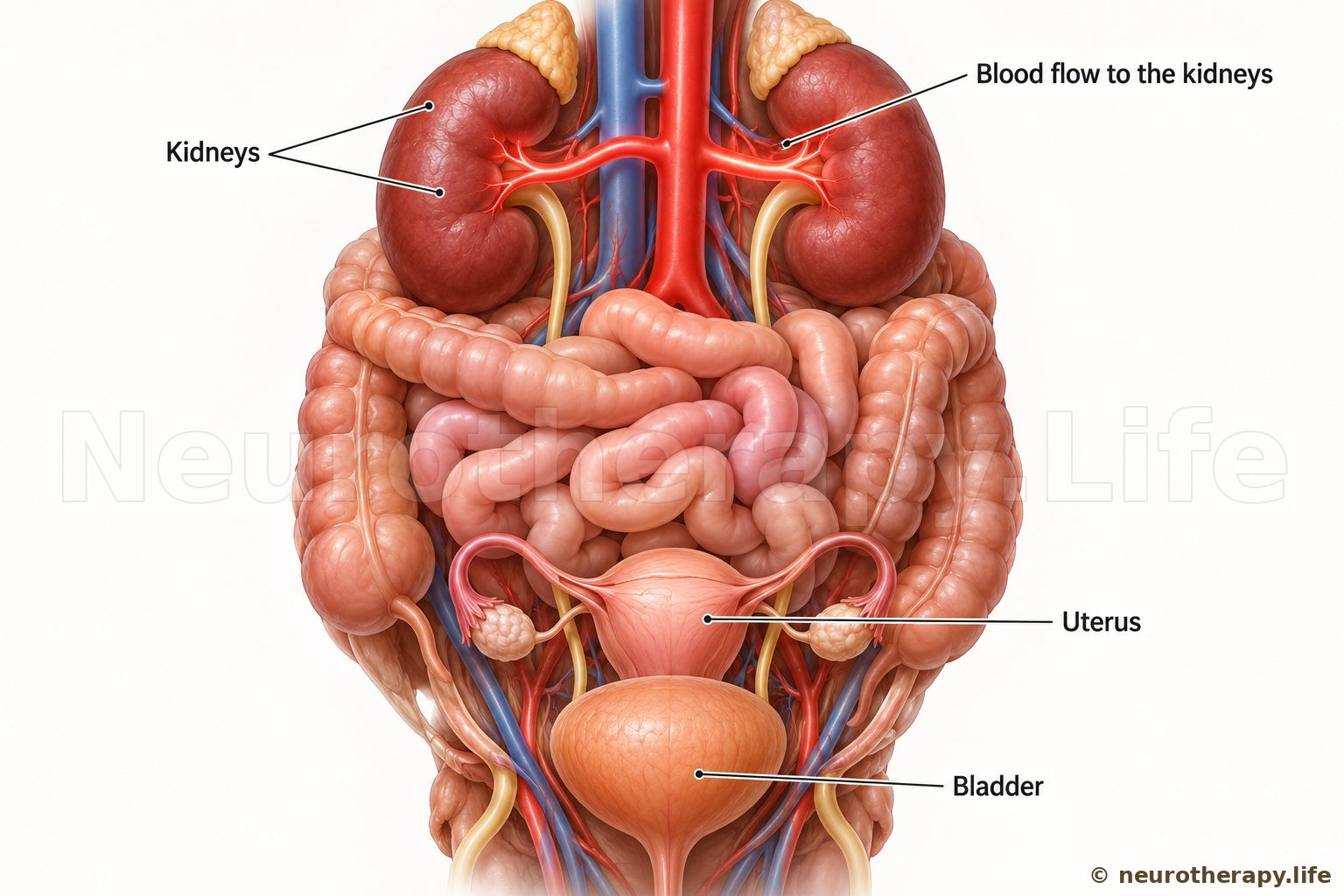
The two kidneys, each about the size of a fist, receive roughly 20% of all the blood the heart pumps — about a litre every minute.
Source: Garza FA, Leslie SW. Anatomy, Abdomen and Pelvis: Kidneys. StatPearls. 2025.
Also called: Folded legs, फोल्डेड लेग्स
Folded Legs is a Neurotherapy (LMNT) treatment in which the patient's own folded thighs gently press their fists into the belly while lying on the back. The teaching says it sets the abdomen, is excellent for pains below the navel, and greatly increases blood flow to the kidneys. It is never given when there is inflammation in the abdomen.
Folded Legs is a physical treatment — named for a movement, not for a gland. It is one of the few treatments in which the instrument is the patient's own body: the therapist folds the legs, and the patient's thighs do the pressing, through the patient's own fists placed beside the navel.
The teaching gives the reason, and finds it more interesting than the movement. The pressure falls on the urinary bladder, the uterus and the organs of the lower belly, and from this the flow of blood into the kidneys increases very greatly. Then the pain of Liv° and Mu° — the two kidney points at the flanks — goes away.
A working kidney, the teaching says, is not a drain but a sorting office: it throws out more of what is in excess and holds back what is short, from the same fluid. So the hope is that the kidneys clean the blood better, strength and the capacity to work increase, and the patient begins to feel healthy.
You lie on your back with both heels drawn close to your buttocks. You make two loose fists, thumbs tucked inside, and rest them on the belly beside the navel, closed palms facing down.
The therapist lifts your legs from the middle and folds them from the knees toward the chest, so that your own thighs come down on your fists. Nothing from the therapist touches the belly itself.
How this point is given — the tool, the pressure, the count and the exact movement — is deliberately not described here. A demonstration video for this point is being prepared; until it is on this page, learn the method hands-on from a trained Neurotherapist before giving it. Please do not give any point from a written description alone: a point given in the wrong place or the wrong way can do harm.
The exact technique is taught hands-on in the Neurotherapy (LMNT) course. See the course →
These are the teaching's stated purposes. That the kidneys receive a large share of the body's blood is plain physiology; that this movement raises it is the therapy's own reasoning from practice.
Folded Legs sits with the navel-setting treatments and the two kidney points.
Chosen after examination, and only where the abdomen is not inflamed.
It stands in the navel-setting part of this long, twelve-part treatment.
“If the stomach, the lungs and the kidneys work properly, then disease simply cannot come.”
No. The therapist folds your legs; your own thighs press your own fists. You stay in control, and it is held only as long as you are comfortable.
Breathing out softens the belly muscles, so the press is gentle and deep instead of forced.
Anyone with inflammation in the abdomen, and anyone whose belly pain needs a doctor first — such as sudden severe pain or a rigid belly.
The two kidneys, each about the size of a fist, receive roughly 20% of all the blood the heart pumps — about a litre every minute.
Source: Garza FA, Leslie SW. Anatomy, Abdomen and Pelvis: Kidneys. StatPearls. 2025.
The kidneys filter about 180 litres of fluid from the blood every day, yet only about 1.5 litres leave as urine. They take back almost all of it — sorting, not just draining.
Source: Garza FA, Leslie SW. StatPearls. 2025.
Besides cleaning the blood, the kidneys make erythropoietin, which tells the marrow to make red cells, and the active form of vitamin D.
Source: Garza FA, Leslie SW. StatPearls. 2025.
A clinical anatomy summary of the kidneys: they receive about 20% of the heart's output, filter around 180 litres a day while passing about 1.5 litres of urine, and balance salts, acid and blood pressure.
This page explains what a Neurotherapy (LMNT) treatment is for; it is not a self-treatment guide and does not diagnose. Neurotherapy (LMNT) works alongside your medical care — keep taking the medicines your doctor prescribed.
Send COURSE for course details, or your name, age and health issue for a consultation.