Also called: Abdomen setting treatment, पेट सेटिंग
Abdomen Setting is a gentle Neurotherapy (LMNT) treatment for a very bad stomach in which no hand touches the belly at all. You lie on your back while the therapist holds your folded knees and moves your hips and lower back through a few slow, passive movements.
Overview
What is Abdomen Setting?
Abdomen Setting is one of the uncommon treatments of Neurotherapy (LMNT) — treatments found one at a time for one trouble each, and kept because they worked. The teaching says it plainly: for those whose stomach is very bad, this is one more excellent treatment for setting the abdomen.
What makes it unusual is what is missing. No hand goes near the belly. The knees are the handle for every movement. The abdomen is 'set' by moving the hips and the lower back in directions they have stopped going in, so the belly is eased from the outside, without being pressed.
It is passive. 'Passive' means the therapist does all the moving and the patient does none. A patient who tries to help tightens the very muscles the movement is meant to loosen, so she is told once: let your legs be heavy and let me do the work.
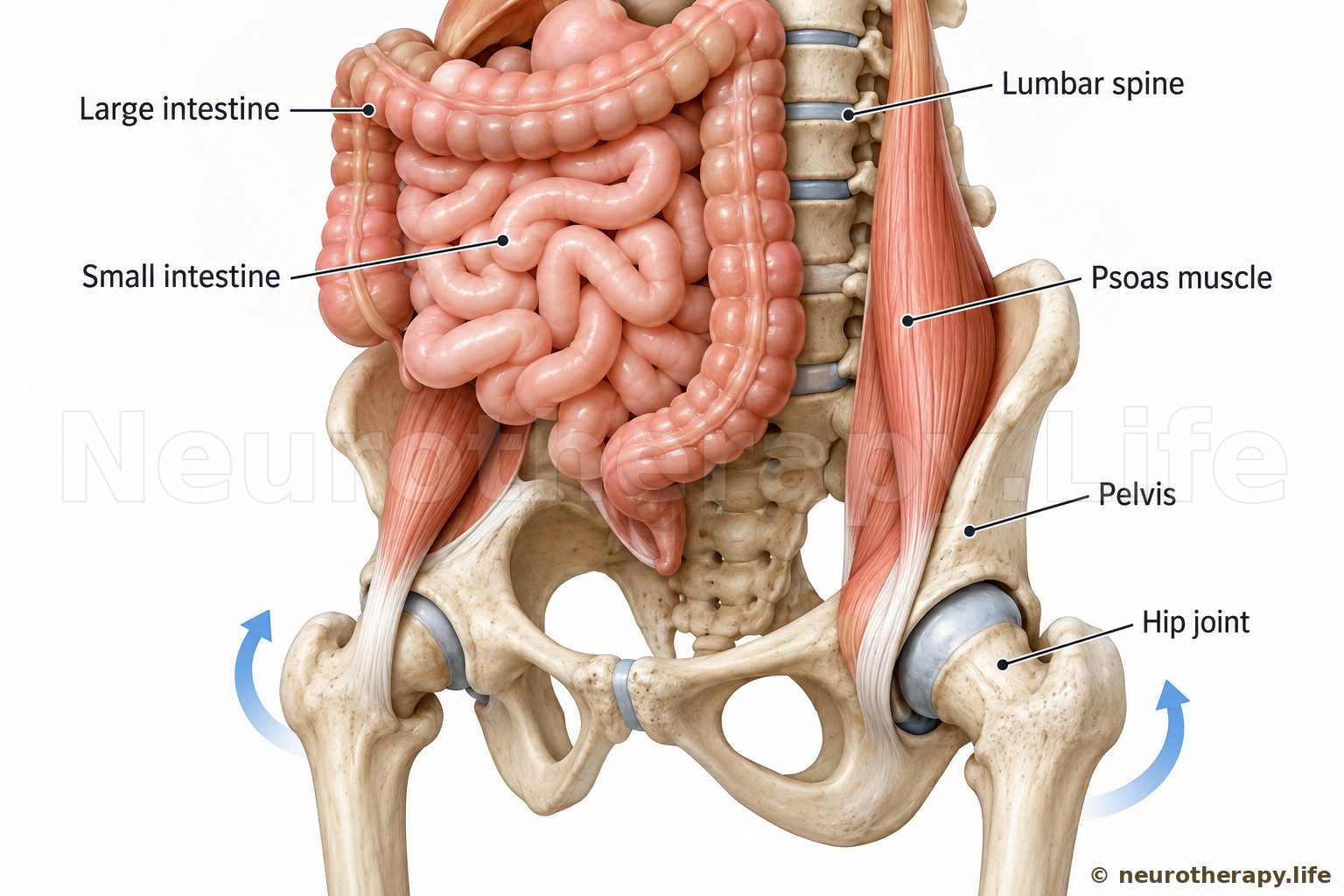
The gut rests in the bowl of the pelvis, against the lower back and hip muscles. Moving the hips moves the whole frame around it.
Where it is given
Where and in what position is it given?
PositionLying on the back
Body areaFolded knees as the handle; the movement reaches the hips, pelvis and lower back — nothing touches the abdomen
You lie straight on your back. The therapist stands beside you and uses the hands only — no chairs and no feet, unlike many other Neurotherapy (LMNT) treatments.
The work happens at the knees and hips, not on the belly. The legs are folded, the hands hold the knees, and the movement travels up through the thighs into the hips, the pelvis and the lower back. In one movement the head also turns, gently, the other way.
How it is given
How is Abdomen Setting given?
How this point is given — the tool, the pressure, the count and the exact movement — is deliberately not described here. A demonstration video for this point is being prepared; until it is on this page, learn the method hands-on from a trained Neurotherapist before giving it. Please do not give any point from a written description alone: a point given in the wrong place or the wrong way can do harm.
Feels likeSlow, easy rocking and turning of the hips and lower back
The exact technique is taught hands-on in the Neurotherapy (LMNT) course. See the course →
What it does
What does Abdomen Setting do?
The teaching describes it as a way of 'setting' a very bad stomach. Body science gives a simple picture of why moving the hips can matter to the belly: the gut lies in the bowl of the pelvis, wrapped by the muscles of the lower back and hips. The claim that it settles the stomach is the therapy's own, made from long clinical experience.
Moves the hips and lower back through directions they have stopped going in.
Lengthens tight muscles around the pelvis without any pressure on the belly.
Does for the patient what a yoga twist would ask her to do herself — useful for someone who cannot twist on her own.
Is used where the stomach is very bad, as one more way of setting the abdomen.
Organs it reaches
Intestines — The coils of gut that rest in the pelvic bowl — the 'stomach' the patient complains of.
Low back — The lower back is turned gently with every movement.
Joints — The hip joints carry the movement from the knees to the trunk.
Muscles — The hip and back muscles are lengthened, not pressed.
What it is used for
When is Abdomen Setting used?
The teaching names one use: a stomach that is very bad. The therapist decides from the examination whether it is added to the plan, and checks the cautions first.
A very bad stomach
Abdominal painWhere the belly stays troubled and the therapist wants to settle it without pressing on it.
ConstipationA heavy, sluggish stomach is the kind of trouble the yoga 'wind-releasing' movements were also meant for.
Pregnancy: not given beyond the early weeks. Lying flat on the back is itself unsuitable later in pregnancy, before any turning is added. Pregnancy care
Not after recent surgery of the abdomen, pelvis or hip.
Not after a hip replacement: taking a bent knee across the middle of the body is exactly the position that can put a replaced hip out of its socket. Joints
Not where a spinal bone is known to have crumbled, and not in brittle bones generally. Osteoporosis
In everyone: stop where the patient guards. A movement that meets resistance has reached its end for today.
“Whether or not the patient gets immediate benefit from our treatment, let no harm reach him through our carelessness — attend to this.”
— Dr. Lajpatrai Mehra
Common questions
Will the therapist press on my stomach?
No. Nothing touches the belly in this treatment. The therapist only holds your knees and moves your legs.
Should I help by moving my legs?
No. Let your legs be heavy. If you help, you tighten the muscles the movement is trying to loosen.
My mother is seventy and has thin bones. Can she have it?
It is closed if a spinal bone has already crumbled, and it is not given in brittle bones. The therapist will check first. Many gentler treatments stay open to her.
Is this the same as a yoga twist?
It is very close. Yoga's pavanamuktasana (the wind-releasing pose) and the lying twist do almost the same movements. The difference is who supplies the effort: here the therapist does it for you.
Surprising facts
1Your gut has its own brain
The wall of the gut holds a mesh of hundreds of millions of nerve cells — the enteric nervous system. It runs the squeezing waves of digestion largely on its own.
Source: Furness JB. The enteric nervous system and neurogastroenterology. Nat Rev Gastroenterol Hepatol 2012;9:286–294.
2A muscle that joins spine to thigh
The psoas muscle starts on the lower spine, runs down behind the belly organs and fixes onto the thigh bone. It is one reason a movement of the hip is felt in the lower back and the belly.
Studies of bloated patients found that mild physical activity helps gas pass along the gut, while lying perfectly still slows it.
Source: Villoria A et al. Physical activity and intestinal gas clearance in patients with bloating. Am J Gastroenterol 2006;101:2552–2557.
4Why replaced hips are guarded
After many hip replacements, patients are told not to bring a bent knee across the middle of the body, because that position is the commonest way the new joint slips out.
Source: NHS / standard orthopaedic hip precautions after posterior-approach total hip replacement.
This page explains what a Neurotherapy (LMNT) treatment is for; it is not a self-treatment guide and does not diagnose. Neurotherapy (LMNT) works alongside your medical care — keep taking the medicines your doctor prescribed.
Ready to begin?
Send COURSE for course details, or your name, age and health issue for a consultation.