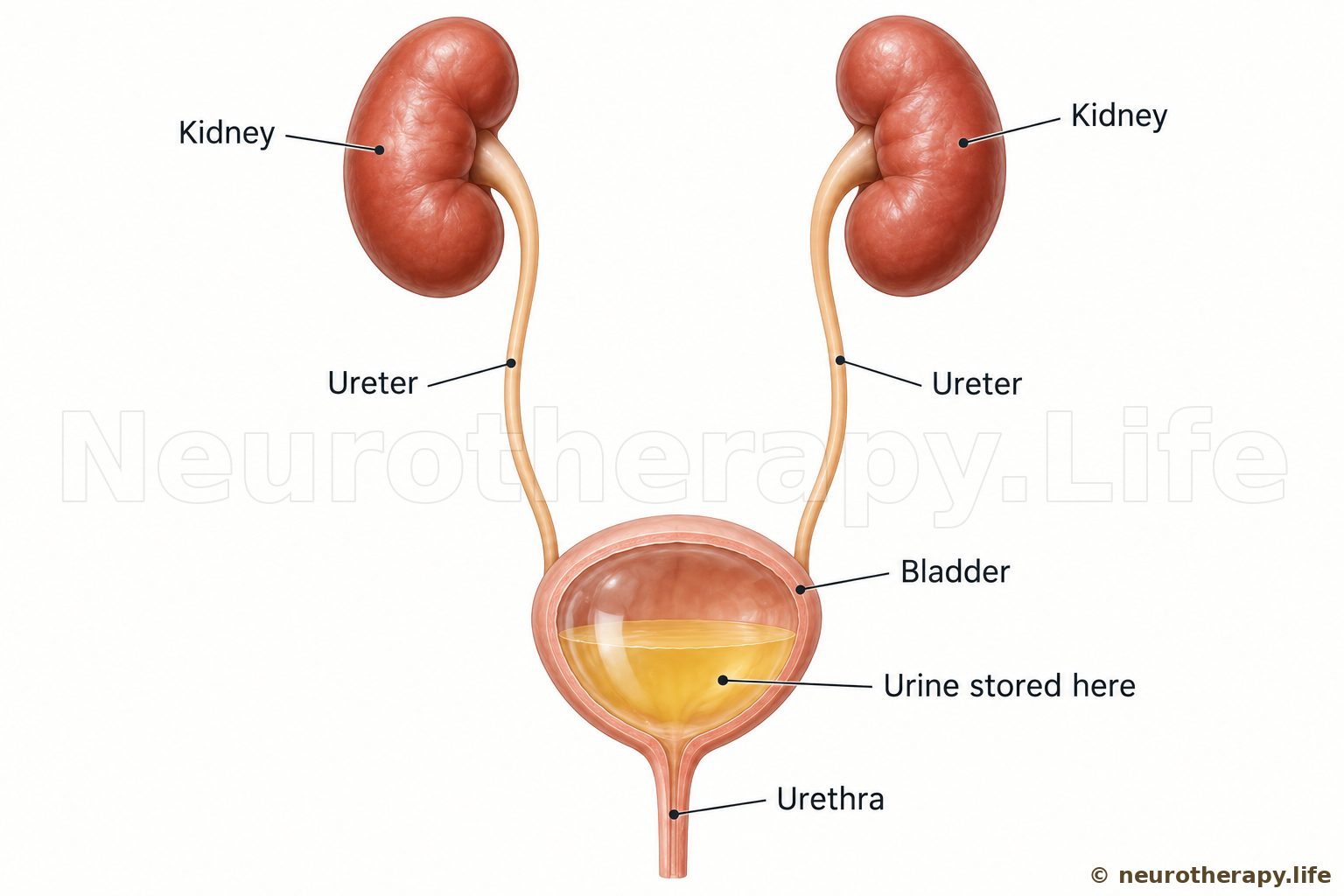
Your bladder is a stretchy, balloon-like bag of muscle low in your belly. It stores the urine your kidneys make all day and night, keeps it sealed in without a drop leaking, and empties it only when you decide the time is right.
Overview
What is the bladder?
Your bladder (urinary bladder) is a hollow, muscular bag that sits low in your pelvis, just behind the pubic bone. It is the storage tank of your urinary system. Two thin tubes, the ureters, bring urine down from the kidneys, and one tube, the urethra, carries it out of the body.
The kidneys make urine all the time, drop by drop. Without a bladder you would leak all day. Instead, the bladder quietly fills, stretches, tells your brain when it is getting full, and holds on until you choose to empty it.
Bladder troubles — burning, leaking, going too often, or urine that will not come — are very common, especially in women and older adults. Many can be helped, and some, like blood in the urine or urine that stops completely, need a doctor quickly.
The bladder is the storage tank at the bottom of the urinary tract: the kidneys make urine, the ureters carry it down, the bladder holds it, and the urethra lets it out.
Function
What does the bladder do?
The bladder has two jobs that are opposites: to store and to empty. For most of the day it is relaxed and tightly closed. A few times a day it switches over — the muscle wall squeezes and the outlet opens — and then it switches back.
Stores urine that the kidneys make non-stop, so you are not leaking all day.
Stretches as it fills while keeping the pressure inside low, so urine can keep draining down from the kidneys.
Sends 'I am filling' messages to the brain through its nerves.
Keeps its outlet sealed with two ring muscles (sphincters) and the muscles of the pelvic floor.
Empties fully when you choose: the wall squeezes and the outlet relaxes at the same moment.
Its lining is a waterproof barrier, so the wastes in urine do not soak back into the body.
Filling
Urine trickles in from the ureters in small squirts. The wall muscle stays relaxed and the folds of the lining open out.
The message
Stretch sensors in the wall report to the spinal cord and brain. At around 150 mL you may first notice it; by about 400 mL the feeling is strong.
Holding on
Until you reach a toilet, the brain keeps the emptying reflex switched off and the outer ring muscle stays tight.
Emptying
When you decide to go, a switch in the brainstem flips: the ring muscles relax, the wall muscle squeezes, and the bladder empties — usually in well under a minute.
How does the bladder work with other organs?
Kidneys — The kidneys filter the blood and make the urine; the bladder stores it and lets it out.
Spinal cord — The nerves that squeeze the bladder and hold its outlet shut come from the lowest part of the spinal cord, at the sacral level.
Brain — The brain decides when it is the right time and place to empty, and keeps the reflex switched off until then.
Muscles — The pelvic floor — a hammock of muscles under the bladder — supports it and helps hold urine in when you cough or sneeze.
Bowel — The bladder and the back passage share nerves and space; a bowel full of hard stool can press on the bladder and upset its control.
Prostate — In men, the prostate wraps around the urethra just below the bladder; when it grows, the flow can weaken.
The bladder has a muscular wall, a special stretchy lining, a smooth triangle at its base where the tubes join, and ring muscles that guard the exit.
The wall
The wall is built in layers, from the inside out.
Urothelium (lining) — A special lining found only in the urinary tract. Its cells flatten out as the bladder fills, and it is waterproof, so urine cannot soak back through.
Folds (rugae) — When the bladder is empty, the lining lies in folds; they smooth out as it fills.
Detrusor muscle — The thick middle layer of smooth muscle, which works without your conscious control. It stays relaxed while filling and squeezes to empty.
Outer covering — A thin outer coat; over the top of the bladder it is covered by the smooth lining of the belly (peritoneum).
Openings and tubes
Ureters — Two muscular tubes, each about 25–30 cm long, that carry urine from the kidneys in little waves. They pass through the bladder wall at a slant, which acts like a one-way valve.
Trigone — A smooth triangle on the floor of the bladder between the two ureter openings and the urethra. It hardly stretches and is very sensitive — irritation here gives a strong urge to go.
Bladder neck — The funnel-shaped lowest part, where the bladder joins the urethra.
Urethra — The tube that carries urine out. It is about 4 cm long in women and about 18–20 cm in men, where it also runs through the prostate.
The guards at the exit
Two ring muscles and a muscle floor keep urine in.
Internal sphincter — A ring of smooth muscle at the bladder neck. It works automatically — you cannot tighten it by choice.
External sphincter — A ring of skeletal muscle around the urethra, below the internal one. This is the one you squeeze when you 'hold on'.
Pelvic floor — A sling of muscles stretched across the bottom of the pelvis. It holds up the bladder, womb and bowel, and tightens when you cough, laugh or lift.
The nerves
Filling and emptying are run by three sets of nerves and a switch in the brain.
Sacral nerves (S2–S4) — 'empty' — Nerves from the lowest part of the spinal cord make the wall squeeze and the inner ring relax.
Lower-back nerves — 'store' — Nerves from the lower back part of the cord keep the wall relaxed and the bladder neck closed while it fills.
Pudendal nerve — 'hold' — Carries your conscious 'hold on' order to the outer ring muscle and the pelvic floor.
The brainstem switch — A small centre in the brainstem (the pons) flips the bladder from 'store' to 'empty', but only when the thinking brain gives permission.
Where is the bladder located?
The bladder sits low in the middle of your pelvis — the bowl of bone at the bottom of your trunk — just behind the pubic bone. When empty it hides completely behind that bone. As it fills, it rises up into the lower belly, and a very full bladder can be felt above the pubic bone.
Behind the bladder lies the back passage (rectum) and the sacrum, the flat triangular bone at the base of the spine. In women the womb rests on top of it and the vagina lies behind it; in men the prostate sits just below it. In young children the bladder sits higher, partly in the belly.
This neighbourhood matters in LMNT teaching. The nerves of the bladder come from the same sacral levels over which the Triangle for piles and (2) S4–S5 are given, face down, on the back of the sacrum.
An empty bladder is a small, flattened, somewhat triangular bag with a thick wall and a folded pink lining inside. As it fills it becomes rounder, like a balloon, and its wall grows thinner and smoother.
From outside it is pinkish-grey and muscular. Its top, called the dome, is the part that rises and stretches; its base, with the trigone and the bladder neck, stays fairly fixed.
How big is the bladder?
An adult bladder comfortably holds about 400–500 mL — roughly two cups. It can stretch further, but by then the urge is strong. Most adults first notice it filling at around 150 mL.
Empty, it is about the size of a small pear. Full, it can grow to the size of a large grapefruit. A child's bladder holds much less — roughly, in mL, 30 times the child's age in years plus 30, up to about age 12.
The kidneys send down about 1–2 litres of urine a day, and most adults empty the bladder about 6 to 7 times in 24 hours.
Conditions and disorders
What conditions and disorders affect the bladder?
Bladder problems fall into a few families: infection and irritation, leaking, urine that will not come out properly, and trouble that starts in the nerves or elsewhere in the body.
Infection, burning and stones
InfectionsUrine infection (cystitis) — burning, going often, cloudy or smelly urine. Much more common in women.
InflammationA bladder lining that stays irritated and sore, sometimes long after an infection.
Kidney stonesStones from the kidney can travel down into the bladder, and stones can also form inside it.
Leaking and control
Urinary problemsLeaking with a cough or sneeze, sudden urges, going too often, or urine that is too little or too much.
Bed-wettingWetting the bed at night in children past the age of dryness.
Uterine prolapseWhen the pelvic floor weakens, the womb and the bladder can sag, bringing leaks or a dragging feeling.
Pregnancy careThe growing womb presses on the bladder, and leaks after childbirth are common.
Enlarged prostate (BPH)In older men, a growing prostate squeezes the urethra — a weak stream, dribbling and night waking.
ConstipationA bowel packed with hard stool presses on the bladder; in children it is a common hidden cause of wetting and infections.
When the cause lies in the nerves or elsewhere
Low back painBack pain with numbness around the seat or urine that will not come can mean the nerves at the bottom of the spine are being crushed — an emergency.
Spina bifidaA spine that did not close before birth can damage the bladder's nerves.
Multiple sclerosis (MS)Urgency and leaking are common, because the messages between brain and bladder are disturbed.
Paralysis and strokeStroke and spinal injury can take away control of the bladder.
Needing to go very often, or suddenly and urgently
Leaking with a cough, sneeze, laugh or lift, or before reaching the toilet
A weak or stop-start stream, straining, or feeling the bladder has not emptied
Waking two or more times a night to pass urine
Cloudy, dark or strong-smelling urine, or pain low in the belly
Blood in the urine, fever with burning, or being unable to pass urine at all — see a doctor the same day
What tests check the health of the bladder?
Urine test and culture — Checks for germs, pus cells, blood, sugar and protein; a culture finds which germ is causing an infection and which medicine will work.
Bladder diary — For two or three days you write down what you drink, when you go and how much — a simple record that tells the doctor a great deal.
Ultrasound (KUB) and leftover urine — Sound waves show the kidneys, ureters and bladder, stones or growths, and how much urine is left after you empty.
Uroflowmetry — You pass urine into a special funnel that measures how strong and how quick the stream is.
Urodynamic tests — Thin tubes measure the pressure inside the bladder as it fills and empties, to understand leaking or poor emptying.
Cystoscopy — A thin camera is passed up the urethra to look inside the bladder — for example when there is blood in the urine.
Blood tests — Kidney function (creatinine), blood sugar, and in men sometimes PSA for the prostate.
How are bladder conditions treated?
Fluids and habits — Drinking enough, cutting down tea, coffee and alcohol, treating constipation, and going at regular times.
Pelvic floor training — Regular squeezing exercises for the muscles that hold urine in — the first treatment for leaking in women, and helpful for men too.
Bladder training — Slowly stretching the time between visits, to calm a bladder that calls too often.
Medicines — For example antibiotics for infection, medicines to calm an overactive bladder, or to relax or shrink an enlarged prostate — prescribed by a doctor.
Catheter — A soft tube to drain urine when the bladder cannot empty by itself.
Procedures and surgery — For example removing stones, treating an enlarged prostate, supporting a sagging bladder, or treating a growth.
Neurotherapy (LMNT)
In LMNT teaching, the bladder's outlet is worked from the back of the pelvis, over the sacrum. Two treatments there face opposite ways: (2) S4–S5 relaxes and opens the ring muscles of the bladder and is given to bring urine that is held back; the Triangle for piles tightens the same muscles and is given for leaking and for children who wet the bed. So before the sacrum is touched, the therapist always asks one short question: how much urine is coming? The answer decides which of the two may be given, and which is barred. The same 'which way is the trouble going?' rule runs through the Medulla and Swt pair: on the left side they open a narrow outlet, on the right they narrow a slack one. This is support alongside a doctor's care — urine that stops, burns with fever, or shows blood goes to a doctor first.
Points
(2) S4 – S5 — Given face down: the heels work beside the lower sacrum to relax and open the ring muscles of the bladder, womb and back passage. Used to bring urine that is held back or scanty. Never given to someone passing too much urine.
Triangle for Piles — The opposite action on the same bone: three upward jerks along the sacrum, pushing towards the head, tighten the pelvic muscles and the ring muscles. Given for control of urine in children and the elderly and for bed-wetting. Never given to someone passing little urine.
(15) Medulla — Opens both Medulla–Swt pairs for the bladder outlet: (15) Left Medulla for a narrow outlet, (15) Right Medulla for a slack one.
(6) Right Swt — With (15) Right Medulla, three rounds: narrows a slack outlet, for women or older people who pass a few drops on laughing or sneezing. Not given in high blood pressure.
(6) Left Swt — With (15) Left Medulla, three rounds: opens a narrowed outlet where urine comes with pain in a hard, fast jet. Guruji recognised it from one question — does the stream strike the wall? Not given in diabetes.
Folded Legs — Lying on the back, the folded legs and the patient's fists press gently on the lower belly as she breathes out. The teaching says the pressure falls on the bladder and womb and increases blood flow to the kidneys. Not given with inflammation in the abdomen.
Liv° — Liv° and Mu° are the kidney points on the back, between the last rib and the hip bone; the therapist checks them before planning any urine work.
WD — The point below the navel whose code covers the womb and the prostate; the organs that sit around the bladder.
(15) Right Medulla (6) Right Swt × 3 treatments, a minute and a half apart, then the Triangle for piles. For urine that leaks with a sneeze or hard laughter — especially in middle-aged women, whose muscles below the navel have become loose. The teaching calls it the same picture as bed-wetting in children.
“Neurotherapy (LMNT) treats according to the condition of the body.”
— Dr. Lajpatrai Mehra
“Only they know the pain; you do not.”
— Dr. Lajpatrai Mehra
Never do this
See a doctor the same day — or go to hospital — if you cannot pass urine at all, if there is blood in the urine, if burning comes with fever, shivering or loin pain, or if back pain comes with numbness around the seat, weak legs or new loss of bladder or bowel control. The last is an emergency of the nerves at the bottom of the spine. How to tell a patient to see a doctor
(2) S4–S5 is never given to someone who passes too much urine — it opens the ring muscles and increases urine. (2) S4 – S5
When too little urine is passed, the Triangle for piles (it tightens the ring muscles) and Gal are not given. Ask how much urine is coming before the sacrum is touched. Triangle for Piles
(6) Right Swt is not given with high blood pressure, and (6) Left Swt is not given with diabetes. (6) Right Swt
Folded Legs is not given when there is inflammation in the abdomen. Folded Legs
Children: a child gets half the adult dose and light treatment only, given by a trained therapist. A child who wets the bed should also be checked for constipation and infection. Lighter formulas for children, the elderly and the weak
Cancer: if the person has cancer, (10) Pan, Thymus, Pit, Lu + Sh, Rt. Ov / Lt. Ov and (30) Medulla are never given — the therapist changes the plan.
Keep taking the medicines your doctor prescribed, and finish any course of antibiotics. Neurotherapy (LMNT) works alongside your medical care, never instead of it.
Care
How can I keep my bladder healthy?
A few simple daily habits protect the bladder at every age.
Drink water through the day
LMNT teaching: a glass of water half an hour after a meal, then about every hour — not all at mealtimes and not in big gulps. Pale straw-coloured urine usually means you are drinking enough.
Do not hold on too long — or go 'just in case'
Go when you feel a normal urge. Holding for hours stretches the bladder; going too often 'just in case' trains it to call early.
Sit and relax to empty fully
Take your time; don't push or strain. Women should sit fully on the seat rather than hover, so the pelvic floor can relax.
Keep the bowel regular
Constipation presses on the bladder. Fibre, water and moving every day help both.
Squeeze your pelvic floor
A few sets of gentle squeezes every day keep the muscles that hold urine strong — before and after childbirth, and with age.
Wipe front to back, and don't smoke
Wiping from front to back keeps bowel germs away from the urethra. Smoking is the biggest risk factor for bladder cancer.
Common questions
How often is it normal to pass urine?
Most adults go about 6 to 7 times in 24 hours; anything from 4 to 10 can be normal if it does not bother you. Waking once at night can be normal with age; waking two or more times regularly is worth mentioning to a doctor.
Why do women get urine infections more often?
Mainly because a woman's urethra is short — about 4 cm, against about 20 cm in a man — so germs from the skin and bowel reach the bladder more easily. About half of all women have at least one urine infection in their life.
Is leaking urine just a part of getting older?
It is common, but it is not something you simply have to live with. Pelvic floor exercises, bladder training, treating constipation and medical care help many people. Tell your doctor — it is a very ordinary thing for them to hear.
What colour should urine be?
Usually pale straw-yellow. Dark yellow often means you need more water. Some foods and vitamins change the colour. Red, brown or cola-coloured urine needs a doctor.
I came for back pain. Why does the therapist ask about my urine?
Because two LMNT treatments given over the sacrum work on the same muscles that control your water, and they pull opposite ways. One opens and is not given if you pass too much urine; the other tightens and is not given if you pass too little. A short question decides which one is safe for you.
Is it bad to hold urine?
Holding for a short while is normal — that is what the bladder is for. Holding for many hours again and again can overstretch it and makes infections more likely. Go when you feel a normal urge.
What should I ask my doctor or therapist?
Is there an infection, and which germ is it? Do I need a urine culture?
How much urine is left in my bladder after I empty it?
Could my sugar, my prostate, my bowel or my medicines be causing this?
Would pelvic floor exercises or bladder training help me, and who can teach me?
Which signs mean I must come back the same day?
(To the therapist) Am I passing too much or too little urine for the sacrum treatments, and which one are you giving me?
Surprising facts
1A lining that stretches like no other
The bladder's lining, the urothelium, is found nowhere else. As the bladder fills, its surface cells flatten out and the folds open, so the bladder can grow several times larger while the pressure inside hardly rises until it is nearly full.
Source: Guyton & Hall, Textbook of Medical Physiology — the cystometrogram (pressure stays low during filling); Gray's Anatomy — urothelium (transitional epithelium).
2A one-way valve with no moving parts
The ureters do not enter the bladder straight. They tunnel through its wall at a slant. As the bladder fills, its own pressure squeezes these tunnels shut, so urine cannot be pushed back up towards the kidneys.
Source: Moore KL, Clinically Oriented Anatomy — oblique course of the ureters through the bladder wall acting as a valve; Guyton & Hall — vesicoureteral reflux prevention.
3The 21-second rule
Engineers who filmed animals from rats to elephants found that almost every mammal heavier than about 3 kg — people included — empties a full bladder in about 21 seconds. A bigger animal has a bigger bladder, but also a longer, wider urethra that lets gravity speed the flow.
Source: Yang PJ, Pham J, Choo J, Hu DL. Duration of urination does not change with body size. PNAS 2014;111(33):11932–11937 (21 ± 13 seconds).
4Urine is not sterile
For generations doctors were taught that healthy urine is sterile. Newer, more careful culture methods have found small communities of bacteria living in the healthy bladder — a 'urinary microbiome' that scientists are still learning about.
Source: Hilt EE et al. Urine is not sterile: use of enhanced urine culture techniques to detect resident bacterial flora in the adult female bladder. J Clin Microbiol 2014;52(3):871–876.
5A switch in the brainstem
A baby's bladder empties by reflex whenever it is full. Toilet training is the thinking brain learning to control a small switch in the brainstem that flips the bladder from 'store' to 'empty'. That is why a stroke or spinal injury can take bladder control away.
Source: Fowler CJ, Griffiths D, de Groat WC. The neural control of micturition. Nature Reviews Neuroscience 2008;9(6):453–466.
64 cm against 20 cm
A woman's urethra is about 4 cm long; a man's is about 18–20 cm. That short distance is the main reason urine infections are so much more common in women — about half of all women will have at least one in their lifetime.
Source: Gray's Anatomy (urethral lengths); Foxman B. Epidemiology of urinary tract infections: incidence, morbidity, and economic costs. Am J Med 2002;113(Suppl 1A):5S–13S.
7Its yellow comes from old blood
The yellow colour of urine comes mainly from urobilin (urochrome), a pigment made when old red blood cells are broken down. The more water you drink, the more it is diluted and the paler your urine looks.
Source: Guyton & Hall — bilirubin metabolism and urobilinogen/urobilin excretion in urine; Cleveland Clinic, 'Urine Color'.
8What you breathe in, your bladder holds
Harmful chemicals in tobacco smoke are absorbed into the blood, filtered out by the kidneys and then sit in the urine against the bladder lining for hours. That is why smoking is the biggest single risk factor for bladder cancer — linked to about half of all cases.
Source: Freedman ND et al. Association between smoking and risk of bladder cancer among men and women. JAMA 2011;306(7):737–745; National Cancer Institute, Bladder Cancer — risk factors.
A day in the life of your bladder
~1–2 Lof urine sent down by the kidneys
~6–7trips to the toilet in 24 hours
~400–500 mLheld comfortably when full
~150 mLwhen you first notice it filling
~21 sto empty a full bladder
Yoga
Pelvic floor squeeze Mūla Bandha (gentle form)
Benefits
Strengthens the muscles that hold urine in when you cough, sneeze, laugh or lift.
Well-studied: regular pelvic floor training helps many women with leaking.
Can be done anywhere — sitting, standing or lying — without anyone noticing.
How to do it
Sit tall on a chair with your feet flat and your thighs relaxed.
Gently squeeze and lift the muscles around the back passage and the urethra — as if stopping wind — without tightening the buttocks or holding your breath.
Hold for 3 to 5 seconds, then relax fully for the same time.
Repeat 8 to 10 times; do this three times a day, slowly building the hold up to 10 seconds.
Add a few quick squeezes of one second each at the end.
Take care
Do not practise by stopping your stream while passing urine — that can upset emptying. If you have pelvic pain, or are pregnant or recently delivered, learn it first from a physiotherapist or doctor. Stop if it causes pain.
Bridge pose Setu Bandhāsana
Benefits
Works the buttock and pelvic floor muscles together, which support the bladder.
Opens the front of the hips after long hours of sitting.
How to do it
Lie on your back with knees bent and feet flat, hip-width apart, arms by your sides.
Breathe in. As you breathe out, gently lift the pelvic floor and raise the hips.
Hold for 3 to 5 slow breaths, keeping the knees in line with the feet.
Lower the back down slowly, one part at a time. Repeat 5 times.
Take care
Avoid it with a recent neck or back injury, or in later pregnancy. Keep the lift small if your back hurts, and never press the weight onto the neck.
Bound angle — the butterfly Baddha Koṇāsana
Benefits
Gently opens the hips and inner thighs and relaxes the pelvic area.
A calm, seated pose that pairs well with slow breathing.
How to do it
Sit on a folded blanket and bring the soles of your feet together.
Draw the heels in only as far as is comfortable; hold the feet with your hands.
Sit tall and let the knees drop gently — do not press them down.
Breathe slowly for 1 to 2 minutes, then straighten the legs.
Take care
Skip it or put cushions under the knees if you have knee, hip or groin pain. Do not bounce the knees.
Watch
UTI PROLONGED - WITH INFLAMATION - LMNT Neurotherapy
A Hindi demonstration of the treatment given when a urine infection has gone on long enough to become inflamed: Liv° and Mu°, Chest Only, 20 Round Arrow along the spine, then (6) Adr on the back.
A urine infection — especially with fever, loin pain or blood in the urine — needs a doctor first. (6) Adr is not given with high blood pressure or when immunity is already low; the video does not say this.
Test yourself
Research
Strong evidence
A large Cochrane review found that women with leaking urine who did pelvic floor muscle training were far more likely to report being dry or clearly better than women who had no treatment.
Using better culture methods on urine taken straight from the bladder, researchers grew bacteria from most healthy women's samples — showing the healthy bladder is not sterile.
A review of how the brain and spinal cord control the bladder: nerves from the sacral cord empty it, a centre in the brainstem switches between storing and emptying, and the thinking brain decides when.
This page explains how the body works; it does not diagnose. Neurotherapy (LMNT) works alongside your medical care — keep taking the medicines your doctor prescribed, and see a doctor for any new or severe symptom.
Ready to begin?
Send COURSE for course details, or your name, age and health issue for a consultation.