(2) S4–S5 is a face-down Neurotherapy (LMNT) treatment given on the sacrum, the flat triangular bone at the base of the spine. It is used to help bring urine that is held back, and to help a scanty bowel motion or a scanty menstrual flow — and it is never given to someone who already passes too much urine.
Overview
What is (2) S4–S5?
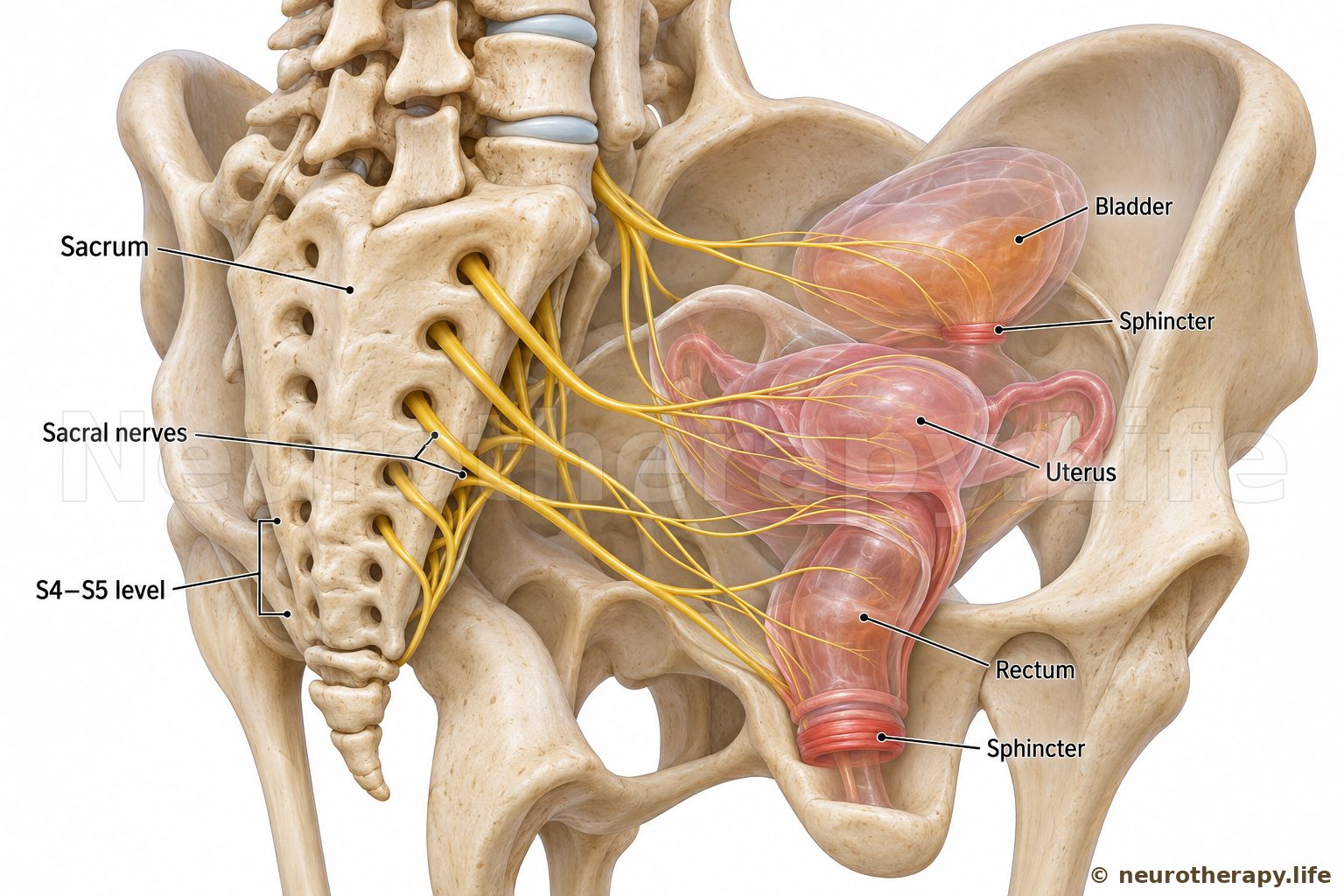
S4 and S5 are the names of the two lowest pieces of the sacrum. The sacrum is the broad, triangular bone at the bottom of your spine, wedged between the two hip bones. It is really five small bones that fuse together into one plate as you grow up.
Through holes in this bone run the sacral nerves — the nerves that serve the bladder, the uterus and the back passage. Each of these organs has a sphincter, a ring of muscle that stays closed to hold things in and opens to let them out.
In Neurotherapy (LMNT) teaching, (2) S4–S5 stimulates the sacral nerves by drawing the muscles on both sides of the lower sacrum downward. This relaxes and opens those sphincters. That is why it is used to increase urine, and also when bowel motions or the menstrual flow are too little.
It has a close neighbour on the same bone, the Triangle for piles, which works in exactly the opposite direction. The Triangle tightens the same sphincters; (2) S4–S5 opens them. Same square of bone, opposite direction, opposite uses — the direction is the treatment.
The lower sacrum carries the nerves that serve the bladder, the uterus and the back passage — the organs (2) S4–S5 is used for.
Where it is given
Where is (2) S4–S5 given?
PositionLying face down
Body areaLower sacrum, both sides of the midline just above the buttock cleft, and just outside it on both sides
You lie face down, with one and a half pillows under the chest — half of the lower pillow sticking out, the chest on the upper one and the chin on the lower. This is the standard face-down placing for the whole group of back points.
The area is the lower part of the sacrum, low on the back just above the cleft of the buttocks, on both sides of the midline, and then just outside it on both sides of the hip. The therapist stands near your waist and carries their own weight on their hands, supported by two chairs, so that the bone never takes the therapist's full body weight.
How it is given
How is (2) S4–S5 given?
How this point is given — the tool, the pressure, the count and the exact movement — is deliberately not described here. A demonstration video for this point is being prepared; until it is on this page, learn the method hands-on from a trained Neurotherapist before giving it. Please do not give any point from a written description alone: a point given in the wrong place or the wrong way can do harm.
The number written before a point's name is not a strength setting. Each numbered form is a separate named treatment with its own method and timing, taught hands-on in the course.
The exact technique is taught hands-on in the Neurotherapy (LMNT) course. See the course →
What it does
What does (2) S4–S5 do in the body?
Neurotherapy (LMNT) teaching says (2) S4–S5 stimulates the sacral nerves and so relaxes and opens the sphincters of the bladder, the uterus and the back passage. Body science confirms that these organs really do take their nerve supply from the lower sacral levels; how a press on the back of the bone reaches them is the therapy's own explanation, from clinical experience.
Helps bring urine that is held back or obstructed.
Is given to increase urine; the teaching adds that high blood pressure may then come down — a claim to check with home readings, not to assume.
Helps when bowel motions come too little, and is added alongside Gas 'I' when constipation is severe.
Helps increase a scanty menstrual flow.
Organs it reaches
Bladder — Its outlet ring of muscle is relaxed and opened, so urine flows more freely.
Uterus (womb) — Used when the menstrual flow is scanty.
Bowel — Used when motions are too little, and in severe constipation with Gas 'I'.
Spine — The sacrum is the last bone of the spine, where the nerves of bladder and bowel leave.
Kidneys — More urine passed means more fluid leaving the body — the route by which the teaching links it with blood pressure.
Its family
Which points work the same area?
The sacrum is worked by several face-down treatments. They share ground but not direction, and some must not be given on the same day.
Triangle for Piles — The exact opposite: lifts toward the head and tightens the sphincters — for piles, fissure, fistula and prolapse. Not given where urine is little.
Fracture Point — Starts on the same sacral ground with a rising and falling heel, for a fractured or slipped lower spine.
(4) Ku — Kundali (Ku) — the hold at the base of the spine, given from between the feet; (4) Ku is one of its named forms.
Gas 'I' — Its partner in severe constipation: Gas 'I' moves the small intestine and (2) S4–S5 is added with it.
What it is used for
What is (2) S4–S5 used for?
The therapist first checks which way the trouble is travelling. (2) S4–S5 is for things held back — never for things already flowing too much.
Never given to anyone who passes too much urine. (2) S4–S5 opens the bladder outlet and increases urine, so it would push the trouble further the way it is already going. Urinary problems
Blood pressure: the claim that it lowers pressure is to be checked, not assumed. Keep home readings morning and evening before and after a course, and never stop blood-pressure medicine on your own. High blood pressure
Bleeding from the back passage is never put down to piles until a doctor has examined it — before any heel goes near the sacrum. How to tell a patient to see a doctor
It includes a quick movement over bone. Jerk-type treatments are held back in osteoporosis, frail bone, long-term steroid use and a bone broken from a small knock, and jerk points are held back in pregnancy. Osteoporosis
“If urine is obstructed, the (2) S4, S5 treatment helps to bring it. It is not to be given to those who pass too much urine.”
— Dr. Lajpatrai Mehra
Common questions
Is (2) S4–S5 the same as the Triangle for piles?
No. They are given on the same bone but in opposite directions. The Triangle tightens the sphincters and is used in piles; (2) S4–S5 opens them and is used when urine, motions or the menstrual flow are too little.
I get up many times at night to pass urine. Will this help?
Not this point. Passing too much urine is exactly where (2) S4–S5 is barred. Frequent urine also needs a doctor's check for sugar, infection or the prostate. Your therapist will choose a different plan.
Can it replace my blood-pressure tablets?
No. Neurotherapy (LMNT) works alongside your medical care. Keep taking your medicine, keep home readings, and let your doctor decide any change.
Does it hurt?
It is felt as a firm, brief draw at the base of the spine. The therapist's weight is held on the hands and chairs, not on your bone. Tell the therapist at once if anything feels sharp.
Surprising facts
1The 'sacred bone'
The name sacrum comes from the Latin os sacrum, 'sacred bone' — a name used for well over a thousand years. Nobody is sure why; one theory is that the original Greek word simply meant 'large'.
The sacrum starts as five separate vertebrae that fuse into a single bone by early adulthood. It acts like a keystone: the weight of the whole upper body passes through it into the hips and legs.
Source: Gray's Anatomy, 41st ed., The vertebral column.
3The bladder's nerves leave from here
The nerves that squeeze the bladder empty come mainly from the sacral levels S2 to S4 of the spinal cord. The same levels serve the lower bowel and the pelvic organs.
Source: Fowler CJ, Griffiths D, de Groat WC. The neural control of micturition. Nat Rev Neurosci. 2008;9:453–466.
4Doctors stimulate these nerves too
Modern medicine uses 'sacral nerve stimulation' — a small implanted device that sends gentle electrical signals to a sacral nerve — for some people with bladder and bowel control problems.
Source: NICE interventional procedures guidance on sacral nerve stimulation; US FDA approval of sacral neuromodulation, 1997.
This page explains what a Neurotherapy (LMNT) treatment is for; it is not a self-treatment guide and does not diagnose. Neurotherapy (LMNT) works alongside your medical care — keep taking the medicines your doctor prescribed.
Ready to begin?
Send COURSE for course details, or your name, age and health issue for a consultation.