Face Down: Treatments Given on the Back and Spine
When the patient lies face down, the whole back, the spine and the sacrum (the flat triangular bone at the base of the spine) lie under the therapist's hand or foot. This guide explains how the patient is laid down, and what the adrenal points, the arrow family and the sacral treatments are used for.
Overview
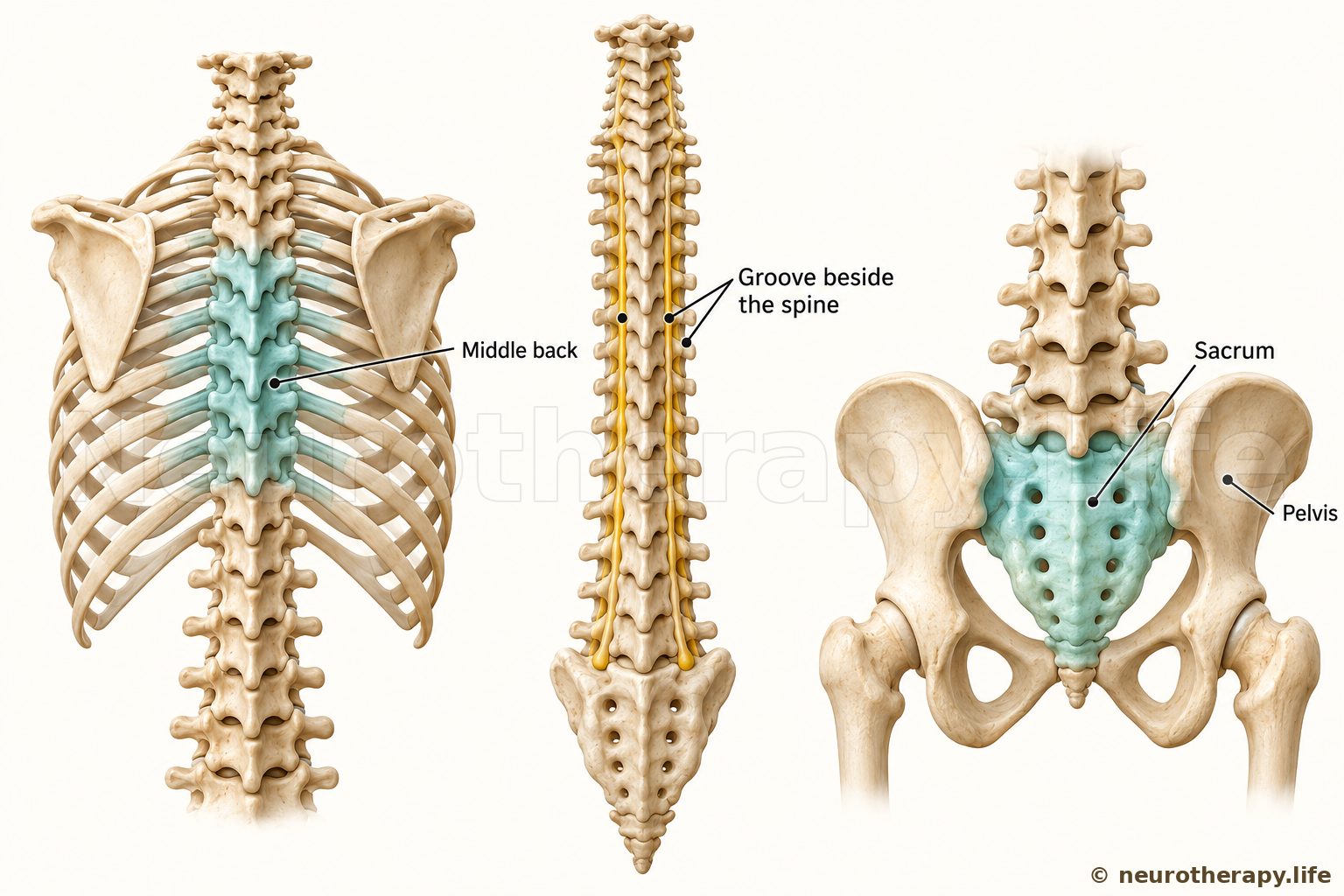
When the patient lies face down, the whole back, the spine and the sacrum (the flat triangular bone at the base of the spine) lie under the therapist's hand or foot. This guide explains how the patient is laid down, and what the adrenal points, the arrow family and the sacral treatments are used for.
The pillows come before any treatment
Every treatment in this group starts with the same rule, and the rule is written again under almost every point: a pillow and a half under the chest is compulsory. Two pillows lie on the floor, but only half of the lower one is under the patient. The upper pillow lifts the chest. The part of the lower pillow that sticks out holds the chin. The face then hangs clear, so the patient breathes with the head straight, not turned to one side.
Why so strict? A teaching case shows it. In a busy camp, an older woman was laid down with only one pillow, so she turned her head to one side to breathe and stayed like that for the whole session. Nothing was done to her neck, yet by evening she could not turn it. Her neck had simply been held at the far end of its turn, without support, for too long. The rule matters most for anyone who already has neck pain or cervical spondylosis (wear of the neck bones), but it is written for everybody.
- The upper pillow lifts the chest and eases the deep arch of the low back.
- The lower pillow sticks out so the chin has a place to rest.
- The head stays straight; the patient is never left with the face turned to one side.
Two adrenal points: Adr and Swt
The group opens with a pair. Adr is given in the middle part of the back with the palms, and it is used to stimulate the cortex, the outer layer of the adrenal glands (two small glands that sit on top of the kidneys). Adr also comes in named variants, such as (2) Adr, (4) Adr and (6) Adr. These are three separate treatments with three separate purposes and three separate cautions, not three strengths of one thing.
Swt is given beside the spine in the middle and lower part of the chest region, with the palms standing on their edge. It is used to stimulate the medulla, the inner core of the adrenal gland, and also the sweat glands. It can be written for both sides, or as Left Swt or Right Swt, and each written form is given differently. The exact hand shapes and directions are taught hands-on in the course.
An honest note sits beside these names. The adrenal glands lie deep, at the back of the belly, far below where the palms rest. What the hand really works on is the muscle, the nerves and the tissue of the back. The name tells the therapist which point is meant; it is not a promise to fix a hormone.
The arrow family: one strip of back, worked in different ways
Several strokes run along or beside the spine, and on a treatment card they are often drawn as small arrow signs rather than written out. They differ in four things: the tool (sole, thumb edge or two fingers), the path, the direction and how the written number is used. An arrowhead on the card shows the direction of the therapist's own push, never a flow inside the patient.
Back Arrow, also called Blood Supply to Lungs, is a light rub with the soft part of the sole from the middle of the back toward the shoulder and upper arm; it is given in all breathing-related diseases. On the Spine rides the row of bony knobs and is used where there is slight unevenness between them. Beside the Spine and Round Arrow work the gutters on either side of the knobs, where the nerves leave the spinal column. When these three are all to be given, the card simply says Three Arrows.
Organ Clearance is the gentlest of the family: a light palm over the whole back, given lying face down or seated on a chair. Its name can suggest that waste is being flushed out by rubbing, which has not been measured. What is well known is simpler: slow, light contact over a large area helps a person settle and relax.
Sudhakar: a name whose method is not published
One more back treatment, Sudhakar, is named after the patient in whom it was worked out. The therapy says only what it does: the muscles around all the vertebrae of the back are moved and brought back to their correct place, and it is useful for the neck, the back and all pains. No tool, path or direction is given for it anywhere. The honest course, kept here, is to leave that silence standing. A therapist who has not been shown Sudhakar hand to hand gives the treatments that do carry a method over the same area, and writes on the card what was actually given.
The sacrum: Ku, Triangle for Piles and S4–S5
The last treatments of the group are given over the sacrum, and they are the most forceful in the face-down work. The therapist stands with the full body weight carried on the hands through two chairs, so the foot delivers only what the arms allow. The chairs also decide the direction of the push.
Ku, the old Kundali, is given with the sole at the very end of the spine. The plain form, (4) Ku, is used to reduce alkali and to ease spasticity (tight, stiff muscles) and stiffness in the joints. Half Ku comes in several named variants, each a separate treatment with its own aim: some are aimed at the white blood cells that fight infection, and some at the pineal gland, the small gland in the brain that makes the sleep hormone melatonin. For the variants aimed at the pineal gland, the therapy itself notes that research is still continuing.
Triangle for Piles works upward over the sacrum, toward the head. Besides piles, it is used in anal fissure, fistula and prolapse of the rectum, for urine control in children and the elderly, and in women for prolapse of the uterus and very heavy periods. (2) S4–S5 works over the same area in the opposite direction: it is used where urine is held back, in high blood pressure, and where the menstrual flow is scanty. Because one tightens and the other releases, each carries its own caution.
What the hand reaches, said honestly
Along the whole spinal cord, nerves leave in pairs, one left and one right: thirty-one pairs in all. Each pair splits almost at once. The larger branch goes forward to the chest wall, the belly wall and the limbs; the smaller branch turns back to the deep muscles and small joints of the spine. That is why the strokes beside the spine aim at the gutters, not at the bony knobs.
The therapy names its points after the organs it hopes to help, but a patient deserves to know the difference between a name and a promise. Back Arrow does not change how the heart pumps blood to the lungs; it loosens a chest wall that has been working hard, alongside the inhaler, never instead of it. Neurotherapy (LMNT) works alongside medical care.
Key points
- A pillow and a half under the chest is compulsory for every face-down treatment, with the head kept straight.
- Adr is used for the outer layer of the adrenal glands, Swt for the inner core and the sweat glands.
- The arrow family works one strip of back; the tool, path and direction separate one point from another.
- Back Arrow is given in all breathing-related diseases; Organ Clearance is a light palm over the whole back.
- Ku and its half variants are separate treatments with separate aims, never stronger or weaker versions of one thing.
- Triangle for Piles tightens and (2) S4–S5 releases, so each is held back where the other is wanted.
Topics in this guide
Go deeper
ADR
Adr — the point for the outer layer of the adrenal gland
SWT
Swt — for the adrenal core and the sweat glands
Back Arrow
Back Arrow — given in breathing-related diseases
Round Arrow
Round Arrow — the gutters on both sides of the spine
Organ Clearance
Organ Clearance — a light palm over the whole back
(4) Ku
(4) Ku — the old Kundali at the end of the spine
Triangle for Piles
Triangle for Piles — the upward work over the sacrum
The Low Back: Treatments for the Back, Hip and Sciatic Leg
The next group: treatments for the low back
Placing the Patient: The Four Positions of Neurotherapy (LMNT)
How patients are placed for treatment
When the Hand Must Stop: Blocked Points and Safety in Neurotherapy (LMNT)
When a point must not be given
Safety: when it is held back
- Ku is not given to women during their periods, nor to anyone with low blood pressure. Both are asked about before the session. Low blood pressure
- Triangle for Piles is not given to anyone who passes little urine, because it tightens the muscles that hold urine in. Urinary problems
- (2) Adr and (6) Adr are both held back in high blood pressure, each for its own reason. High blood pressure
- In diabetes, Round Arrow is given only over the low back, not the full length of the spine. Diabetes
- The pillow rule is compulsory for everyone, and matters most with neck pain or cervical spondylosis. Cervical spondylosis
- Never ATF in alkalosis, never ALTF in acidosis. Children get light treatment. Correcting the Two Kingdoms: Acid and Alkali Formulas
- In cancer, (10) Pan, Thymus, Pit, Lu+Sh, Rt.Ov/Lt.Ov and (30) Medulla are never given. Cancer care: Neurotherapy (LMNT) support
Guruji says
“In all these treatments, do not forget to give one and a half pillows under the chest.”
Common questions
Why is it 'one and a half' pillows and not two?
Because only half of the lower pillow is under the patient; the other half sticks out, and that is where the chin rests. Call it two, and both may end up stacked under the chest, leaving nothing for the face.
Why press my back when my problem is in my stomach?
Because the nerves that serve the stomach come out of the spine, and the back is where they can be reached from outside. The therapist is working where the wiring runs, not on the skin itself.
Is the jerk over the hip bone safe?
It is a short movement, not a heavy one. The therapist's weight is carried on two chairs, so it can be made as small as needed. You may ask the therapist to stop at any moment, without giving a reason.
Will the adrenal point fix my hormones?
The name tells the therapist where to find the point on your card; it is not a promise. The gland lies deep and no hand reaches it. What the hands work on is your back and the nerves in it. Keep taking any medicine your doctor has given you.
Watch
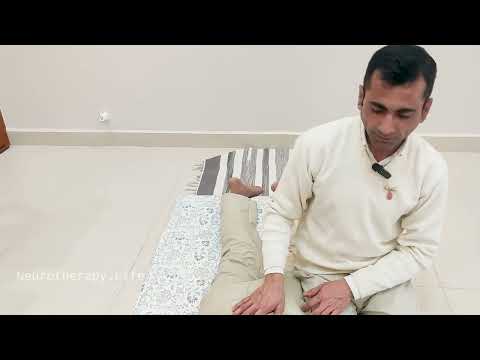
A short Hindi demonstration of Organ Clearance: the patient lies face down on two pillows, and the therapist's open hands work over the whole back in overlapping strokes — first up and down, then side to side — twice each, leaving no area out.
Test yourself
Explore more
Organs
Body systems
Diseases
Points
Formulas
Topics
Read more
This page explains what a Neurotherapy (LMNT) treatment is for; it is not a self-treatment guide and does not diagnose. Neurotherapy (LMNT) works alongside your medical care — keep taking the medicines your doctor prescribed.