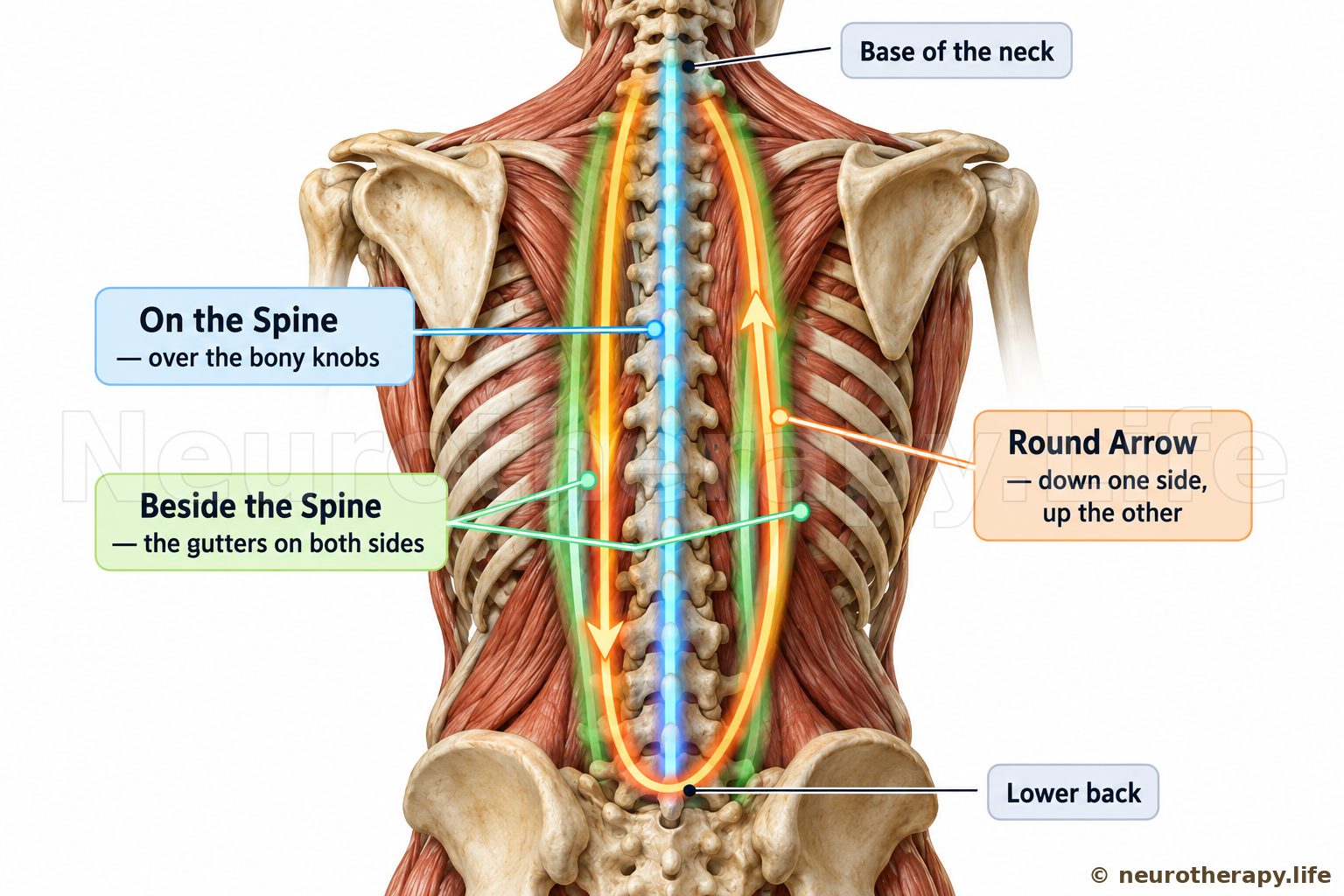
Three Arrows is a shortcut in the writing, not a separate treatment. When a card asks for On the Spine, Beside the Spine and Round Arrow all together, it simply writes '3 arrows' — three face-down strokes along the backbone, each given in full.
Overview
What is Three Arrows?
The back has its own family of treatments called the arrows, because each is drawn on a card as an arrow-shaped symbol showing the path of the stroke. Three of them work right along the backbone: On the Spine, Beside the Spine and Round Arrow.
When all three are to be given, the therapy writes '3 arrows' as a shortcut. It adds nothing new: it is those three strokes, each given in full. The number written in front is not shared out among them — each of the three receives the whole of it.
Shorthands are where doses get lost, which is why this one is taught carefully. A therapist who reads '3 arrows' as one small treatment has given only a third of what was written.
'3 arrows' is three strokes along one strip of back: over the knobs, beside them, and round them.
Where it is given
Where is Three Arrows given?
PositionLying face down
Body areaThe whole length of the spine, from the base of the neck to the lower back
You lie face down with one and a half pillows under the chest — this is compulsory for every face-down treatment. Half of the lower pillow sticks out beyond the edge, your chest rests on the upper one and your chin on the lower, so the head stays straight and you can breathe without turning your neck.
The work runs along the backbone, from the base of the neck down to the lower back and back up again: over the bony knobs, in the soft gutters on both sides of them, and down one side of the knobs and up the other.
How it is given
How is Three Arrows given?
How this point is given — the tool, the pressure, the count and the exact movement — is deliberately not described here. Watch the demonstration video on this page, and learn the method hands-on from a trained Neurotherapist before giving it. Please do not give any point from a written description alone: a point given in the wrong place or the wrong way can do harm.
Feels likeThree firm, smooth passes along the back
The exact technique is taught hands-on in the Neurotherapy (LMNT) course. See the course →
What it does
What does Three Arrows do?
It does what its three parts do. The source credits them with these effects:
On the Spine is used where there is a slight unevenness between the spinal beads.
Beside the Spine works the gutters where the spinal nerves leave the backbone.
Round Arrow is credited with lowering acid in the body, and with stimulating the fluid and the cord inside the spine along which messages travel to the brain.
Together they form the spinal part of the Oxygen formulas, written for any body wanting more oxygen in its tissues.
One and a half pillows under the chest are compulsory. Without them the head turns to breathe and the neck can stiffen — the trouble then comes from the position, not the treatment. Where pillows go during treatment, and where they never go
In diabetes and in chronic illness, all the arrows are given only over the lower back, because the full arrow is held to provoke both the thymus and the adrenal glands. Diabetes
Every back is screened first. Numbness between the legs, new trouble passing or holding urine or motion, weakness in both legs, a past cancer with back pain, pain that wakes you at night, fever, a recent fall or unexplained weight loss — see a doctor first. How to tell a patient to see a doctor
Thin bones, long-term steroid use, the elderly and the very thin: a gentle hand. Children receive light treatment. Neurotherapy (LMNT) works alongside medical care. Osteoporosis
A teaching case
Teaching case: the missing half pillow
At a camp, an older woman was laid face down with only one pillow under her chest because the second was in use elsewhere. With nowhere to rest her chin, she turned her head to one side to breathe and lay like that through the arrows and the back sweep. By the next morning she could not turn her neck, and believed the treatment had hurt her. Nothing had been done to her neck; the position had done it — which is why the pillows are not optional.
A composite case written to teach the reasoning — not one patient’s file.
Common questions
Is Three Arrows a separate point?
No. It is a shortcut in the writing for three existing strokes — On the Spine, Beside the Spine and Round Arrow — all given in full.
Is the number on the card shared among the three?
No. Each of the three strokes receives the full number written.
Why do I need one and a half pillows?
So that your chin rests on the lower pillow and your head stays straight. Lying with the head turned for a long time can leave the neck stiff.
Surprising facts
1Thirty-one pairs of nerves
Thirty-one pairs of spinal nerves leave the spinal cord through small openings between the vertebrae — the gutters beside the spine lie right over their exits.
Source: Standring S (ed). Gray's Anatomy, 41st ed. Elsevier, 2016.
2The cord is shorter than the spine
In adults the spinal cord usually ends around the first or second lumbar vertebra; below that, a bundle of nerve roots continues down inside the canal.
Source: Standring S (ed). Gray's Anatomy, 41st ed. Elsevier, 2016.
3A cushioned column
Between most vertebrae sits an intervertebral disc — a tough ring with a soft centre — which together make up roughly a quarter of the length of the spine above the sacrum.
Source: Standring S (ed). Gray's Anatomy, 41st ed. Elsevier, 2016.
Watch
LMNT Oxygen Formula — Drugless Support for Asthma & Low Oxygen
This video shows the LMNT Oxygen formula, shared as support alongside medical care for asthma, breathlessness and low oxygen.
Note: keep your inhaler with you and use it as your doctor advised.
This page explains what a Neurotherapy (LMNT) treatment is for; it is not a self-treatment guide and does not diagnose. Neurotherapy (LMNT) works alongside your medical care — keep taking the medicines your doctor prescribed.
Ready to begin?
Send COURSE for course details, or your name, age and health issue for a consultation.