1The bone you can always find
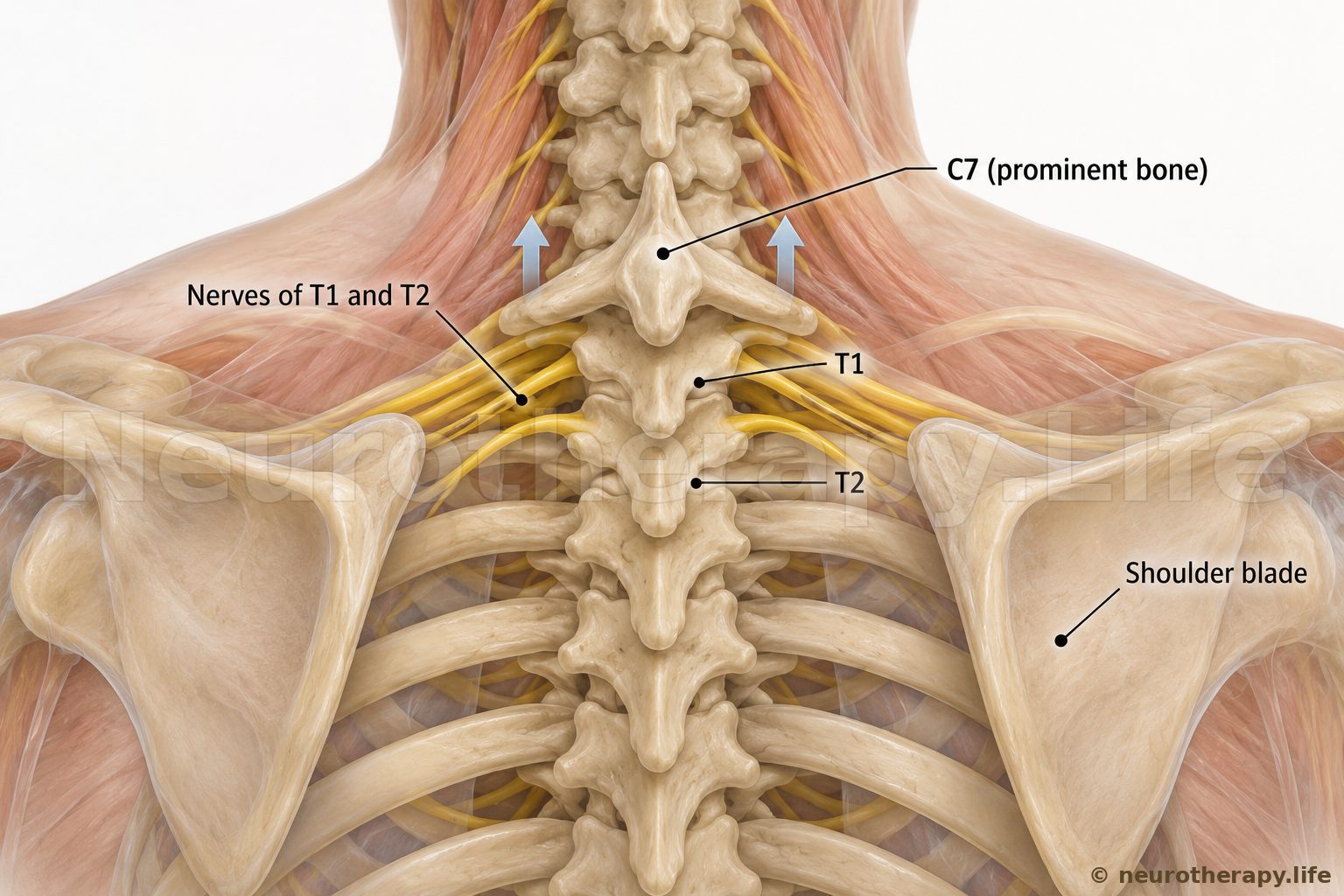
C7 is called the vertebra prominens — the prominent vertebra — because its long spine stands out at the base of the neck when the head is bent forward.
Source: Gray's Anatomy, 41st ed., cervical vertebrae.
Also called: H arrow, ऐच एरो, ↑o↑
H Arrow is a Neurotherapy (LMNT) point given face down between the shoulders, on both sides of the prominent bone at the base of the neck (C7). In the Oxygen formulas it is given so that, through the nerves of T1 and T2, the message reaches the nerves of the brain properly.
H Arrow belongs to the arrow family — a group of strokes along or beside the spine that differ in tool, path, direction and count. On a card it is often drawn rather than spelled: two upward arrows with a small circle between them (↑o↑). Both arrowheads point up, because the stroke runs one way only, from below upward.
Its own entry gives no separate purpose. The purpose is written in the Oxygen formula, where it is given 'so that through the nerves of T1/T2 the message reaches the nerves of the brain properly'. T1 and T2 are the first two bones of the upper back, just below C7.
You lie face down with one and a half pillows under the chest and the chin resting, as in every face-down treatment.
It is given between both shoulders, on both sides of the C7 bone — the bone that stands out most when you bend your head forward.
How this point is given — the tool, the pressure, the count and the exact movement — is deliberately not described here. A demonstration video for this point is being prepared; until it is on this page, learn the method hands-on from a trained Neurotherapist before giving it. Please do not give any point from a written description alone: a point given in the wrong place or the wrong way can do harm.
The exact technique is taught hands-on in the Neurotherapy (LMNT) course. See the course →
In the Oxygen formula, H Arrow is given so that, through the nerves of T1 and T2, the message reaches the nerves of the brain properly. It works alongside Back Arrow, which increases the blood supply to the lungs. Body science confirms that the nerves of T1 and T2 leave the spine right here, and that T1 also joins the nerve network of the arm.
The arrow family shares one strip of back; each member has its own tool, path, direction and count.
H Arrow is used as part of the formulas it belongs to; these are the conditions named for them.
To increase oxygen in the tissues; H Arrow appears at its opening and again at its close.
A long treatment often taught to families, for MS, MND, back pain and more; H Arrow is in its first part.
The name comes from its written symbol — two upward arrows with a small circle between them — used on treatment cards.
It is mostly met inside formulas, such as the Oxygen formula, where it works with Back Arrow and Stretch.
No. It runs from below upward only, with no return stroke.
C7 is called the vertebra prominens — the prominent vertebra — because its long spine stands out at the base of the neck when the head is bent forward.
Source: Gray's Anatomy, 41st ed., cervical vertebrae.
T1 is the first vertebra to carry a pair of ribs. Below it the spine is braced by the rib cage; above it the neck is free to turn.
Source: Gray's Anatomy, 41st ed., thoracic vertebrae.
The T1 nerve joins the brachial plexus, the nerve network of the arm, and helps supply the small muscles of the hand.
Source: Gray's Anatomy, 41st ed., brachial plexus.
This page explains what a Neurotherapy (LMNT) treatment is for; it is not a self-treatment guide and does not diagnose. Neurotherapy (LMNT) works alongside your medical care — keep taking the medicines your doctor prescribed.
Send COURSE for course details, or your name, age and health issue for a consultation.