On the Spine (the stroke along the row of spinal beads)
Also called: On the spinal column, ओन द स्पाइन
On the Spine is a Neurotherapy (LMNT) treatment given face down, in which the edge of the therapist's thumb rubs along the row of bony knobs down the middle of the back and back up again. It is used where there is a slight unevenness between the spinal beads, and it is one of the three strokes that make up '3 arrows' in the Oxygen formulas.
Overview
What is On the Spine?
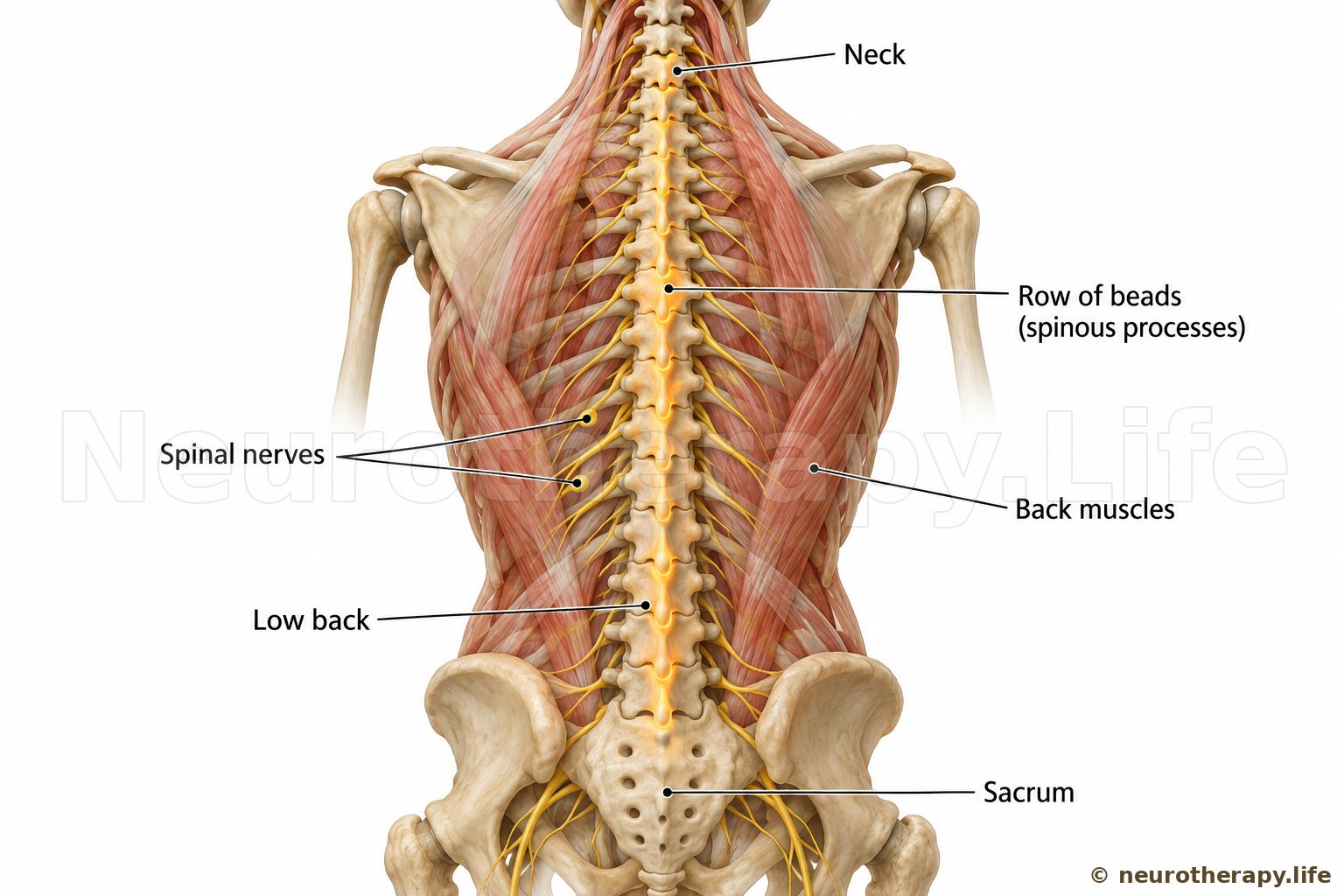
Run a finger down someone's back and you feel a row of hard knobs, like beads on a string — in Hindi, manka. Each is the backward-pointing spur of one vertebra, the only part of the bone near the surface. On the Spine is the stroke that rides directly on that row of beads.
It belongs to the arrow family — six ways of working one strip of back, given face down. The family differs in the tool, the path, the direction and the count. On the Spine rides the beads; its sisters, Beside the Spine and Round Arrow, work the gutter on either side of them.
The teaching gives it one plain purpose: where there is a slight unevenness between the beads, it helps to correct it. On a card it is drawn as a short stem with a small ring at the top and an arrowhead pointing down.
On the Spine rides the row of bony knobs — the beads — down the middle of the back.
Where it is given
Where is On the Spine given?
PositionLying face down
Body areaThe midline of the back, on the row of spinal beads, from the base of the neck to the low back and back up
You lie face down with one and a half pillows under the chest — compulsory for every face-down treatment. Two pillows are used: the chest rests on the upper one, and half of the lower one sticks out beyond the edge so the chin can rest on it and the face stays clear, with the head straight rather than turned.
The stroke runs down the middle of the back, on the row of beads, from the base of the neck to the lowest bone of the low back, and then back up towards the top of the chest spine.
How it is given
How is On the Spine given?
How this point is given — the tool, the pressure, the count and the exact movement — is deliberately not described here. A demonstration video for this point is being prepared; until it is on this page, learn the method hands-on from a trained Neurotherapist before giving it. Please do not give any point from a written description alone: a point given in the wrong place or the wrong way can do harm.
The exact technique is taught hands-on in the Neurotherapy (LMNT) course. See the course →
What it does
What does On the Spine do?
The teaching names a local purpose — evening out slight unevenness between the beads — and, inside the Oxygen formula, setting right the circulation of blood in the whole body. Body science can honestly say that steady, firm, repeated pressure along the back reduces how much pain a person feels; it does not need any claim that a bone has been moved.
Helps correct a slight unevenness between the spinal beads.
In the Oxygen formula, it is one of three strokes given to set right the circulation of blood in the whole body.
Works on the back muscles and the small branches of the spinal nerves that serve the back.
Spinal cord — The cord and its paired nerves inside and beside the column.
Muscles — The long muscles that hold the spine upright.
Its family
Which strokes belong to the same family?
The arrow family works one strip of back in six ways. Three of them together are written as '3 arrows'.
Beside the Spine — Two fingers straddle the beads and press into the gutter on both sides — nothing rides the beads.
Round Arrow — The thumb edge goes down one side of the beads and up the other, pressing on their side walls.
Three Arrows — The shortcut for On the Spine, Beside the Spine and Round Arrow given together, each at the full number written.
Back Arrow — A light sole-rub from the mid-back out to the shoulder — also called blood supply to the lungs.
H Arrow — An upward rub beside the prominent bead at the base of the neck.
Down Arrow — A different point with a similar sign: a palm slide down the back for one kind of dizziness.
What it is used for
What is On the Spine used for?
It is used on its own for slight unevenness of the beads, and more often as part of '3 arrows' inside a formula — always after the back has been screened.
The back
Low back painSlight unevenness between the beads, once the red-flag questions are answered.
Cervical spondylosisBack and neck stiffness; the face-down pillows matter most when the neck is already stiff.
Its first part includes the three spinal strokes, before the kidney, chest and vitamin work.
Safety: when it is held back
Every back is screened first. Numbness in the 'saddle' area, new trouble passing or holding urine or motion, or weakness in both legs means hospital today — no treatment. How to tell a patient to see a doctor
No pressure on the spine with any past cancer and back pain, pain that wakes you at night, fever with severe back pain, a recent fall, or a possible broken vertebra (after menopause, long steroid use or an earlier easy fracture) until a doctor has seen it. Osteoporosis
In chronic illness all the arrows are given only as far as the low-back bones, because in such illness some patients can be harmed through the thymus and some through the adrenal. Diabetes
No. There is no thrust, crack or twist. It is a steady rub with the edge of the thumb along the beads of the back.
Why do I need two pillows under my chest?
They lift the chest, ease the arch of the low back, leave your face clear to breathe, and keep your head straight rather than twisted. The rule is compulsory for every face-down treatment.
What does '3 arrows' on my card mean?
It is a shortcut for three strokes given together: On the Spine, Beside the Spine and Round Arrow — each at the full number written, not divided among them.
Why did the therapist ask me questions about my bladder before touching my back?
Because a few back problems are emergencies, and they announce themselves through numbness, bladder or bowel changes and leg weakness. Those questions take a minute and can prevent serious harm.
Surprising facts
1Thirty-three bones, twenty-four that move
The spine has twenty-four movable bones — seven in the neck, twelve in the chest, five in the low back — then the sacrum, five bones fused into one plate, and the small tail bone.
Along the whole cord, nerves leave in pairs, one left and one right, through small gaps between the bones — thirty-one pairs in all. Everything you feel and everything you move travels one of those routes.
Source: Gray's Anatomy, 41st ed. (spinal nerves).
3The knobs are only handles
The knobs you feel down your back are only the backward spurs of the vertebrae. The weight-bearing blocks, the cushioning discs and the joints lie several centimetres deeper and further forward, out of reach of any thumb.
This page explains what a Neurotherapy (LMNT) treatment is for; it is not a self-treatment guide and does not diagnose. Neurotherapy (LMNT) works alongside your medical care — keep taking the medicines your doctor prescribed.
Ready to begin?
Send COURSE for course details, or your name, age and health issue for a consultation.