The back chart: the kidney points Mu° and Liv°, and back pain that comes from inside
Mu° and Liv° are the Neurotherapy (LMNT) code names for the left and right kidney, checked in the soft hollow between the last rib and the hip bone. The back chart also shows where trouble in an inner organ can be felt as back pain.
Overview
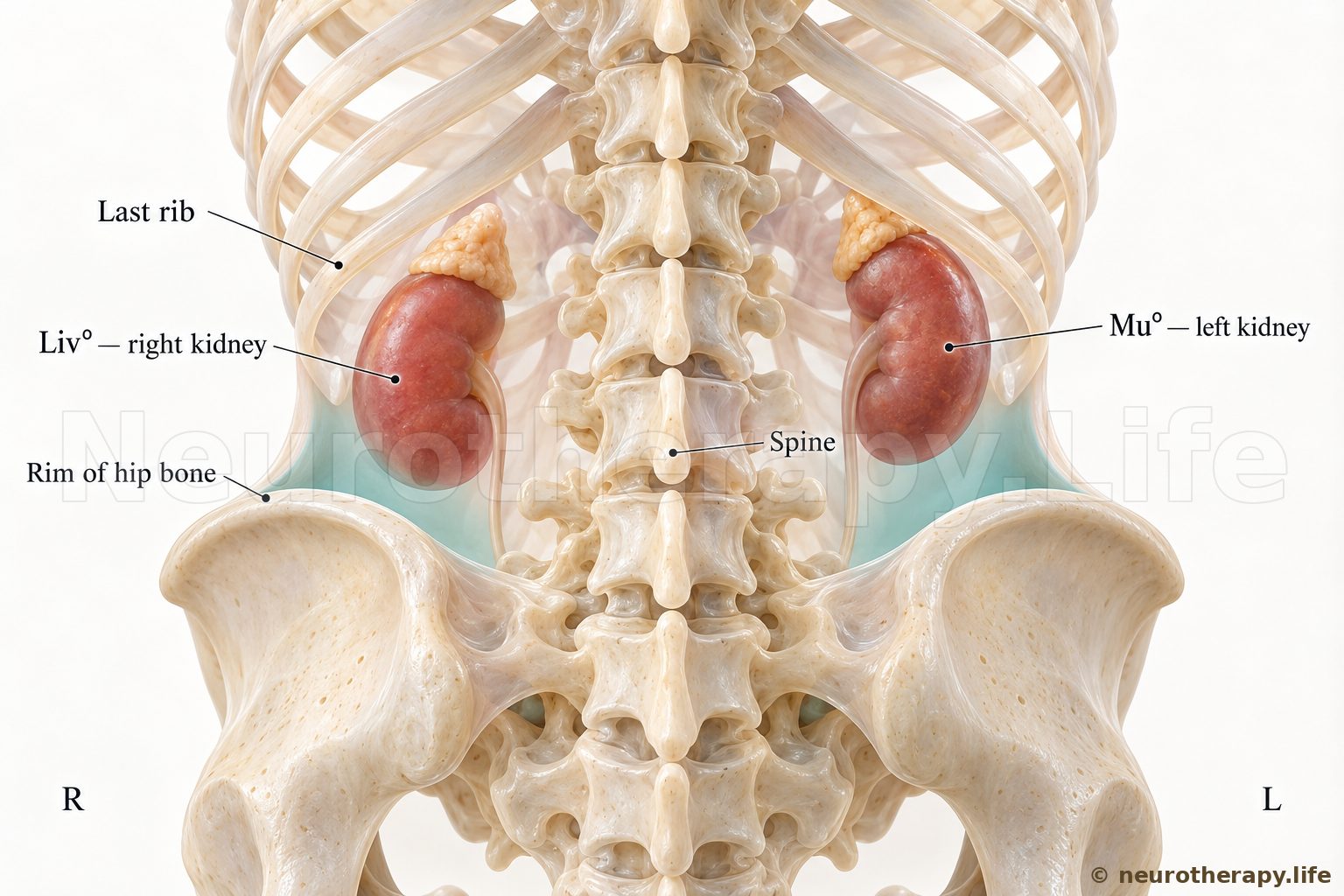
Between the lowest rib and the rim of the hip bone, on each side of the back, there is a gap where the wall feels softer than everywhere around it. It is the one window into the back of the belly that no bone covers, and the kidneys lie behind it, packed in fat. The left one is called Mu° (read ‘Mu zero’) and the right one Liv° (‘Liv zero’). These two are the first points checked in a Neurotherapy (LMNT) examination, and they are always compared with each other, never read alone.
Why code names? First, kindness. The word ‘kidney’ frightens many patients and can even push up an anxious person's blood pressure. Second, memory. The Liv point on the front lies right of the navel, with the right kidney behind it, so the right kidney became Liv°. The Mu point lies left of the navel, so the left kidney became Mu°. The small ring also reminds the therapist that these points are given a little differently from Liv and Mu — a detail taught hands-on in the course.
The back chart also shows something the body does all the time: it reports trouble in an inner organ as an ache in the back. A troubled pancreas can bore through to the mid-back, a kidney is felt in the loin, and the womb or prostate low over the sacrum. But most back pain is muscle and posture. The chart is a prompt to ask ‘could this be coming from the front?’, not a diagnosis.
Key points
- Mu° is the left kidney and Liv° the right; both are checked in the soft hollow between the last rib and the hip bone.
- The two sides are always compared with each other — one flank alone means very little.
- The code names spare patients fear and make the points easy to remember.
- A code may hide a word, never a finding: a worrying sign is always said plainly.
Go deeper
Mu°
Mu° — the left kidney point
Liv°
Liv° — the right kidney point
Kidneys
The kidneys
Mu° pain (examination sign)
What pain at Mu° can mean
Liv° pain (examination sign)
What pain at Liv° can mean
Low back pain
Low back pain
The Navel Speaks First: The Map of the Pain Points
Guide: The Navel Speaks First
Read the full guide
This topic is part of: The Navel Speaks First: The Map of the Pain Points
Safety: when it is held back
- Do not press a flank that is already tender with fever, shivering, burning urine or vomiting — that needs a doctor the same day. Kidney disease
- Keep away from the area with a known kidney swelling, a recent biopsy, or a tube or stent in place. A transplanted kidney sits low in the pelvis, where a hand on the lower belly may reach it.
- Blood thinners or a bleeding disorder: lightest pressure only. In thin bones or a frail elder, never press on the last rib — it is a floating rib and breaks easily. Frail and elderly patients (gentle care)
- Back pain must leave the treatment room when there is numbness in the saddle area, new trouble with urine or bowel control, or weakness in both legs (hospital the same hour); loin pain with fever, or with blood in the urine (doctor today); or pain between the shoulder blades with sweating, breathlessness or pain into the jaw or arm (emergency, call 108/112). How to tell a patient to see a doctor
Watch

Dr. Diwakar Shukla shows students where the Mu° point lies and how it is pressed, both to examine the body and as part of treatment.

Dr. Diwakar Shukla explains and demonstrates the Liv° point — where it lies on the right side and how it is pressed to examine the body.
This page explains what a Neurotherapy (LMNT) treatment is for; it is not a self-treatment guide and does not diagnose. Neurotherapy (LMNT) works alongside your medical care — keep taking the medicines your doctor prescribed.