1Thirty-one pairs
Thirty-one pairs of spinal nerves leave the spinal cord: eight in the neck, twelve in the chest, five in the low back, five at the sacrum and one at the tail bone.
Source: Standard anatomy: Gray's Anatomy (41st ed.), spinal nerves.
Also called: बिसाइड द स्पाइन, Beside the spine stroke
Beside the Spine is a face-down Neurotherapy (LMNT) stroke given in the soft gutter on both sides of the backbone, where the spinal nerves leave the spine. It is one of the three spinal strokes, and it is used mostly inside formulas such as the Oxygen formula.
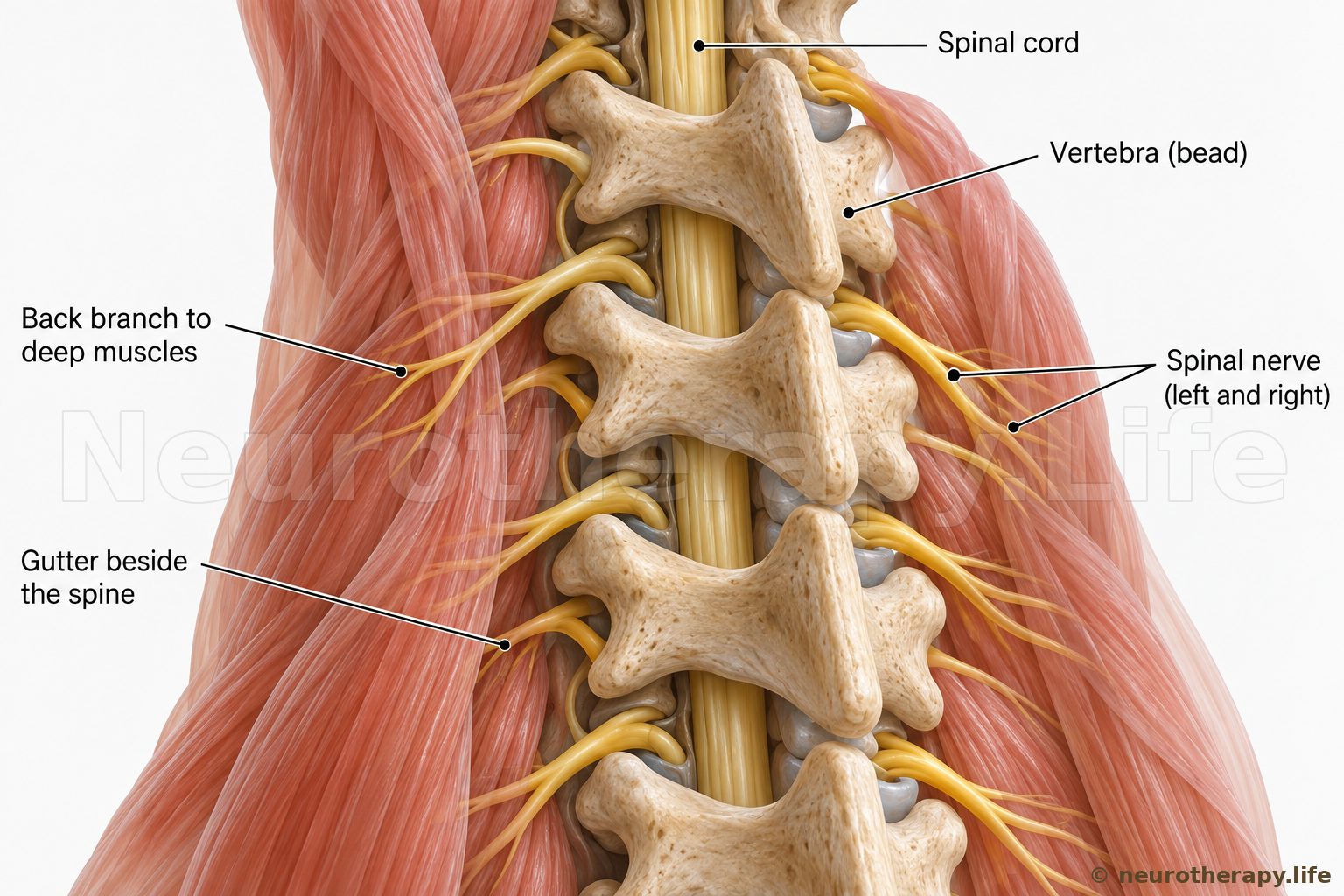
Your backbone is a stack of small bones, called vertebrae (the 'beads' of the spine). Between them, nerves leave the spinal cord in pairs, one to the left and one to the right — thirty-one pairs in all. Everything you feel and everything you move travels along one of these routes.
Beside the Spine works in the soft channel on each side of these beads, not on the beads themselves. Its aim, as the teaching gives it, is to stimulate the spinal nerves that lie on both sides of the backbone. In the Oxygen formula it is given to set right the circulation of blood in the whole body.
It has two sisters. On the Spine rides the beads themselves, and Round Arrow presses on the side of the beads. When all three are written together, the card says 'Three Arrows' as a shortcut.
The patient lies face down with pillows under the chest, the head straight, as for every face-down treatment.
The area is the channel on both sides of the backbone, along the length of the back from the base of the neck to the low back. Nothing rides on the beads themselves — that is what makes it different from On the Spine.
How this point is given — the tool, the pressure, the count and the exact movement — is deliberately not described here. A demonstration video for this point is being prepared; until it is on this page, learn the method hands-on from a trained Neurotherapist before giving it. Please do not give any point from a written description alone: a point given in the wrong place or the wrong way can do harm.
The exact technique is taught hands-on in the Neurotherapy (LMNT) course. See the course →
Each spinal nerve divides just after it leaves the bone. Its smaller back branch supplies the deep muscles that hold the spine upright, the small joints between the beads, and a strip of skin beside the midline. That branch lies right under this stroke.
Beside the Spine is one of the three spinal strokes. Written together, the three are called Three Arrows, and each is still given at the full written number.
Beside the Spine is rarely given on its own. It is used mainly through the formulas that contain it, inside a plan built from the patient's own findings.
Opens the chest, works the whole spine, then opens the chest again — to raise oxygen in the tissues.
A long treatment often taught to a family; the three spinal strokes come early in it.
“In chronic illnesses, some patients can be harmed by Thymus, while some others by Adr. So in such illnesses all the arrows are to be given only as far as L1–L5, so that the patient comes to no harm.”
No. On the Spine rides the beads of the backbone; Beside the Spine works the channels on either side of them. They are separate strokes, often written together with Round Arrow as Three Arrows.
No. The cord is protected deep inside the bones. The stroke works the muscles and the small nerve branches near the surface beside the spine.
The pillows keep the head straight and the back evenly supported, so the pressure falls where it should and the neck is not twisted.
Not always. In chronic illness the arrows are kept to the low back only, as a safety rule. Your therapist decides this from your findings.
Thirty-one pairs of spinal nerves leave the spinal cord: eight in the neck, twelve in the chest, five in the low back, five at the sacrum and one at the tail bone.
Source: Standard anatomy: Gray's Anatomy (41st ed.), spinal nerves.
Within a finger's breadth of leaving the bone, each spinal nerve splits. The bigger branch goes forward to the chest, belly and limbs; the smaller goes back to the deep back muscles and skin.
Source: Standard anatomy of dorsal and ventral rami (Gray's Anatomy).
In adults the spinal cord ends near the first or second lumbar vertebra. Below that, the nerve roots run down inside the spine like a horse's tail, called the cauda equina.
Source: Standard anatomy (Gray's Anatomy); StatPearls, Anatomy, Back, Spinal Cord.
This page explains what a Neurotherapy (LMNT) treatment is for; it is not a self-treatment guide and does not diagnose. Neurotherapy (LMNT) works alongside your medical care — keep taking the medicines your doctor prescribed.
Send COURSE for course details, or your name, age and health issue for a consultation.