Thoracic T1/T2: the treatment area just below the base of the neck
Thoracic T1/T2 is a seated treatment area over the first two bones of the upper back, just below the big bump at the base of the neck. It is almost always given together with Medulla work, most often as (4) Medulla clockwise with T1/T2.
Overview
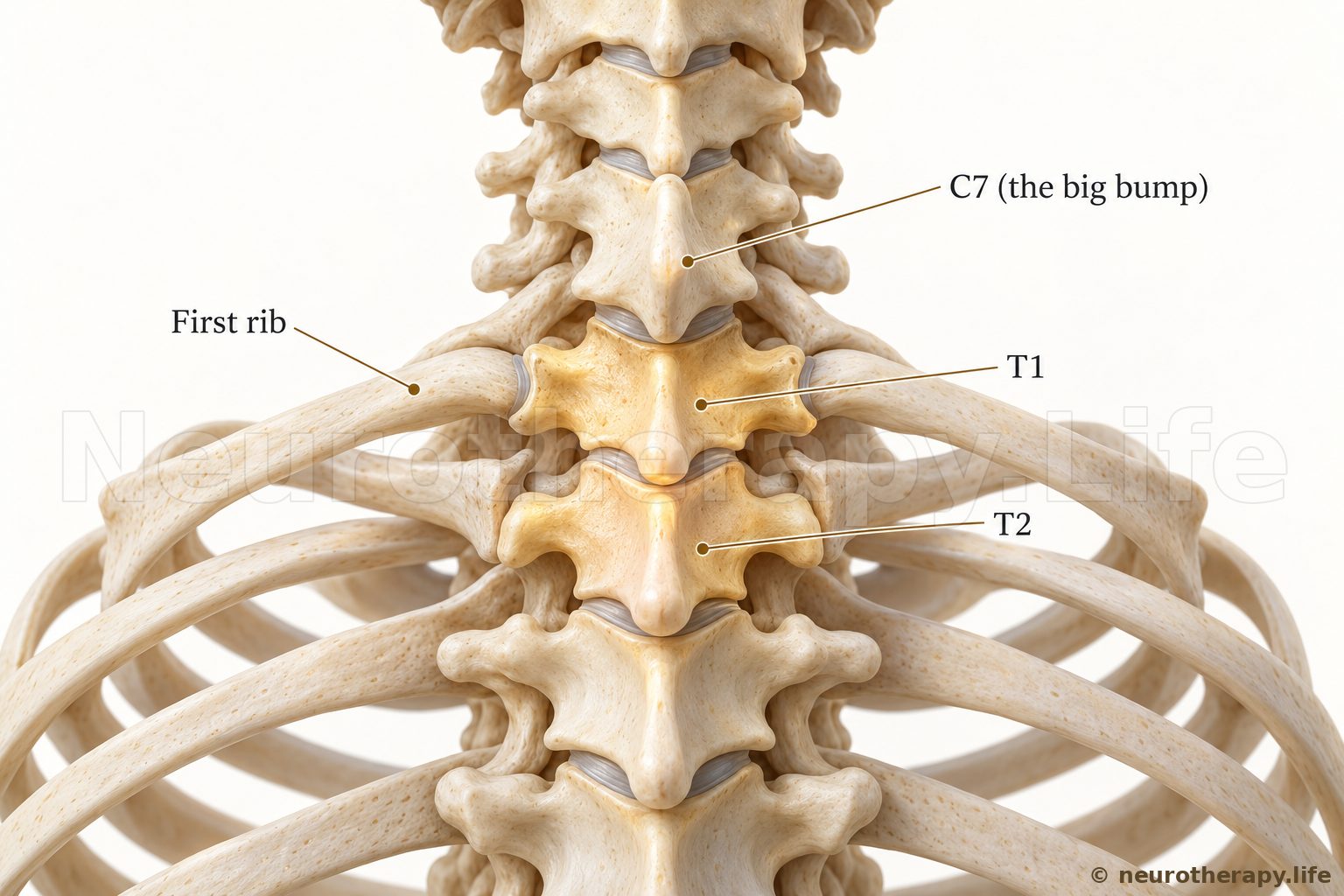
T1 and T2 are the first and second thoracic vertebrae, that is, the top two bones of the upper back. They sit just below the most prominent bone at the base of the neck, called C7, which you can feel through clothing when the head bends forward. In Neurotherapy (LMNT) this small area is a treatment station given with the patient sitting on a firm chair.
Thoracic T1/T2 is almost never written on a treatment card by itself. It is added to the Medulla work at the back of the neck, most often as the formula (4) Medulla clockwise with T1/T2. What the station is used for belongs to that formula: pains of the neck, and of the arm from the shoulder down to the fingers. Raman may be added to it, but only after a check.
The same level is also reached from face down. The arrow treatments run along the whole spine between T1 and the low back, and pass through this station on their way. Thoracic T1/T2 is the seated station; the arrows are the face-down journeys that cross it.
What lies underneath matters. This is where the ribs begin, and where the chain of nerves that drives the body's alarm response, the fight-or-flight system, has its topmost station. It is also a place where thin bone can give way. That is why the touch here is always light. The exact method is taught hands-on in the course.
Key points
- T1 and T2 are the two upper back bones just below the big bump at the base of the neck.
- It is a seated station, given on a firm chair.
- It is almost always given inside (4) Medulla clockwise with T1/T2, for neck and arm pain.
- Light hands always: this is where thin bone can give way.
Go deeper
Thoracic T1/T2
The full page on the Thoracic T1/T2 point
(4) Medulla clockwise with T1/T2
The formula this station almost always belongs to
Medulla, Mesencephalon and Dorsal: three treatments at the back of the neck
Medulla, Mesencephalon and Dorsal at the back of the neck
Raman
Raman, added only after a check
The arrow treatments: strokes along the spine, given face down
The arrow treatments that run down the spine through this level
Cervical spondylosis
Neck pain from worn neck bones
Spine
How the spine is built, bone by bone
Seated Treatments I: The Back of the Head and the Neck
The full guide to the seated neck treatments
Read the full guide
This topic is part of: Seated Treatments I: The Back of the Head and the Neck
Safety: when it is held back
- In the elderly, in anyone who has taken steroid tablets for a long time, and where cancer may have reached the bone, the upper back bones can give way under ordinary pressure. Only very light contact is used here, and none where bone is known to be affected. Osteoporosis
- Seated neck work is a glide, never a thrust: no twisting, no pulling, no sudden movement of the neck.
- The exact method is taught hands-on in the course, under a trained therapist. Please do not try it on yourself or others from this page.
Watch

This video shows the right way to give (4) Medulla, Raman and the T1–T2 point for neck and shoulder pain and numbness.
This page explains what a Neurotherapy (LMNT) treatment is for; it is not a self-treatment guide and does not diagnose. Neurotherapy (LMNT) works alongside your medical care — keep taking the medicines your doctor prescribed.