1The bump you can feel
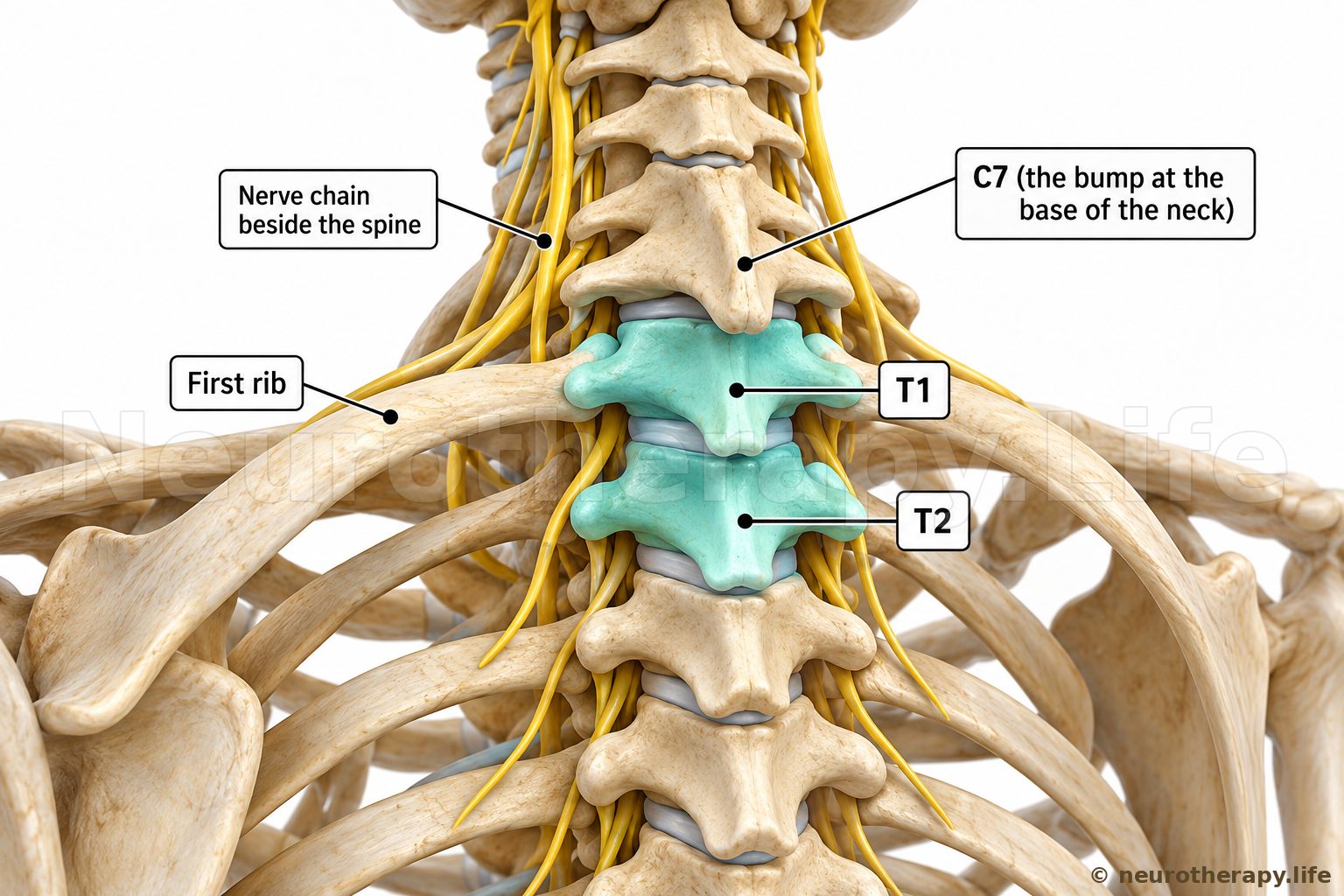
C7 is called the vertebra prominens because its long spine sticks out at the base of the neck — it is the usual landmark for counting down to T1 and T2.
Source: Standring S (ed). Gray's Anatomy, 41st ed. Elsevier, 2016.
Also called: T1/T2, T1-T2, First and second thoracic, टी1/टी2
Thoracic T1/T2 is a seated Neurotherapy (LMNT) station on the two spinal bones just below the bump at the base of the neck. It is almost always given as part of a Medulla treatment, where it is credited with easing chest pain, and on its own it is said to rouse the lymph nodes and end pain elsewhere in the body.
Your spine is a stack of small bones called vertebrae, or beads. The seven in the neck are numbered C1 to C7; the twelve in the upper back, which carry the ribs, are numbered T1 to T12. C7 is the bump you can feel at the base of your neck when you bend your head forward.
T1 and T2 are the two beads immediately below C7. Together they form the station called Thoracic T1/T2. It sits where the neck ends and the chest begins — where the first ribs attach.
It is a physical point of the seated group, and it is almost never written by itself. On a card it usually appears attached to Medulla work, most often as (4) Medulla clockwise with T1/T2, and what it is credited with belongs to that formula.
You sit on a chair, as for every member of the Medulla family. Inside the clockwise Medulla treatment it is given right after the neck work, without moving you.
The station is at the top of the upper back, on the two beads immediately below the prominent bump at the base of the neck.
How this point is given — the tool, the pressure, the count and the exact movement — is deliberately not described here. A demonstration video for this point is being prepared; until it is on this page, learn the method hands-on from a trained Neurotherapist before giving it. Please do not give any point from a written description alone: a point given in the wrong place or the wrong way can do harm.
The number written before a point's name is not a strength setting. Each numbered form is a separate named treatment with its own method and timing, taught hands-on in the course.
The exact technique is taught hands-on in the Neurotherapy (LMNT) course. See the course →
The source credits the station with these effects:
T1/T2 is the seated station of the upper back. The arrows given face down pass through the same level.
Mostly through the formulas it belongs to:
Its home formula: the clockwise Medulla, then T1/T2, with Raman when needed
The heart patient's gateway treatment, which opens with the same combination
Bend your head forward and feel the biggest bump at the base of your neck — that is C7. The next two bumps below it are T1 and T2.
Almost never. It usually follows the clockwise Medulla treatment, in the same sitting position.
It sits where the nerves of the neck give way to those of the chest. In the source teaching, adding it to the Medulla work takes away right and left chest pain — but heart pain must always be checked by a doctor first.
C7 is called the vertebra prominens because its long spine sticks out at the base of the neck — it is the usual landmark for counting down to T1 and T2.
Source: Standring S (ed). Gray's Anatomy, 41st ed. Elsevier, 2016.
T1 is the first vertebra to carry a rib. The first rib, short and flat, curves around the top of the lung just behind the collarbone.
Source: Standring S (ed). Gray's Anatomy, 41st ed. Elsevier, 2016.
Beside the spine near the neck of the first rib lies the stellate ganglion, a relay station of the nerves that run the body's 'fight or flight' responses for the head, neck and arms.
Source: Standring S (ed). Gray's Anatomy, 41st ed. Elsevier, 2016.
This page explains what a Neurotherapy (LMNT) treatment is for; it is not a self-treatment guide and does not diagnose. Neurotherapy (LMNT) works alongside your medical care — keep taking the medicines your doctor prescribed.
Send COURSE for course details, or your name, age and health issue for a consultation.