1Eight nerves, seven bones
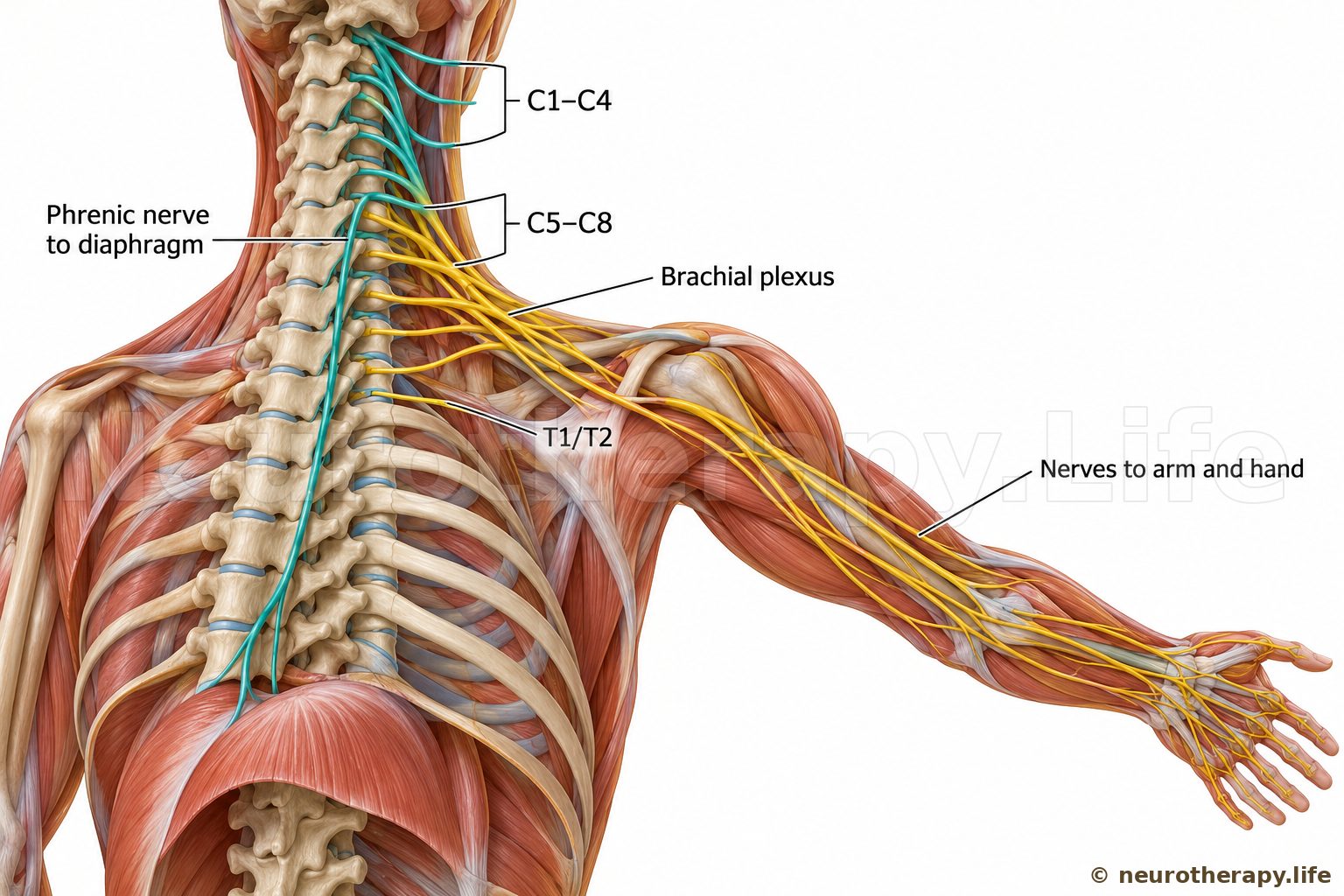
The neck has seven vertebrae but eight pairs of spinal nerves. The extra pair, C8, leaves below the seventh neck bone.
Source: Gray's Anatomy (41st ed.), spinal nerves.
Also called: 4 Medulla, (4) Medulla clockwise, (4) Medulla with T1/T2
(4) Medulla is the one member of the Medulla family given with a direction — clockwise — and paired with the T1/T2 station at the base of the neck. It is used for neck pain, chest pain from the nerves of the neck, and the pains of the shoulder, arm, hand and fingers.
(4) Medulla is one of the nine numbered Medulla treatments. Together with (2) Medulla, it was the last to be found. Unlike the rest of the family, it is not a plain downward thumb glide: it is worked in a clockwise way over the muscles of the side of the neck, and then the T1/T2 station just below the base of the neck is added.
The neck carries eight pairs of spinal nerves, C1 to C8. The upper ones (C1–C4) supply the neck and, through the phrenic nerve, the diaphragm; the lower ones (C5–C8) join to form the network that supplies the whole arm and hand. LMNT teaching credits (4) Medulla clockwise with T1/T2 with relieving pains that come from both groups.
When both ring fingers are painful — which this therapy reads as a possible sign of rheumatoid arthritis — a third part, Raman, may be added. But only after a check, because Raman can make some patients worse.
You sit on a firm chair, feet flat, back supported, as for every Medulla. A very ill or very weak patient can be treated lying down.
The first part is worked on the muscles at the side of the neck, from behind the ear down towards the shoulder, on both sides. Then, without the patient moving, the T1/T2 station is worked: the two bones just below the big bump at the base of the neck.
How this point is given — the tool, the pressure, the count and the exact movement — is deliberately not described here. Watch the demonstration video on this page, and learn the method hands-on from a trained Neurotherapist before giving it. Please do not give any point from a written description alone: a point given in the wrong place or the wrong way can do harm.
The number written before a point's name is not a strength setting. Each numbered form is a separate named treatment with its own method and timing, taught hands-on in the course.
The exact technique is taught hands-on in the Neurotherapy (LMNT) course. See the course →
LMNT teaching credits (4) Medulla clockwise with T1/T2 with relief in pains arising from the neck nerves. Body science confirms that the neck nerves supply the neck, the diaphragm, the chest wall and the whole arm, and that neck trouble can send pain far down the arm; the effect of the treatment is the therapy's own clinical observation.
(4) Medulla belongs to the Medulla family but is almost always given as part of a set with its two companions.
The therapist chooses it from the pattern of pain, and decides about Raman only after the Liv° and Mu° check.
The treatment set as a formula: (4) Medulla clockwise, T1/T2, and Raman when allowed.
For heart disease, hardened arteries and raised cholesterol — it opens with (4) Medulla clockwise.
Given after (4) Medulla clockwise with T1/T2 in the full joint-pain and RA protocol.
The very light rubbing of every joint that closes that protocol.
A teaching case, put together from several patients: a schoolteacher in his forties had stiff, painful hands every morning for two years and carried an RA-negative report as proof that nothing was wrong. Both ring fingers were painful, the left worse, and Mu° was more tender than Liv°. The check allowed Raman, so the joint protocol began with (4) Medulla clockwise with T1/T2 and Raman on the side the check named, while he was advised to keep his own doctor informed.
A composite case written to teach the reasoning — not one patient’s file.Because (4) Medulla clockwise is a different treatment from plain (4) Medulla. The direction is part of what is given, so it is written on the card.
The first two bones of the upper back, just below the big bump at the base of your neck. It is worked straight after the neck part.
Probably because the check showed pain at Liv° and not at Mu°. In that case Raman can increase pain sharply, so it is held back.
Yes — (2), (4) or (6) Medulla may be given in heart disease, and (4) Medulla opens the Angina / Athero treatment. Keep taking your heart medicines and tell your cardiologist.
The neck has seven vertebrae but eight pairs of spinal nerves. The extra pair, C8, leaves below the seventh neck bone.
Source: Gray's Anatomy (41st ed.), spinal nerves.
The diaphragm sits under the ribs, but its nerve — the phrenic nerve — comes from C3, C4 and C5 in the neck. Medical students learn it as 'C3, 4, 5 keeps the diaphragm alive'.
Source: Gray's Anatomy (41st ed.), phrenic nerve.
A pinched C6 or C7 nerve root often causes tingling in the thumb or middle finger, far from the neck where the problem is.
Source: Gray's Anatomy (41st ed.), dermatomes of the upper limb.

This video shows the right way to give (4) Medulla, Raman and the T1–T2 point for neck and shoulder pain and numbness.
This page explains what a Neurotherapy (LMNT) treatment is for; it is not a self-treatment guide and does not diagnose. Neurotherapy (LMNT) works alongside your medical care — keep taking the medicines your doctor prescribed.
Send COURSE for course details, or your name, age and health issue for a consultation.