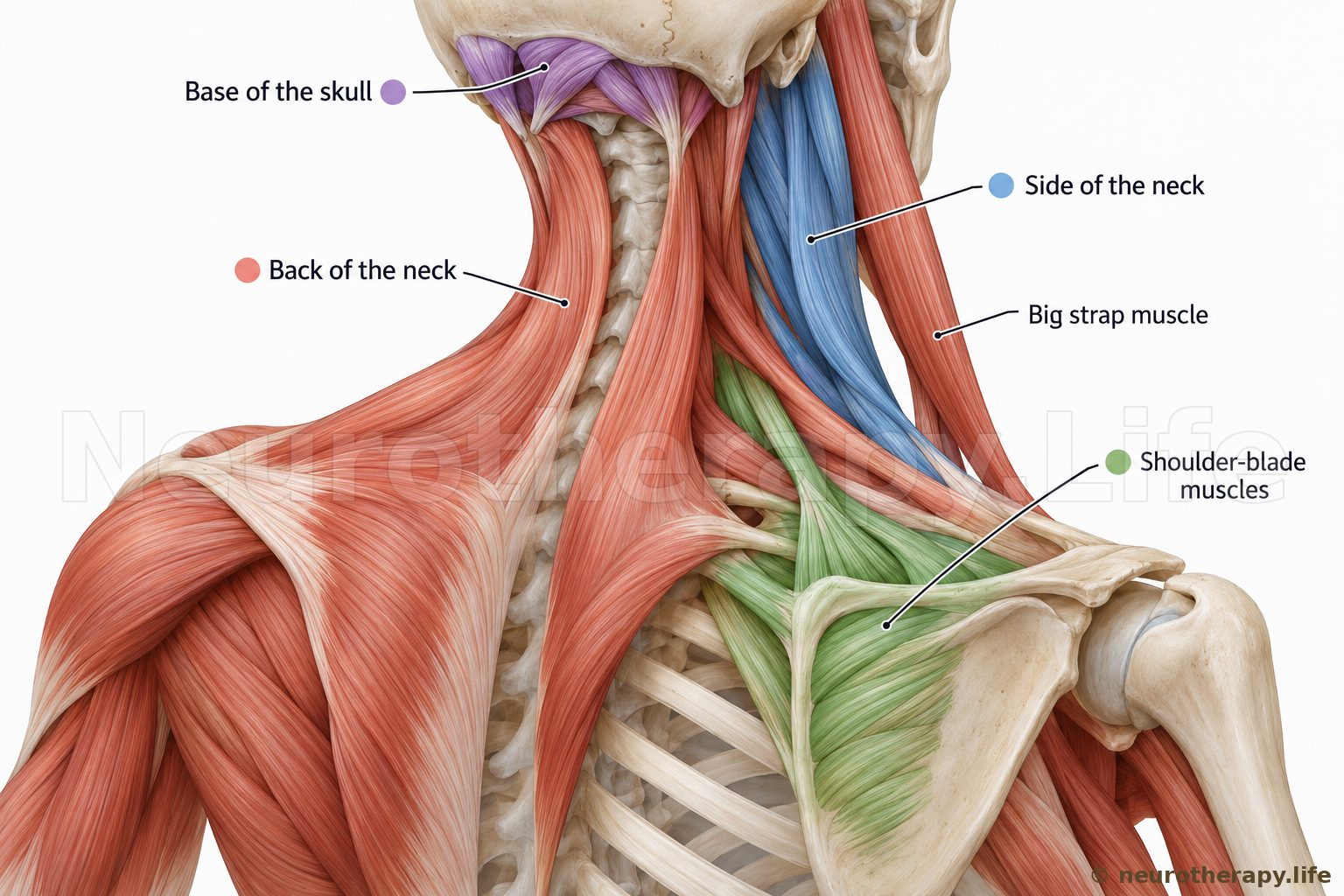
Neck Ghisai is a seated Neurotherapy (LMNT) treatment that relaxes the muscles all round the neck in four stages, ending at the shoulder blade. It is used for pain of the neck, head, shoulders, arms and fingers and in cervical spondylosis — and it is added to a formula only when the neck itself is painful.
Overview
What is Neck Ghisai?
Ghisai (घिसाई) means rubbing. In Neurotherapy (LMNT) it names a gliding, travelling stroke along a length of muscle — not a still press. In a ghisai the length travelled and the direction of travel are the instruction.
Neck Ghisai relaxes the muscles all round the neck in a set order of four stages: first the muscles at the front and the back of the neck, with light hands; then the muscles of the right and left sides; then a necklace-like stage along the base of the skull; and finally the muscles attached to the shoulder blade.
It is a physical point: it works on muscle and tissue, not on a gland. That is why it is chosen by a simple gate — if there is pain in the neck, it is added; if there is no neck pain, it is left out.
Neck Ghisai works all round the neck and ends at the muscles of the shoulder blade.
Where it is given
Where is Neck Ghisai given?
PositionSitting
Body areaAll round the neck, the base of the skull and the shoulder-blade muscles — the front only with the lightest touch
You sit well back on a firm, flat chair, feet flat on the floor, back supported and hands loose in your lap. A patient who is very ill or very weak may be treated lying down instead.
The work covers the back and both sides of the neck, the base of the skull, and the muscles that run down to the shoulder blade. At the front of the neck only the lightest touch is used on the muscles, and the hands never press into the front of the throat.
How it is given
How is Neck Ghisai given?
How this point is given — the tool, the pressure, the count and the exact movement — is deliberately not described here. A demonstration video for this point is being prepared; until it is on this page, learn the method hands-on from a trained Neurotherapist before giving it. Please do not give any point from a written description alone: a point given in the wrong place or the wrong way can do harm.
The exact technique is taught hands-on in the Neurotherapy (LMNT) course. See the course →
What it does
What does Neck Ghisai do?
The teaching describes Neck Ghisai as relaxing the muscles all round the neck. Body science confirms that tight neck and shoulder muscles are a common source of neck pain and of headache felt at the back of the head; how far relaxing them helps each patient is learned from clinical experience.
Is beneficial for pain of the neck, the head, the shoulders, the arms and the fingers.
Is given in cervical spondylitis or spondylosis — wear and stiffness of the neck bones.
Relaxes the small muscles at the base of the skull and the muscles that tie the neck to the shoulder blade.
With Neck Ghisai when pain returns and Mu° is no longer painful.
Safety: when it is held back
The front of the neck is never pressed. The first stage begins at the front, and its instruction carries its own answer: with light hands. The front border of the big strap muscle is a fence the hands do not cross. Neck
Glide, never thrust: no rotation, no traction, no leverage, no sudden movement.
Before any neck is worked, the therapist asks about the hands and the walk. New clumsiness with buttons or coins, a change in walking, new unsteadiness, or any change in the bladder goes to a doctor today, not onto the mat. How to tell a patient to see a doctor
The session ends with nothing given at the neck for a first-ever sudden headache, new or unusual neck pain with headache, any new change in vision, speech or balance, a hot, swollen or tender neck, or a lump in the neck. Vertigo and giddiness
Light contact only in thin bones, long steroid use, blood-thinning tablets, a bleeding disorder, or cancer that may involve bone. Osteoporosis
The very ill and very weak may be treated lying down, with less pressure; children receive light treatment. Keep taking your medicines and stay under your doctor's care for spondylosis. Frail and elderly patients (gentle care)
Common questions
Will Neck Ghisai be given every time I come?
Only while your neck is painful. It is a conditional addition: no neck pain, no Neck Ghisai.
Will the therapist crack or twist my neck?
No. Neurotherapy (LMNT) never twists, pulls or jerks the neck. Every contact is a glide.
Why does the therapist ask about my hands and walking before touching my neck?
Because new clumsiness, unsteadiness or bladder changes can mean pressure on the spinal cord in the neck. That needs a doctor first, and no pressure at the neck until it is checked.
Can I have it if I have cervical spondylosis?
Yes — it is named for it. Your therapist will still screen your neck first, and you continue your doctor's treatment.
Surprising facts
1Tiny muscles, huge reporting
The small muscles at the top of the neck, no longer than a thumb joint, are packed with sensors that report where the head sits — among the densest such sensors in the body.
The nerves of the upper neck and the nerve of the face meet on the same cells in the upper spinal cord. That is why a tight neck can be felt as a headache at the back of the head or behind the eyes.
Source: Bogduk N, Govind J. Cervicogenic headache. Lancet Neurol 2009;8:959–968.
3Small bones, big movement
The seven neck bones are the smallest in the spine, yet they give the most movement — nodding, turning and tilting. The muscles around them work all day just to hold the head balanced on top.
This page explains what a Neurotherapy (LMNT) treatment is for; it is not a self-treatment guide and does not diagnose. Neurotherapy (LMNT) works alongside your medical care — keep taking the medicines your doctor prescribed.
Ready to begin?
Send COURSE for course details, or your name, age and health issue for a consultation.