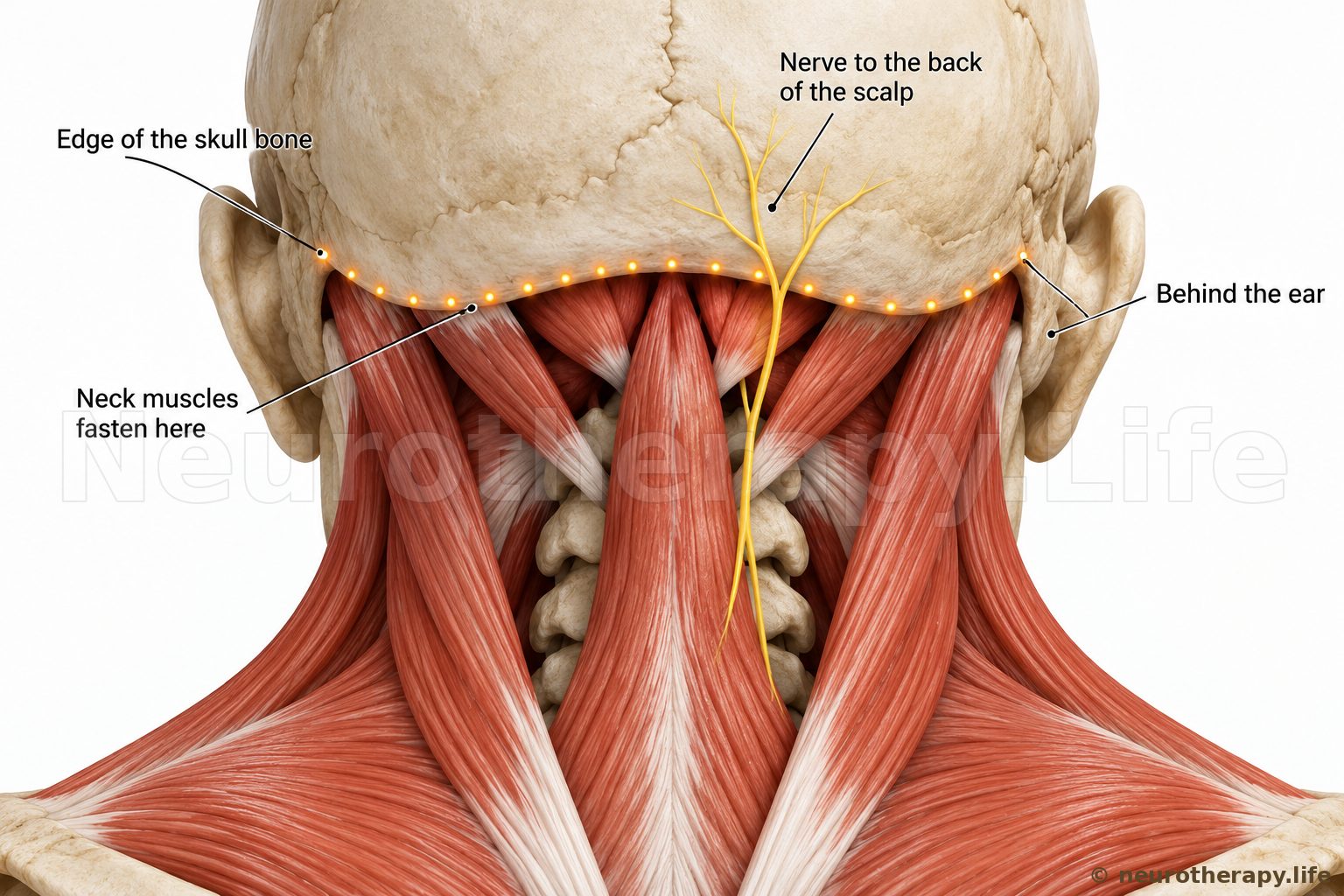
Necklace (the string of presses at the base of the skull)
Also called: Necklace treatment, नैकलेस
Necklace is a seated Neurotherapy (LMNT) treatment given along the edge of the skull bone at the back of the head, from behind one ear to behind the other, like a string of beads. It relaxes the muscles at the base of the skull and is used to reduce pain in the head, the neck and the whole body.
Overview
What is the Necklace treatment?
Necklace is named for its shape. The therapist presses at many closely spaced spots in an arc along the lower edge of the skull bone at the back of the head, and the row of presses lies there like a necklace. On a treatment card its symbol is a shallow half-moon curve with a small circle at each end and a row of dots along it.
The arc is the ridge of bone into which the great muscles of the neck and shoulder all fasten — a crowded anchorage. The teaching says Necklace relaxes the muscles just below this bone, so that the coming and going of impulses — waves of sensation — between the brain and the rest of the body is not obstructed, and communication happens properly.
In the point-by-point review of the formulas, Necklace is said to reach the ganglia leaving the skull and to reduce pain. That is why the heaviest formula written for pain in the body opens with it.
Necklace runs along the edge of the skull bone, where the big neck muscles fasten.
Where it is given
Where is Necklace given?
PositionSitting
Body areaBack of the head, along the edge of the skull bone from behind one ear to behind the other
You sit well back on a firm, flat chair, feet flat, hands loose in your lap, head level. The therapist stands behind you and rests one hand lightly on your head only to keep the forehead still — it steadies, it never pulls, pushes or turns the head.
The presses run along the lower edge of the skull bone at the back of the head, from behind one ear across to behind the other — on the bone, not below it into the soft neck.
How it is given
How is Necklace given?
How this point is given — the tool, the pressure, the count and the exact movement — is deliberately not described here. A demonstration video for this point is being prepared; until it is on this page, learn the method hands-on from a trained Neurotherapist before giving it. Please do not give any point from a written description alone: a point given in the wrong place or the wrong way can do harm.
The exact technique is taught hands-on in the Neurotherapy (LMNT) course. See the course →
What it does
What does Necklace do?
In the teaching, Necklace relaxes the muscles at the base of the skull and reduces pain. Body science confirms that tension here feeds into the cells where the nerves of the neck and the face arrive together; one honest correction is that a nerve message is not squeezed off like water in a kinked hose — it is crowded rather than blocked.
Reduces pain in the head, the neck, or the whole body.
Is used for pain in one half of the body, excluding the forehead.
Helps bring urine under control, and to correct the habit of passing urine in bed.
Is given in paralysis to reduce pain and to relax the body.
Organs it reaches
Neck — The muscles that fasten into the base of the skull.
Brain — The traffic of signals between the brain and the body.
Bladder — Its use for urine control and bed-wetting.
Its family
Which treatments are close to Necklace?
It belongs to the seated group worked at the back of the head and neck.
Raman — The shoulder lift that follows Necklace in the pain and digestion formulas.
Neck Ghisai — The four-stage rubbing of the neck, which includes a necklace-like stage.
Medulla — The thumb glide that begins just below and behind the ears.
Neck Clockwise — Clockwise circling of the side of the neck.
What it is used for
What is Necklace used for?
Necklace is used for pain, and as the opening of formulas for pain, brain disease and digestion.
Pain
Headache and migrainePain in the head and neck — after the headache has been screened.
Follows Necklace in the treatment written for retinitis pigmentosa.
Safety: when it is held back
The steadying hand steadies: it never pulls the head back, pushes the chin down, or turns the head. No rotation, no traction, no leverage.
Stop and see a doctor the same day for dizziness, disturbed vision, unsteadiness, slurred speech, or a headache unlike any you have had before — especially one that began suddenly with effort, or comes with a drooping eyelid. A tear in a neck artery announces itself this way, before a stroke. How to tell a patient to see a doctor
The front of the neck is never worked, and a lump at the side of the neck that has not been examined is referred, not rubbed. Neck
Light contact only in thin bones, long steroid use, blood-thinning tablets, a bleeding disorder, or cancer that may involve bone. Osteoporosis
In diabetes, (10) Medulla is barred; the diabetic formula that opens with Necklace already leaves it out. (10) Medulla
Teaching case: the headache that needed a scan first
A teaching case, put together from several patients: a man who had never had headaches came with pain at the back of the head that began suddenly as he lifted a shop shutter, a stiff neck, and one eyelid that looked sleepy. The base of his skull was tender — exactly where Necklace is given — yet nothing was given at the head or neck. He was sent the same day, a torn neck artery was found and treated, and only weeks later, with his doctor's agreement, did gentle neck work begin.
A composite case written to teach the reasoning — not one patient’s file.
Common questions
Why is it called Necklace?
Because the row of presses lies along the back of the skull from ear to ear, like a necklace worn at the back.
Why do I feel one spot go up into my head?
A nerve to the back of the scalp comes up through the muscle just beside the middle of the back of the head. A press near it is felt travelling upward. That is normal; dizziness or a change in vision is not.
How can a treatment at the back of the head help with bed-wetting?
The teaching names urine control and bed-wetting among Necklace's uses, from clinical experience. Bed-wetting in a child should also be checked by a doctor for infection or other causes.
Can someone who cannot sit receive Necklace?
Yes. The seated treatments may be given lying down to anyone very ill or very weak, with less pressure.
Surprising facts
1Old surgeons marked this place
The surgical teaching of Ayurveda named the joint of the head and neck as a marma — a vital place where flesh, vessel, ligament, bone and joint meet. It was named to be protected, which is why the touch here is so gentle.
The nerves of the upper neck and the main nerve of the face arrive on the same cells in the upper spinal cord. That is why tightness at the base of the skull can be felt as a headache behind the eyes.
Source: Bogduk N, Govind J. Cervicogenic headache. Lancet Neurol 2009;8:959–968.
3A crowded anchorage
The ridge at the back of the skull is where the large trapezius and several deep neck muscles all fasten, and where the nerve to the back of the scalp pierces through them.
This page explains what a Neurotherapy (LMNT) treatment is for; it is not a self-treatment guide and does not diagnose. Neurotherapy (LMNT) works alongside your medical care — keep taking the medicines your doctor prescribed.
Ready to begin?
Send COURSE for course details, or your name, age and health issue for a consultation.