Diabetics and poor digestion, the eight-stage treatment for
Also called: Eight-stage treatment for diabetics, Eight-stage UDF treatment for poor digestion
This eight-stage Neurotherapy (LMNT) treatment is written for people with diabetes and for anyone with poor digestion. It is the twin of the body-pain, brain-disease and paralysis formula, with (10) Medulla taken out so it can be given in diabetes.
Overview
What is the eight-stage treatment?
It is one of two UDF treatments written for people with diabetes — UDF meaning undigested food in the stool. The shorter one gives only Gas Only. This longer one works on the neck and shoulders, the hips, the base of the spine, the stomach and finally the absorption organs.
The teaching says it is useful for diabetics and for all those who have poor digestion. Some of them may have pain or tenderness at the gall bladder or liver points as well as at the Gas point.
Seven of its eight stages are identical to the formula for body pain, brain disease and paralysis. Only one stage differs: the point barred in diabetes, (10) Medulla, is simply not written, and nothing is put in its place.
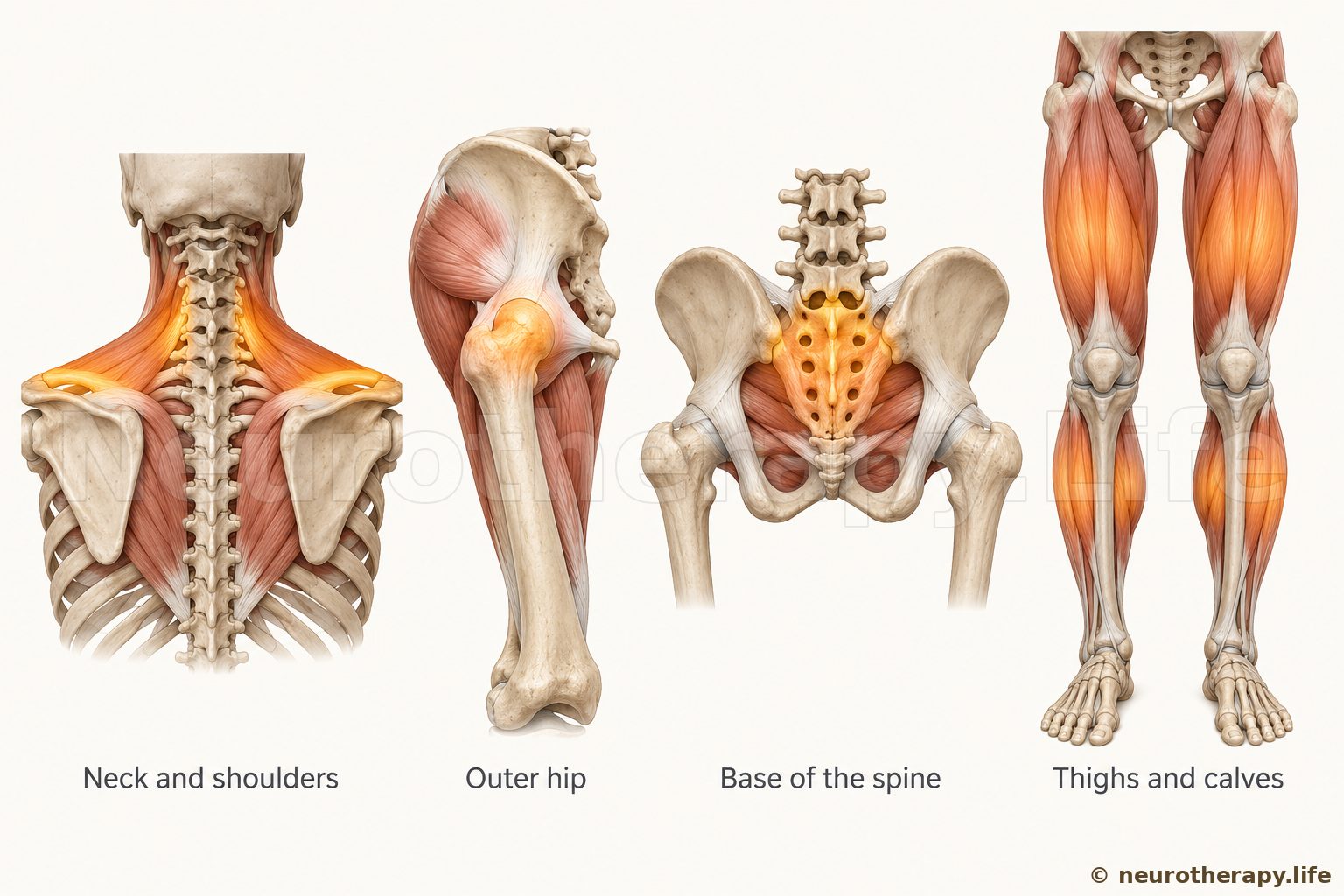
The eight stages move the patient through four positions, from the neck and shoulders down to the legs.
What it is for
What is it used for?
Poor digestion and undigested food in the stool in people with diabetes, where (10) Medulla cannot be given.
Poor digestion in anyone, whether or not they have diabetes.
Patients with pain at the Gas point, and sometimes also at the gall bladder or liver points.
Points it works through
Which points does it work through?
I (3) Necklace · II (3) Raman Trt · III (2) Rt. Parkhoo (2) Lt. Parkhoo · IV (8) Rt. Parkhoo (8) Lt. Parkhoo · V (½) Ku – 20 sec. × 2 Trts. · VI (½) Ku – 6 sec. × 2 Trts. · VII (1) Gas only – 6 Pts. · VIII (8) Pan (1) Gal (2) Liv – 3 Pts. (1) Gas 'I' – 6 Pts.
Eight stages, with a written rest after each. The points are listed here as a set with what each contributes. The exact method is taught hands-on in the Neurotherapy (LMNT) course. This page lists the points of the formula and what each one contributes; it does not describe how any point is given. For the method, watch the demonstration video of each point on its own page and learn hands-on from a trained Neurotherapist. Please do not give a formula from a written description alone.
Gas 'I', down both calves — the small intestine, closing the absorption tail.
Position:Seated, then on the side (side-lying), then face down (prone), then on the back (supine).
The exact technique is taught hands-on in the Neurotherapy (LMNT) course. See the course →
How it works
How is it built?
Put this formula side by side with the formula for body pain, brain disease and paralysis. Seven stages match exactly. In that formula, one stage carries (10) Medulla, Gas Only and Gas 'I' together. Here the same stage carries Gas Only alone.
(10) Medulla is barred in diabetes, so it is not written. The Gas 'I' that closed that stage is also not repeated; Gas 'I' appears once, in the last stage. Nothing was substituted and nothing added to compensate. The teaching calls this the clearest example of how a formula is fitted to a patient who cannot be given one of its points.
Its family
Which formulas are related?
It belongs to the diabetic branch of the UDF line.
I do not have diabetes. Can I still have this treatment?
Yes. The teaching says it is useful for all those who have poor digestion. Your therapist decides after checking your pain points.
Why does it start at the neck if it is for digestion?
It shares its opening stages with the body-pain formula. In Neurotherapy (LMNT), Raman over the shoulders is linked with the peritoneum, the lining that covers the organs of the belly.
Why do I have to change position so many times?
Each point is reached from a particular position. Your therapist will help you turn safely; ask for help rather than twisting quickly.
Surprising facts
1The peritoneum is as large as your skin
The thin membrane lining the belly and wrapping its organs has a surface area roughly similar to the skin of the whole body — close to two square metres in an adult.
Source: Gray's Anatomy, 41st ed., the peritoneum (surface area comparable to the skin).
2The absorption tail is where nutrients enter
Pancreatic enzymes and bile finish digestion in the small intestine, and its lining then absorbs nearly all nutrients — which is why the last stage targets these organs together.
Source: Guyton & Hall Textbook of Medical Physiology, 14th ed., digestion and absorption in the small intestine.
3Diabetes can affect the whole gut
High blood sugar over years can damage the nerves of the gut, slowing the stomach and changing bowel habits — one reason digestion matters so much in diabetes.
Source: National Institute of Diabetes and Digestive and Kidney Diseases (NIDDK), Diabetes and digestive problems / gastroparesis.
This page explains what a Neurotherapy (LMNT) treatment is for; it is not a self-treatment guide and does not diagnose. Neurotherapy (LMNT) works alongside your medical care — keep taking the medicines your doctor prescribed.
Ready to begin?
Send COURSE for course details, or your name, age and health issue for a consultation.