Also called: Half Ku 6, Half Kundali 6, Half Kundli 6, हाफ़ कुंडली 6
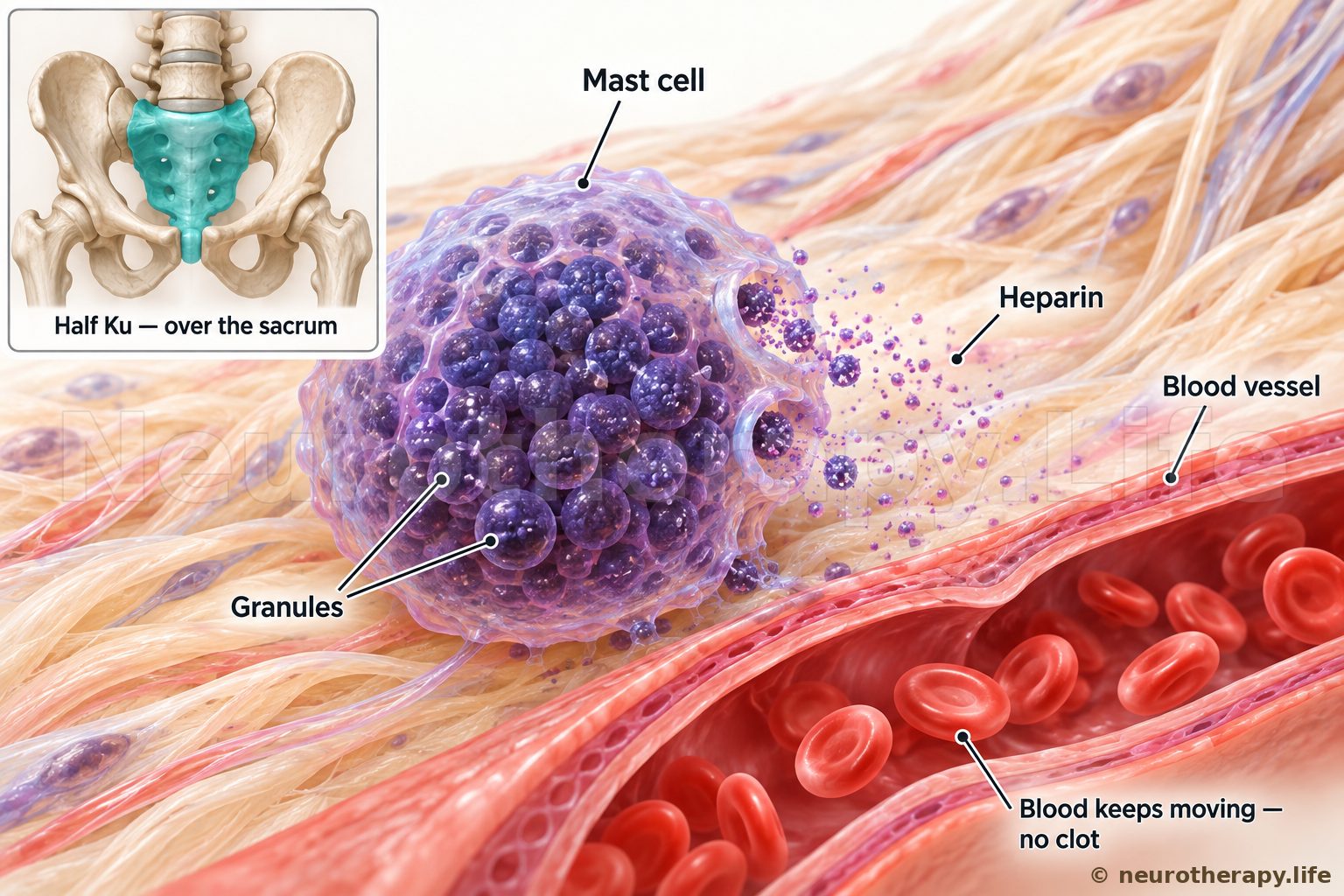
(½) Ku – 6 secs is the half Ku form linked to the mast cells, which help make heparin, the body's own anti-clotting substance. It is one steady press at the very end of the spine, lying face down, and it is the recommended opening for the Heparin formulas of Neurotherapy (LMNT).
Overview
What is (½) Ku – 6 secs?
Ku — Kundali — is given over the sacrum, the triangular bone at the base of the spine. The half Ku is one single, steady press, and each named form of it is credited with its own target.
This form is given for the mast cells, which assist in producing heparin. Heparin's job is simple to say: not to let clots form in the blood. LMNT teaches that most of the body's heparin comes from mast cells of the liver and lungs, and the rest from tissues everywhere and from basophils — white cells that travel in the blood. That is why this form stands at the front of the Heparin formulas.
In the Complement System formula the same form is listed against the basophils, as one of four white-cell forms that reduce the effects of inflammation and infection.
Mast cells store heparin, the body's own guard against unwanted clots. This form of half Ku is given for them.
Where it is given
Where is it given?
PositionLying face down
Body areaThe lower end of the spine — the sacrum, just above the tail bone, in the midline
You lie face down with pillows under the chest, and the therapist sits at your feet. The press lands on the last end of the spinal column — the lower sacrum, just above the tail bone, in the midline.
How it is given
How is it given?
How this point is given — the tool, the pressure, the count and the exact movement — is deliberately not described here. A demonstration video for this point is being prepared; until it is on this page, learn the method hands-on from a trained Neurotherapist before giving it. Please do not give any point from a written description alone: a point given in the wrong place or the wrong way can do harm.
The number written before a point's name is not a strength setting. Each numbered form is a separate named treatment with its own method and timing, taught hands-on in the course.
The exact technique is taught hands-on in the Neurotherapy (LMNT) course. See the course →
What it does
What does it do?
In LMNT this form is aimed at the cells that store heparin. These are the therapy's own clinical observations and reasoning.
For the mast cells, which assist in producing heparin — the substance that stops unwanted clots from forming.
Recommended at the start of the Heparin formulas, which are used for clotting, paralysis and blockages.
Listed against the basophils in the Complement System, where the four short forms reduce the effects of inflammation and infection.
Used with (½) Ku – 20 secs in the improved and stomach-setting UDF formulas.
Ku is not given to women during menstruation, and not to people with low blood pressure. Low blood pressure
If pain stays at Mu° after Ku, the Round Arrow is given as required until it clears. Round Arrow
Anyone on blood thinners, or with a sudden stroke, chest pain or a hot, swollen leg, needs a doctor first and keeps all prescribed medicines. How to tell a patient to see a doctor
Heart disorders: in its Heparin formulas, (10) Medulla is never given on both sides — only (10) Left Medulla; (30) Medulla is not given to heart patients. (10) Medulla
No. Nothing is given into the body. LMNT's idea is that the body's own cells are encouraged to do their work. Never stop a prescribed blood thinner on your own.
Why does the page mention both mast cells and basophils?
Because the teaching lists this form against both: against mast cells and heparin for the Heparin formulas, and against basophils in the Complement System. The two cells are close cousins — one lives in tissues, the other travels in the blood.
Is it the same as the old Kundali?
No. The old Kundali, (4) Ku, is a series of presses used to reduce alkali and joint stiffness. This is a single press with a different purpose.
Surprising facts
1Bags of gravel
Mast cells live in the skin, airways and gut lining, packed with granules of histamine and heparin that they can empty within moments.
Source: Krystel-Whittemore M, Dileepan KN, Wood JG. Mast Cell: A Multi-Functional Master Cell. Frontiers in Immunology. 2016;6:620.
2Found by a student
Heparin was discovered in 1916 by Jay McLean, a medical student working on clotting at Johns Hopkins, and it took its name from the liver (hepar), where it was first found.
Source: Wardrop D, Keeling D. The story of the discovery of heparin and warfarin. British Journal of Haematology. 2008;141(6):757–763.
3The rarest white cell
Basophils make up less than one in a hundred white blood cells — the rarest kind in the blood.
Source: Standard haematology reference ranges (Guyton & Hall, Textbook of Medical Physiology, 14th ed.)
Test yourself
Research
Strong evidence
A review of mast cells: they live in tissues at the body's borders such as skin and airways, and their granules store histamine, heparin and other messengers. It explains the body science behind this form; it does not test Neurotherapy (LMNT).
This page explains what a Neurotherapy (LMNT) treatment is for; it is not a self-treatment guide and does not diagnose. Neurotherapy (LMNT) works alongside your medical care — keep taking the medicines your doctor prescribed.
Ready to begin?
Send COURSE for course details, or your name, age and health issue for a consultation.