Also called: The Medulla family, Graded Medulla treatments, (2) to (30) Medulla
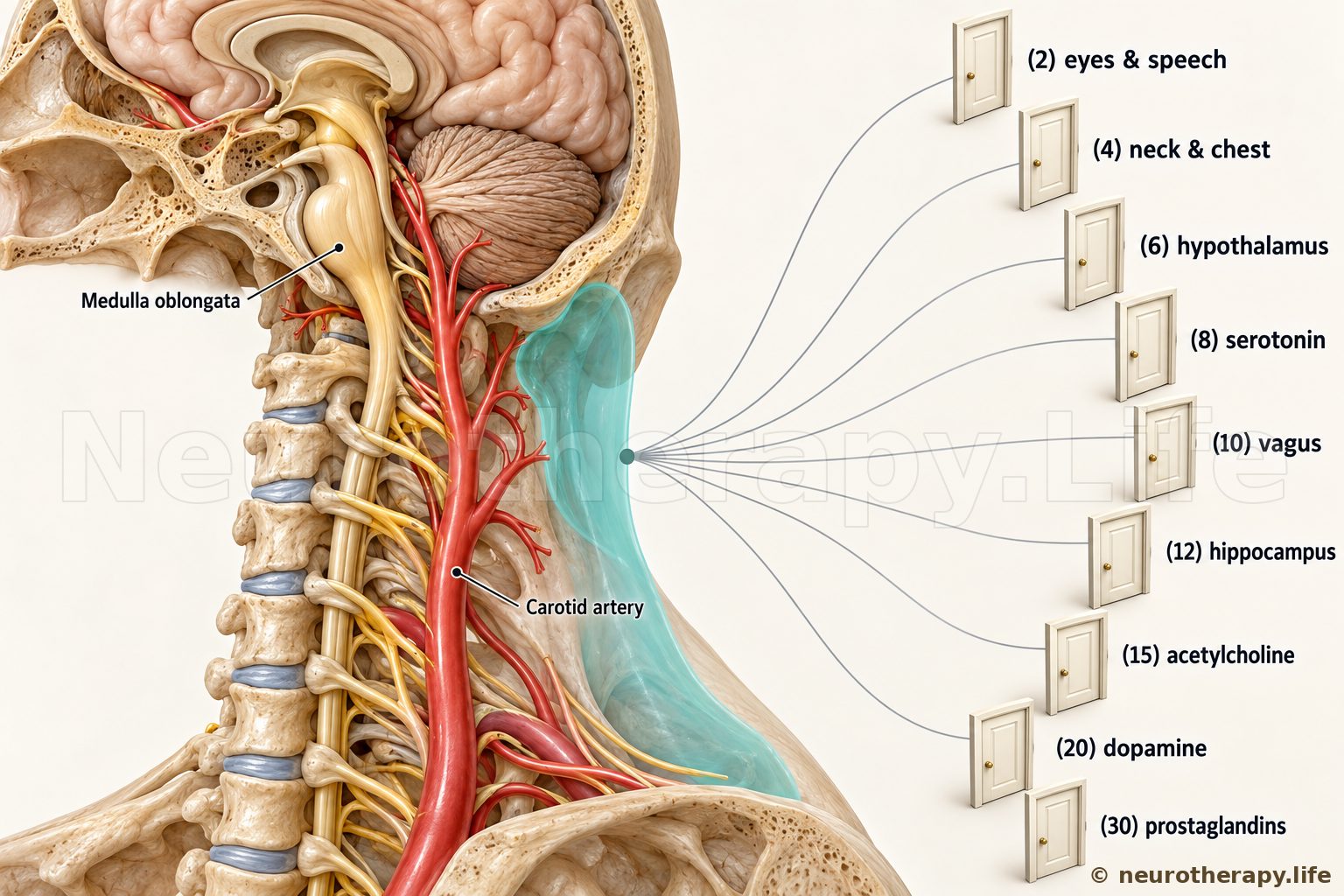
The graded Medulla series is a family of nine Neurotherapy (LMNT) treatments — (2), (4), (6), (8), (10), (12), (15), (20) and (30) Medulla — all given at one place on the neck below the ears. The number in front of the name does not make the treatment stronger or weaker: each number names a different treatment with a different purpose.
Overview
What is the graded Medulla series?
It began with children whose movement improved with stomach treatments, but whose brain development showed little change. Guruji asked how a pair of hands could reach the brain from outside. Two facts answered him: the arteries carrying blood to the brain run up the neck past the side of the ear, and the medulla oblongata — the stalk at the base of the brain through which nerve messages pass — lies close to the skin between the ear and the neck.
He worked there, and several of those children changed. Over the years, many different treatments for many different diseases were found at that same place. Because they all share one site, they all share one name, Medulla. What tells them apart is the number written before the name.
The thumbs never reach the medulla oblongata itself; it lies inside the skull. Medulla is the name of the treatment, chosen for what it was aimed at. Neurotherapy (LMNT) calls this family a gift of nature: nothing in it was designed, everything was noticed.
One site, nine treatments. The number before the name chooses the door; it is not a dial.
What it is for
What is the series used for?
To reach different areas of the brain and nervous system from one place on the neck — each member for its own job.
Up to (12), the number matches a cranial nerve (one of the twelve pairs of nerves that leave the brain directly), and the treatment is held to do that nerve's work — (2) for the eyes, (10) for the vagus nerve.
Above twelve there are no more cranial nerves. (15), (20) and (30) are linked instead to body chemicals: acetylcholine, dopamine and prostaglandins.
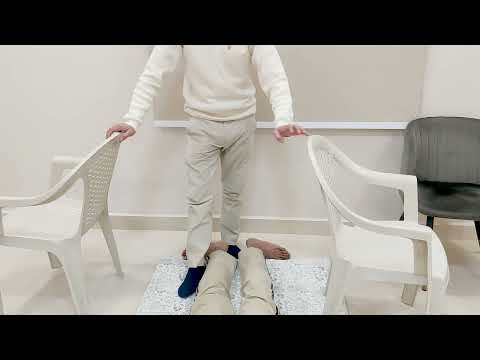
Nine members, all at the same place. Each is a separate treatment with its own uses and its own cautions. The exact method is taught hands-on in the Neurotherapy (LMNT) course. This page lists the points of the formula and what each one contributes; it does not describe how any point is given. For the method, watch the demonstration video of each point on its own page and learn hands-on from a trained Neurotherapist. Please do not give a formula from a written description alone.
The prostaglandin treatment — inflammation, side effects of medicines, period pain, asthma.
Position:Seated on a firm chair, feet flat and back supported — or lying down if the patient is very ill or weak. The work stays on both sides of the neck below the ears, never at the front of the neck.
The exact technique is taught hands-on in the Neurotherapy (LMNT) course. See the course →
How it works
Why is the number a selector, not a dial?
Everywhere else in Neurotherapy (LMNT), a bigger number in front of a point usually means more of the same thing. The Medulla family is the one place where that habit is wrong. (15) and (10) Medulla are not two strengths of one treatment. They are two different treatments: one supplies acetylcholine, the other rouses the digestive glands through the vagus nerve.
So a Medulla number is never changed to suit the patient. Changing it does not adjust a dose; it swaps one treatment for another the patient did not come for. If a number seems wrong, the therapist changes the formula or asks — never the number.
The family was not found in number order. (6) came first, then (10), then (30), then the rest, and (2) and (4) last of all.
Its family
Which formulas are built on the Medulla family?
Many formulas open with one member of the series. Knowing which member is inside tells you which cautions come with it.
A caution belongs only to the member it is written against. There is no general Medulla ban — and no member's ban may be guessed or carried across to the others.
(10) Medulla is not given in diabetes, in cancer, or where stomach acid is already raised. In heart disorders it is never given on both sides — only (10) Left Medulla. (10) Medulla
(30) Medulla is not given in heart disease, and never in cancer. (30) Medulla
(8) Medulla is not given in inflammation, in cancer or in high blood pressure. (8) Medulla
(6) Medulla is not given to young people aged 13 to 20 who come for treatment to increase height, unless there is a special need. Low height in children (short stature)
(15) Medulla is not given where (2) Pan is being given to treat a tumour. (15) Medulla
The work stays behind and below the ear. The front of the neck, where the great artery to the brain divides, is never pressed. Neck
“Apart from calling these treatments a gift of nature, or the grace of Hari, there is no other way in which their effect can be described.”
— Dr. Lajpatrai Mehra
Common questions
Is (30) Medulla stronger than (10) Medulla?
No. They are different treatments at one site. (30) works on inflammation through the prostaglandins; (10) rouses digestion through the vagus nerve.
Do the thumbs touch the brain stem?
No. The medulla oblongata is inside the skull. The treatment works on the skin, nerves and small muscles at the base of the skull and side of the neck, and is named for what it was aimed at.
Why are some numbers, like (3) or (7), missing?
They exist, but they belong to the cranial-nerve set, where each number does the work of the cranial nerve of that number. The graded series is the nine members that grew up as general treatments.
If I am diabetic, can I have no Medulla at all?
Not so. The diabetes caution is written against (10) Medulla. Other members carry their own, different cautions, and your therapist checks each one.
Surprising facts
1The medulla keeps you breathing
The medulla oblongata holds the centres that set the rhythm of breathing and help control heart rate and blood pressure, without any thought from you.
The small deep muscles at the base of the skull are packed with tiny sensors that report muscle length, and nerves from the face and the upper neck meet on the same cells in the spinal cord. That is why a stiff neck can be felt as pain behind the eye.
Source: Bartsch T, Goadsby PJ. Stimulation of the greater occipital nerve induces increased central excitability of dural afferent input. Brain. 2002;125(7):1496–1509.
Watch
बिना दवा गहरी नींद कैसे पाएं? | LMNT Serotonin Treatment for Sleep Disorders | Insomnia Root Cause
Shows the Serotonin treatment for sleep: (8) Medulla below the ears, 1 Gas 'I' at six points on the shin, (6) Adr on the upper back, and gentle massage behind the knees and at the back of the head. It is given to support deep, natural sleep.
Note: (8) Medulla is not given in high BP, inflammation or cancer; (6) Adr is not given in high BP, diabetes, cancer or HIV.
भयंकर Migraine और सिरदर्द से तुरंत आराम | Migraine Pain Relief | 15 Medulla & Head Massage Point
Shows (15) Medulla four times below both ears, a fingertip head massage in lines from the forehead to the back of the head, and gentle circles between the eyebrows. It is shared as self-care for relief in migraine and headache.
Note: the video gives (15) Medulla; the LMNT migraine treatment uses (5) Medulla. Follow your therapist's plan.
How to Give 4 Medulla, Raman & T1 T2 in Neurotherapy | LMNT Cervical, Shoulder pain & Numbness
This video shows the right way to give (4) Medulla, Raman and the T1–T2 point for neck and shoulder pain and numbness.
Test yourself
Research
Strong evidence
This reference describes the medulla oblongata: the cranial nerve centres it holds and its control of breathing, heart rate and blood pressure — the brain structure this family was named after.
This page explains what a Neurotherapy (LMNT) treatment is for; it is not a self-treatment guide and does not diagnose. Neurotherapy (LMNT) works alongside your medical care — keep taking the medicines your doctor prescribed.
Ready to begin?
Send COURSE for course details, or your name, age and health issue for a consultation.