1Named after a seahorse
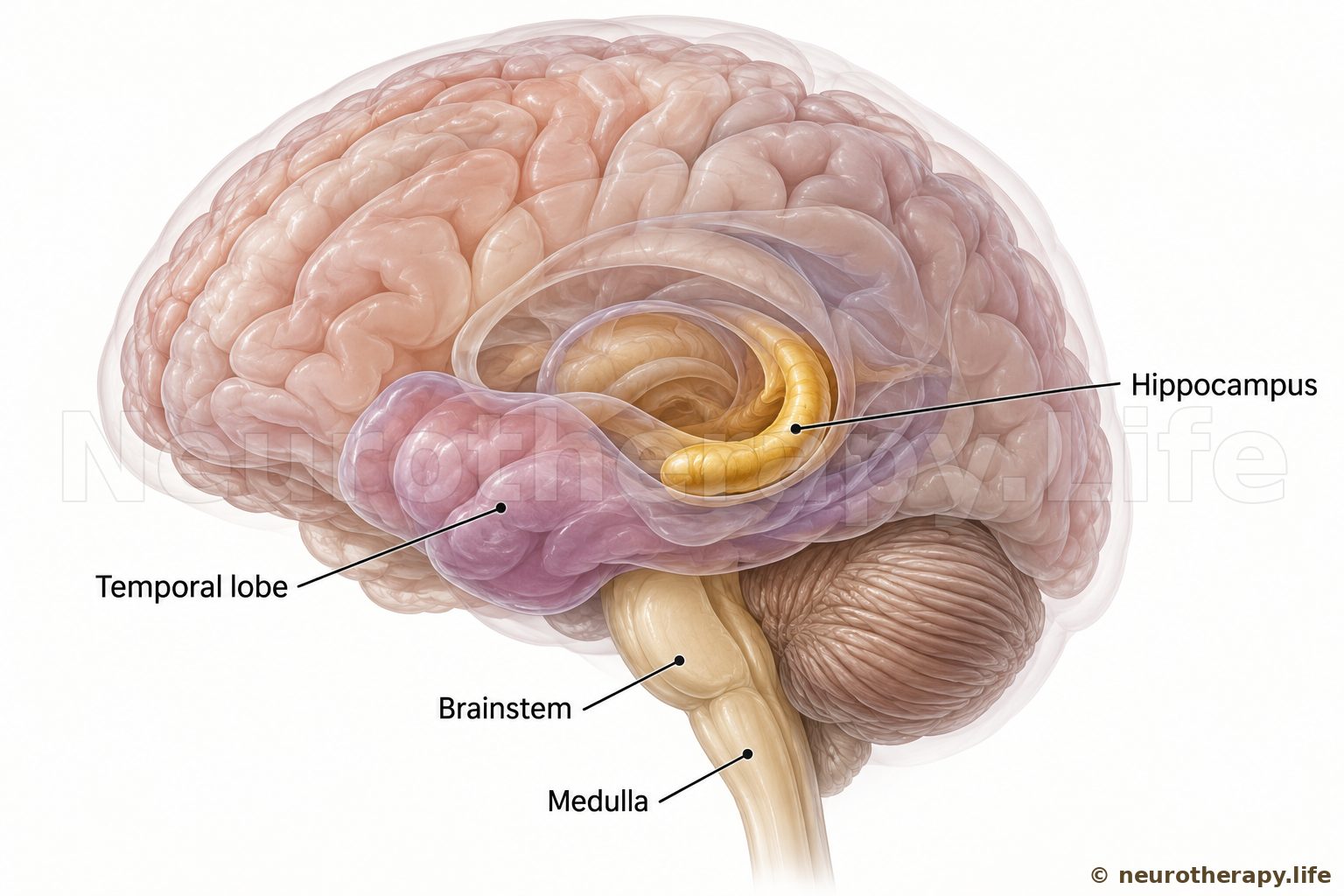
Hippocampus is Greek for 'seahorse' — early anatomists thought its curled shape looked like one.
Source: Gray's Anatomy (41st ed.), the hippocampal formation.
Also called: 12 Medulla, the hippocampus treatment, हिप्पोकैम्पस ट्रीटमेंट
(12) Medulla is the member of the Medulla family linked to the hippocampus, a part of the brain that helps keep fits in check. It is given behind the ears for fits that come during sleep, and — given at bedtime — for the small worms seen in children's stools.
(12) Medulla is one of the nine numbered treatments of the Medulla family, all given at one place behind the ears. Two quite different effects have been seen from it, and the therapy reports both honestly without trying to join them together.
The first: in patients who get fits at night or while lying asleep, the fits became much fewer or stopped. The hippocampus — a curved strip deep in each side of the brain, important for memory — plays a key role in controlling fits, so the inference is that (12) Medulla improves its working.
The second: in children whose stools show small white worms, a quarter to half an inch long, the treatment given before sleep was followed the next morning by many worms passing in the stool. How this second use came to be known is not explained; the therapy simply records it.
You sit on a firm chair, feet flat, back supported; a very ill or very weak patient, or a sleepy child, can receive it lying down.
It is given on both sides of the neck, one side at a time: behind each ear, just below the skull bone, and down the side of the neck towards the shoulder.
How this point is given — the tool, the pressure, the count and the exact movement — is deliberately not described here. A demonstration video for this point is being prepared; until it is on this page, learn the method hands-on from a trained Neurotherapist before giving it. Please do not give any point from a written description alone: a point given in the wrong place or the wrong way can do harm.
The number written before a point's name is not a strength setting. Each numbered form is a separate named treatment with its own method and timing, taught hands-on in the course.
The exact technique is taught hands-on in the Neurotherapy (LMNT) course. See the course →
LMNT teaching holds that (12) Medulla provokes the hippocampus and, through the twelfth cranial nerve, the muscles of the tongue. Body science confirms the roles of these structures; the link from the neck is the therapy's own clinical finding.
(12) Medulla shares its place and touch with the other members of the Medulla family.
These are reports of benefit seen in practice, always alongside the doctor's treatment.
Because both effects were seen in practice. The therapy reports them side by side and does not claim to know what links them.
The timing is part of the instruction. It also matches the worm's own habit: the female moves to the skin at the back passage at night to lay eggs, which is why the itching is worst at night.
(12) Medulla is written for fits that come during sleep or just after waking. For other fits the therapist may choose a different member, such as (6) or (20) Medulla.
Hippocampus is Greek for 'seahorse' — early anatomists thought its curled shape looked like one.
Source: Gray's Anatomy (41st ed.), the hippocampal formation.
The temporal lobe, where the hippocampus lies, is the most common starting point of focal epilepsy in adults.
Source: Engel J Jr. Mesial temporal lobe epilepsy: what have we learned? The Neuroscientist 2001;7:340–352.
The threadworm, the small white worm of childhood, lays its eggs on the skin around the anus at night — the reason the itch keeps children awake.
Source: WHO / CDC parasite fact sheets, enterobiasis (pinworm).
This page explains what a Neurotherapy (LMNT) treatment is for; it is not a self-treatment guide and does not diagnose. Neurotherapy (LMNT) works alongside your medical care — keep taking the medicines your doctor prescribed.
Send COURSE for course details, or your name, age and health issue for a consultation.