The Medulla Family: One Place, Many Treatments
The Medulla treatments are all given at one small area of the neck, just below the ears. The number written in front of each one — (6), (10), (30) and so on — is part of its name: each number is a separate treatment with its own purpose and its own cautions.
Overview
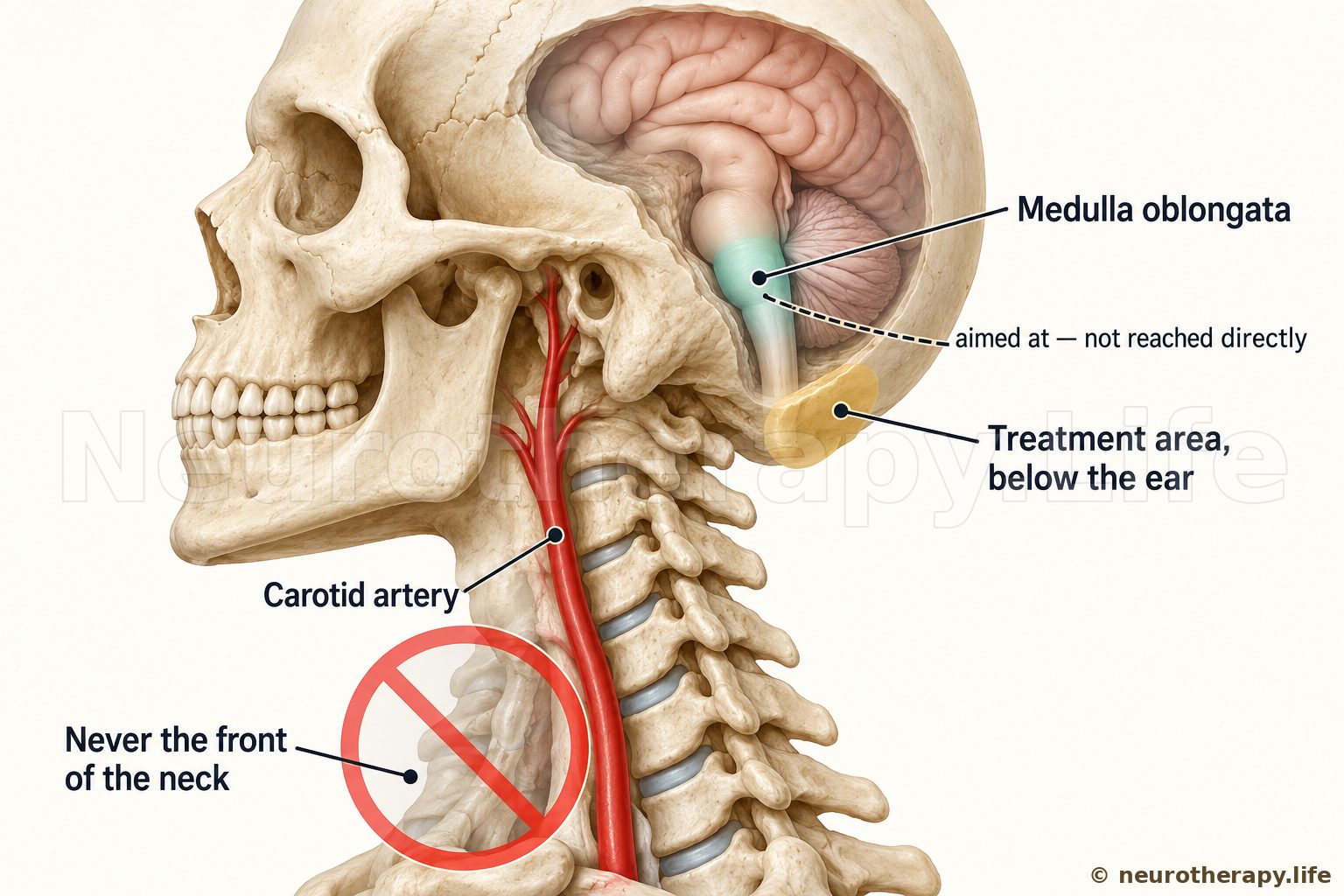
The Medulla treatments are all given at one small area of the neck, just below the ears. The number written in front of each one — (6), (10), (30) and so on — is part of its name: each number is a separate treatment with its own purpose and its own cautions.
The children whose bodies improved but whose minds did not
In the early years, parents brought Guruji children of slow development. He treated them the way he knew best — by setting the stomach. The parents came back and said: he eats better, walks better, holds the cup now — but in his mind there is not much change. Guruji wrote that down as a failure and went to find out how the brain is supplied.
Two facts guided him. The carotid arteries, which carry blood to the brain, run up the neck past the side of the ear. And the medulla oblongata — the stalk at the base of the brain through which every nerve between brain and body passes — lies roughly behind the patch of skin between the ear and the neck. He began working gently at that patch, and in several of those children a change was seen. He called it the Medulla treatment.
The therapy is honest about the anatomy: the medulla lies inside the skull, and no thumb reaches it. The name records what the treatment was aimed at. What lies under the hand is a densely nerve-rich area at the base of the skull.
The number is a name, not a dial
(6) Medulla was found first, then (10), then (30), and the smallest members, (2) and (4), came last of all. Over the years it became clear that changing the number gave a completely different result. So the family is not one treatment given harder or softer. It is several different treatments given at one place.
Think of a hospital lift. Button 3 is not more lift than button 2; it takes you to a different floor, a different department. The Medulla area is the lift, and the number is the button. This is why a bigger number is never chosen just because a patient is improving slowly — that would be a different treatment, not more of the same one. It also means that the cautions written for one member belong to that member only.
There is a system in the numbers. Up to (12), the number points to the cranial nerve of the same number — the twelve pairs of nerves that leave the brain directly: (2) for the second nerve, of sight; (10) for the tenth, the vagus. Above twelve there are no more nerves, so (15), (20) and (30) are linked instead with body chemicals.
The members and their errands
Each member is linked by the therapy with a particular part of the brain or a particular body chemical. These links are the therapy's own reasoning from what was observed in patients; they are offered as explanation, not as proved science.
- (2) Medulla — the second cranial nerve: eyes and speech; used in ataxia and Parkinson's.
- (4) Medulla — given in a clockwise way with T1/T2 for neck-nerve troubles and pain in the chest, arms and hands.
- (6) Medulla — the hypothalamus: body temperature, hunger and thirst, the glands' master signals; used in epilepsy and paralysis.
- (8) Medulla — serotonin: deep sleep and low mood.
- (10) Medulla — the vagus nerve: the digestive glands and stomach acid.
- (12) Medulla — the hippocampus: fits that come during sleep; also used for small worms in children's stools.
- (15) Medulla — acetylcholine: breathing, voluntary muscles; given first, before other nerve treatments.
- (20) Medulla — dopamine: Parkinson's, raised prolactin, fits.
- (30) Medulla — prostaglandins: inflammation, side effects of medicines, period-related breast heaviness, asthma.
When the family joins other points
Some members combine with points from elsewhere. The two erythropoietin formulas join (15) or (30) Medulla with Swt on the back, reasoning that together they may raise erythropoietin, the kidney hormone that tells the bone marrow to make red blood cells. The therapy itself marks both as still to be tried on a suitable patient.
(4) Medulla may be followed by Raman, but only after checking pain at Liv° and Mu°, because Raman given without that check can make some patients worse. And (12) Gas 'I' on the calves is said to work like (20) Medulla, asking for dopamine from the gut instead of the head — useful when one of the two is barred. Exactly how each member is given is taught hands-on in the course.
Key points
- All Medulla treatments are given at one area: the side of the neck, just below the ears — never the front of the neck.
- The number in front of 'Medulla' is part of its name; each number is a different treatment.
- A bigger number is not a stronger dose of the same thing.
- Up to (12) the number points to a cranial nerve; (15), (20) and (30) are linked with body chemicals.
- Each member carries its own cautions, and they belong to that member only.
- (15) Medulla is given before other nerve treatments.
Topics in this guide
Go deeper
Medulla
The Medulla point: where it is and what it reaches
Medulla, the graded series
The Medulla series, member by member
(10) Medulla
(10) Medulla, the vagus treatment
(30) Medulla
(30) Medulla, the inflammation treatment
(15) Medulla
(15) Medulla, given first
(4) Medulla clockwise with T1/T2
(4) Medulla clockwise with T1/T2
Erythropoietin formula II
The erythropoietin formula
Medulla (brainstem)
The medulla oblongata, in plain words
Cranial Nerve and Brain Formulas
The cranial-nerve treatments
Safety: when it is held back
- Never work on the front of the neck; the great artery to the brain lies there.
- (10) Medulla is not given in diabetes, cancer, or where stomach acid is already raised. In heart disorders it is never given on both sides — only (10) Left Medulla. (10) Medulla
- (30) Medulla is never given in cancer, and not to heart patients. (30) Medulla
- (8) Medulla is not given in inflammatory diseases, in cancer or in high blood pressure. (8) Medulla
- (6) Medulla is not given to young people aged 13 to 20 who come to increase their height, unless there is a special need. Low height in children (short stature)
- Raman is added only after checking pain at Liv° and Mu°; given without that check it can increase pain. Raman
- In cancer, (10) Pan, Thymus, Pit, Lu+Sh, Rt.Ov/Lt.Ov and (30) Medulla are never given. Children always get light treatment. Cancer care: Neurotherapy (LMNT) support
- Fits, Parkinson's, breathing difficulty, slow development and hormone problems all need a doctor's diagnosis and tests. Neurotherapy (LMNT) works alongside that care, and no medicine is stopped because of it. How to tell a patient to see a doctor
Common questions
You are working on my neck. My problem is my stomach.
The nerve that runs your stomach, intestines and belly glands — the vagus — comes down from the brain and passes through the neck. The treatment asks that nerve to do its work better, and the effect shows in the belly, not under the hand.
It helped. Can you do more of it?
Not here. In this family the number tells the therapist which treatment to give, not how much. A bigger number would swap it for a different treatment made for a different problem. The answer is more days, not a bigger number.
I have heart trouble. Can I be treated at all?
Yes. It means two things: one member, (30) Medulla, is not given to you, and (10) Medulla is given on the left side only. Everything else can go on. Tell the therapist every tablet you take and every doctor you see.
My son is fifteen and short. Can he have the treatment his friend got?
Several different treatments are given at that same place. One of them is deliberately not given to young people between 13 and 20 who come about height; two others are used for height. The therapist will examine him first and explain which one is chosen.
Watch

This video shows the right way to give (4) Medulla, Raman and the T1–T2 point for neck and shoulder pain and numbness.

Shows (15) Medulla four times below both ears, a fingertip head massage in lines from the forehead to the back of the head, and gentle circles between the eyebrows. It is shared as self-care for relief in migraine and headache.
Note: the video gives (15) Medulla; the LMNT migraine treatment uses (5) Medulla. Follow your therapist's plan.

Shows a five-minute self-routine before bed: (8) Medulla below the ears three times, pressure while sitting in Vajrasana, massage just below the knees and at the back of the head, plus tips on screens and dim light. It is shared to support better sleep.
Test yourself
Research
- Strong evidence
A review of prostaglandins — the local chemicals the therapy links with (30) Medulla. They help keep the body healthy, but they also drive the redness, heat, swelling and pain of inflammation; common painkillers like aspirin work by blocking their production.
Explore more
Organs
Body systems
Diseases
Points
Formulas
Topics
Read more
This page explains what a Neurotherapy (LMNT) treatment is for; it is not a self-treatment guide and does not diagnose. Neurotherapy (LMNT) works alongside your medical care — keep taking the medicines your doctor prescribed.