The Medulla treatments: nine members and the order they were found
The Medulla family is nine different treatments given at one place, the back and sides of the neck below the ears. They were not found in number order, and each has its own work.
Overview
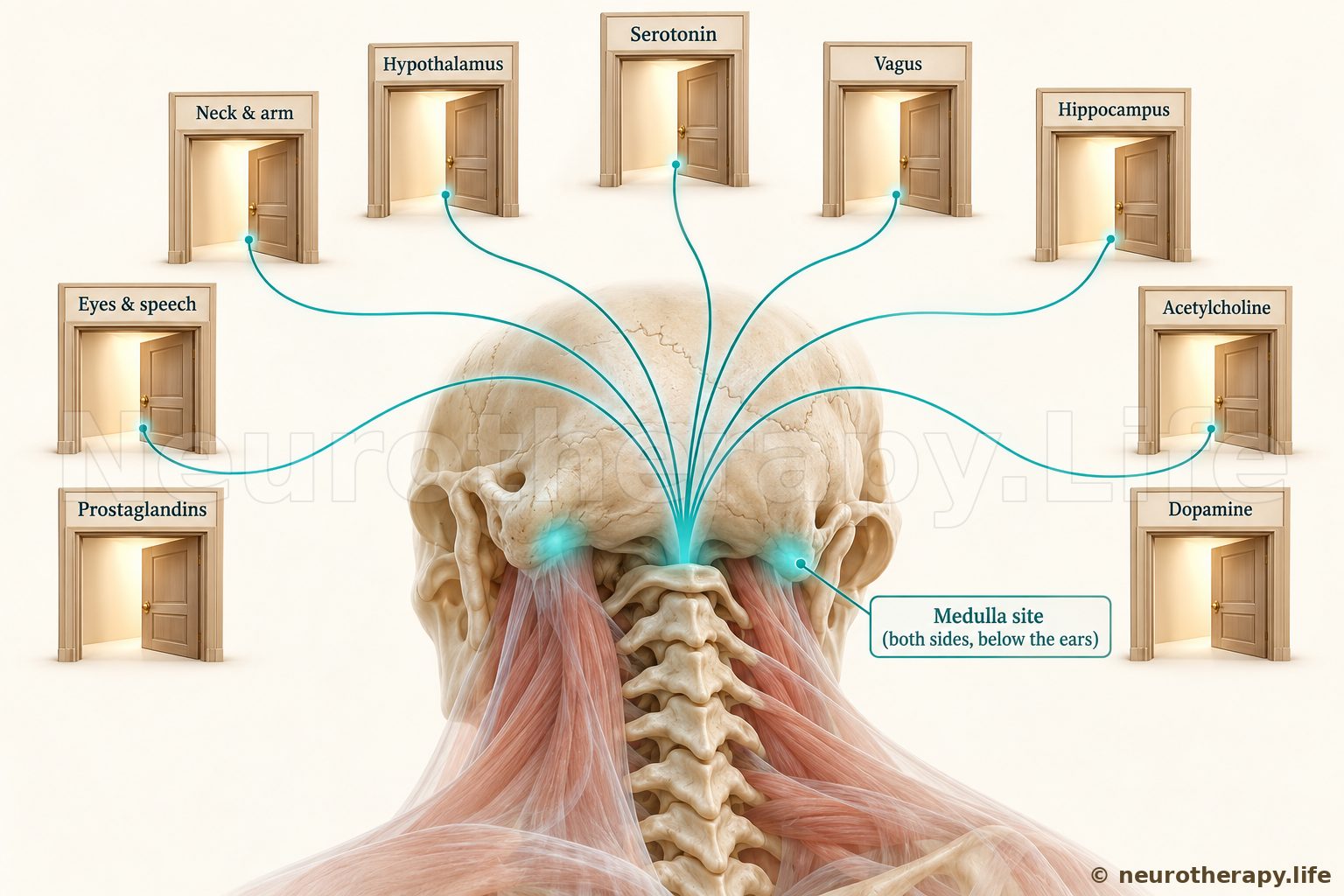
The Medulla treatments did not arrive in number order. First the work of (6) Medulla was discovered, then (10), then (30), then the others, and last of all the two smallest, (2) and (4). By research and practice it came to be known that many areas of the brain and the cranial nerves, the twelve pairs of nerves that leave the brain directly, can be stimulated in this way. The numbers on the page are a filing order, not a history.
In one line each: (2) Medulla for the eyes and speech; (4) Medulla, given clockwise with T1/T2, for neck, chest and arm pain; (6) for the hypothalamus, which governs temperature, hunger and thirst; (8) for serotonin, sleep and low mood; (10) for the vagus nerve and the digestive glands; (12) for the hippocampus and fits during sleep; (15) for acetylcholine and breathing; (20) for dopamine and Parkinson's disease; (30) for prostaglandins and inflammation.
All nine share one place and one manner. They are given at the back and sides of the neck below the ears, by gentle rubbing rather than pressing, with the patient seated, or lying down if very weak or ill. The only thing that changes is the number written before the name, and that number is the treatment. The exact method is taught hands-on in the Neurotherapy (LMNT) course.
Key points
- Nine Medulla treatments share one site on the back of the neck.
- They were found in the order (6), (10), (30), the rest, then (2) and (4).
- The number before the name decides which treatment it is.
- Each member has its own work and its own bars.
Go deeper
Why each Medulla number is a different treatment
Why each Medulla number is a different treatment
What each Medulla treatment is used for
What each Medulla treatment is used for
Medulla
The Medulla point
(6) Medulla
(6) Medulla, the first one found
(10) Medulla
(10) Medulla, the vagus treatment
(30) Medulla
(30) Medulla, the inflammation treatment
Medulla (brainstem)
The medulla, in the brain stem
The Medulla Family: One Place, Many Treatments
The Medulla family
Read the full guide
This topic is part of: The Medulla Family: One Place, Many Treatments
Safety: when it is held back
- Each Medulla treatment carries its own bars, and they do not travel to the others. (10) Medulla: not in diabetes, cancer or raised stomach acid; in heart disease only (10) Left Medulla. (8) Medulla: not in inflammation, cancer or high blood pressure. (30) Medulla: not in heart disease. (6) Medulla: not for teenagers who come about height. (15) Medulla: not where (2) Pan is being given for a tumour. Medulla
- In cancer, (10) Pan, Thymus, Pit, Lu+Sh, Rt. Ov / Lt. Ov and (30) Medulla are never given. Cancer care: Neurotherapy (LMNT) support
- Medulla work stays at the back and sides of the neck, below the ears. The front of the neck is never worked. Neck
- Neurotherapy (LMNT) works alongside your medical care. Do not stop or change any medicine on your own; ask the doctor who prescribed it.
Guruji says
“Apart from calling these treatments a gift of nature, or the grace of Hari, there is no other way in which their effect can be described.”
Watch

Shows (15) Medulla four times below both ears, a fingertip head massage in lines from the forehead to the back of the head, and gentle circles between the eyebrows. It is shared as self-care for relief in migraine and headache.
Note: the video gives (15) Medulla; the LMNT migraine treatment uses (5) Medulla. Follow your therapist's plan.
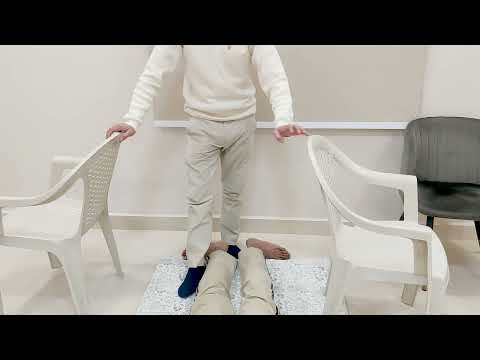
Shows the Serotonin treatment for sleep: (8) Medulla below the ears, 1 Gas 'I' at six points on the shin, (6) Adr on the upper back, and gentle massage behind the knees and at the back of the head. It is given to support deep, natural sleep.
Note: (8) Medulla is not given in high BP, inflammation or cancer; (6) Adr is not given in high BP, diabetes, cancer or HIV.

This video shows the right way to give (4) Medulla, Raman and the T1–T2 point for neck and shoulder pain and numbness.
This page explains what a Neurotherapy (LMNT) treatment is for; it is not a self-treatment guide and does not diagnose. Neurotherapy (LMNT) works alongside your medical care — keep taking the medicines your doctor prescribed.